Catfishing: smascherare profili falsi
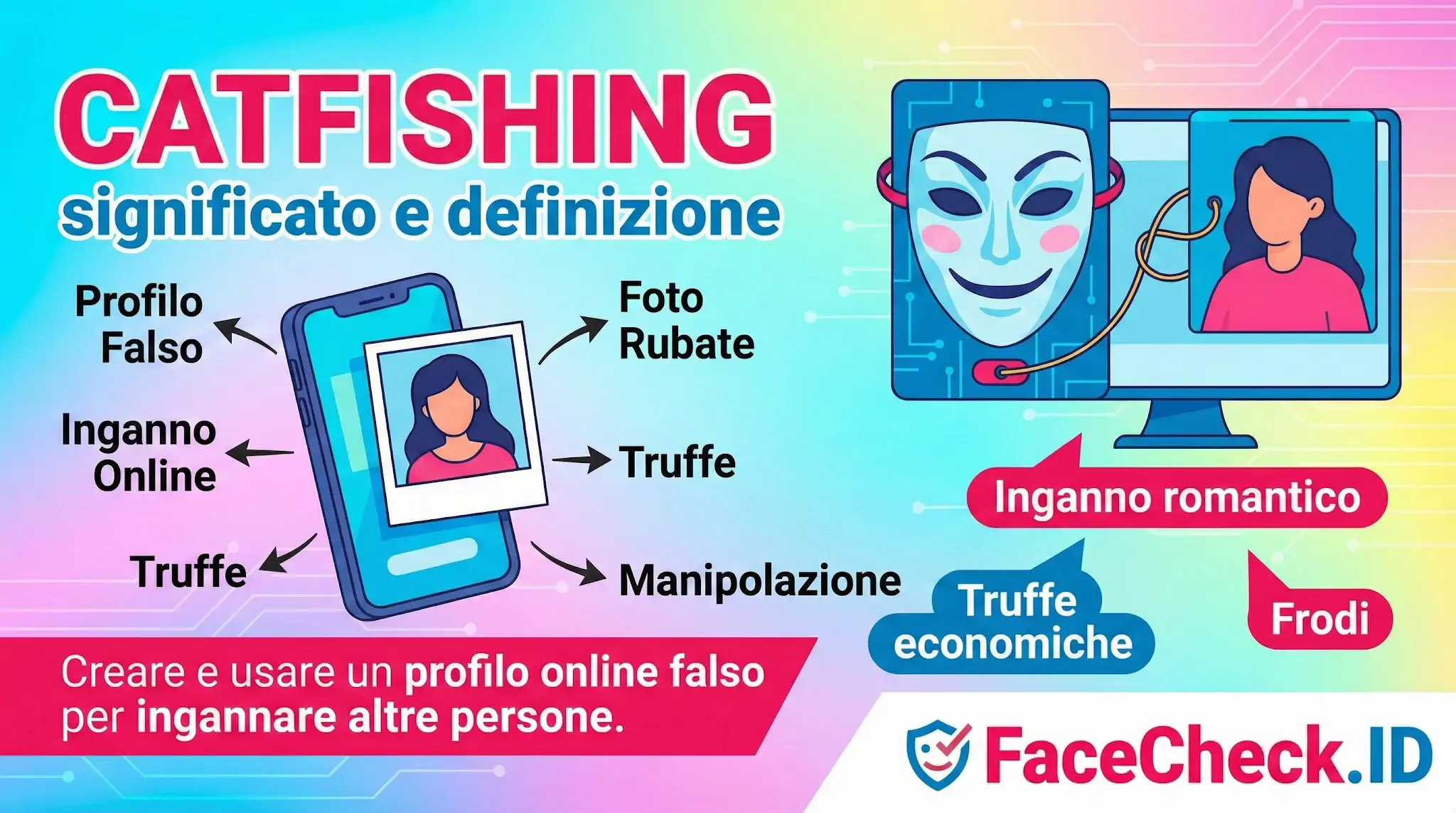
Catfishing is one of the most common reasons people run a face on FaceCheck.ID. When someone behind a screen claims to be a person they're not, reverse image search of their profile photos is often the fastest way to confirm whether the face actually belongs to the name, location, and story attached to it.
How face search exposes a catfish
A catfish almost always relies on stolen photos, because building a fake identity from scratch with original images is too much work. Those stolen photos usually come from real people with public footprints: models, fitness influencers, military personnel, doctors with clinic bios, or random Instagram accounts with open settings. Once an image is pulled from a public profile, it tends to spread across reposts, scraper sites, and scam-warning forums.
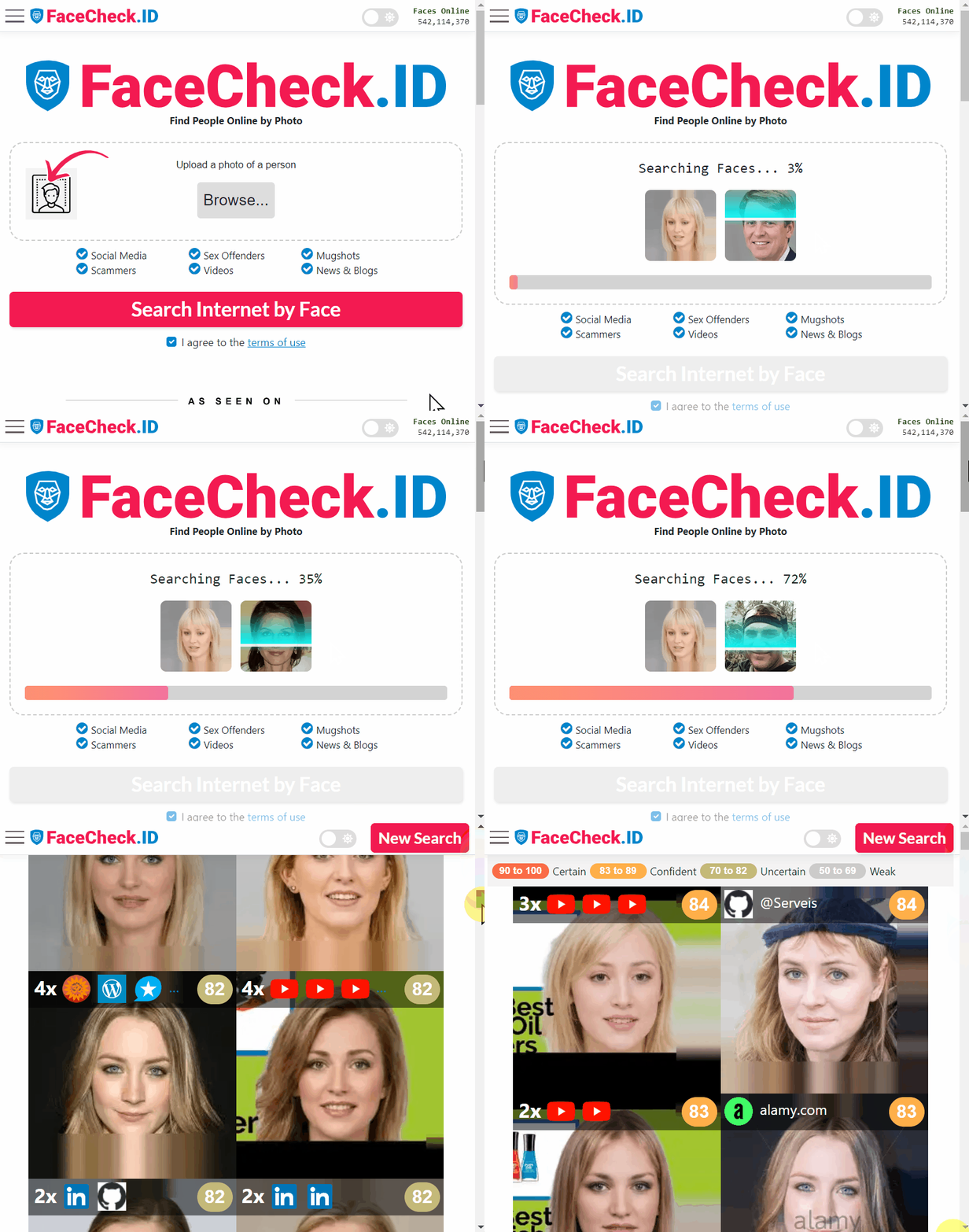
Searching the photo by face rather than by file does two useful things. First, it finds the same person even when the image has been cropped, recolored, mirrored, or run through a filter, which is exactly what scammers do to avoid basic reverse image lookups. Second, it surfaces other appearances of that face under different names, which is the clearest sign of impersonation. If a profile claims to be "Daniel, oil engineer in Houston" but the same face shows up on a Brazilian model's verified Instagram and on three scam-report threads, the conclusion is straightforward.
Patterns that show up in search results
Certain match patterns are strong indicators that a profile is a catfish rather than a real person:
- The face appears on a public influencer or model account with a different name and a much larger following than the suspect profile.
- Multiple dating-app profiles, in different countries or languages, use the same face under different names and ages.
- The face turns up on romance scam databases, scammer-list sites, or breakup forums where victims post screenshots.
- Hits cluster on stock-photo or AI-generated face galleries, suggesting the photo was never of a real social media user at all.
- The earliest indexed appearances of the face predate the suspect profile by years, on accounts with detailed personal history the catfish doesn't reference.
A single hit on a real person's social account is usually enough. Catfishes rarely use photos of strangers with no online presence, because they need a steady supply of new pictures to keep the lie going.
Practical workflow when you suspect catfishing
Before confronting anyone, gather more than one image. Run the main profile photo, then any secondary photos, group shots, and screenshots from video calls if the person has sent any. Catfishes sometimes mix one stolen source with a second to throw off basic checks, and inconsistent face matches across their own gallery are revealing.
Pay attention to image quality and angle. A face shown only in heavily filtered, sunglasses, or distant shots may be deliberately chosen to defeat recognition. Ask for a specific live pose or a video call holding up a written word. Refusal, repeated technical excuses, or sudden camera failures every time are behavioral confirmations that pair well with whatever the search results suggest.
If matches confirm impersonation, the real person whose photos were stolen is also a victim. Many of them appreciate being told, since it helps them report the impersonating accounts and warn their own followers.
What a face match does and does not prove
Reverse face search can confirm that the same face is being used under multiple identities, or that a photo was lifted from someone else's public account. That alone is enough to walk away from a suspicious chat. What it cannot do is identify who is actually operating the fake profile. The person typing on the other end could be anywhere, using any name, and the stolen-photo subject is rarely involved.
It also cannot prove intent on its own. People sometimes use a single misleading photo for privacy reasons rather than to defraud anyone. The catfishing label fits when stolen images are paired with fabricated stories, pressure tactics, requests for money, or refusal to verify in real time. Face-search evidence is strongest when it lines up with those behavioral signs, not when it stands alone.
Domande frequenti
Che cos’è il “catfishing” e come si collega ai motori di ricerca basati su riconoscimento facciale?
Il catfishing è una forma di inganno in cui qualcuno usa foto (spesso rubate) per presentarsi online con un’identità fittizia. I motori di ricerca basati su riconoscimento facciale possono aiutare a verificare se la stessa immagine (o un volto molto simile) compare altrove sul web, suggerendo possibili riusi della foto tipici di profili falsi.
Quali segnali nei risultati di un face search engine possono indicare un possibile caso di catfishing?
Segnali comuni includono: la stessa foto associata a nomi diversi, la presenza del volto su profili in lingue/paesi molto diversi senza spiegazione credibile, immagini identiche riutilizzate su siti di incontri o annunci, oppure risultati che mostrano versioni “ritagliate” o leggermente modificate della stessa foto. Questi elementi non provano una truffa, ma aumentano la probabilità di riuso fraudolento.
Come ridurre i falsi positivi quando si usa il riconoscimento facciale per individuare catfishing?
Per ridurre errori: usa una foto nitida e frontale, evita immagini con filtri pesanti o occhiali molto riflettenti, prova più scatti della stessa persona (se disponibili), e confronta sempre dettagli contestuali (bio, cronologia, rete di contatti, watermark, metadata quando presenti). Considera i match come “indizi” e non come identificazione certa.
È corretto usare i risultati di un motore di ricerca facciale come “prova” che una persona è un catfish?
No: un risultato può essere coerente con il catfishing, ma raramente è una prova definitiva. Somiglianze tra volti, omonimie, account fan/parodia, repost legittimi o aggregatori di immagini possono generare interpretazioni sbagliate. La conclusione dovrebbe basarsi su più riscontri indipendenti (coerenza delle informazioni, verifiche dirette, segnali di truffa, e—quando appropriato—richiesta di verifica consensuale come videochiamata).
In che modo FaceCheck.ID può essere utile in indagini di catfishing, e quali limiti bisogna ricordare?
FaceCheck.ID può essere utile per trovare possibili occorrenze online dello stesso volto o di volti simili, aiutando a scoprire riusi della foto in profili diversi o in contesti sospetti. I limiti principali restano: risultati incompleti (non tutto il web è indicizzato), possibili falsi positivi/negativi, e l’impossibilità di dedurre con certezza l’identità reale o l’intento (truffa vs riuso legittimo). Usalo come strumento di triage e verifica, non come giudizio finale.

Post consigliati relativi a catfishing
-
Ricerca di Immagini Invertita - Social Catfish vs FaceCheck.ID
Esplora il Potere della Ricerca Basata su Immagini con Social Catfish e FaceCheck.ID per Connessioni Online Sicure. Entra nel mondo dei servizi di verifica dell'identità e di ricerca inversa come Social Catfish e FaceCheck.ID! Social Catfish.
-
Come si fa a Fare la Ricerca Inversa di Immagini sui Siti di Incontri?
Ma l'anonimato di internet ha anche dato origine a catfishing e truffe sugli appuntamenti utilizzando profili falsi e storie di dolore fittizie per manipolare le vittime. In questa guida, esploreremo come l'esecuzione di ricerche di foto inverse può aiutarti a evitare di cadere nelle sofisticate truffe di catfishing e incontri. Individua Catfish e Truffe negli Incontri.
-
I 4 vantaggi principali del riconoscimento facciale negli appuntamenti online con FaceCheck.ID
Niente più catfish nel tuo mondo degli appuntamenti: connettiti con FaceCheck.ID. Ma insieme alle opportunità, crescono anche i rischi: il catfishing e le truffe sentimentali colpiscono migliaia di persone ogni anno. Protezione contro catfishing e truffe.
-
Come Riconoscere un Catfish Online in Meno di 60 Secondi con FaceCheck.ID
Nel 2025, le truffe romantiche e il catfishing hanno raggiunto livelli record. How to Spot a Catfish in 60 Seconds... Ma esiste una difesa rapida ed efficace contro le frodi romantiche: FaceCheck.ID, un motore di ricerca di riconoscimento facciale specializzato, creato appositamente per combattere il catfishing e l’inganno sull’identità.
-
Top 6 Siti Mobile per la Ricerca Inversa di Immagini per Trovare Persone, Prodotti e Luoghi
FaceCheck.ID, PimEyes e Social Catfish: Specializzati nella Ricerca Inversa di Immagini di Persone. Social Catfish:. Come utilizzare: Vai al sito web di Social Catfish.