IDV (Identity Verification)
.webp "IDV (Identity Verification)")
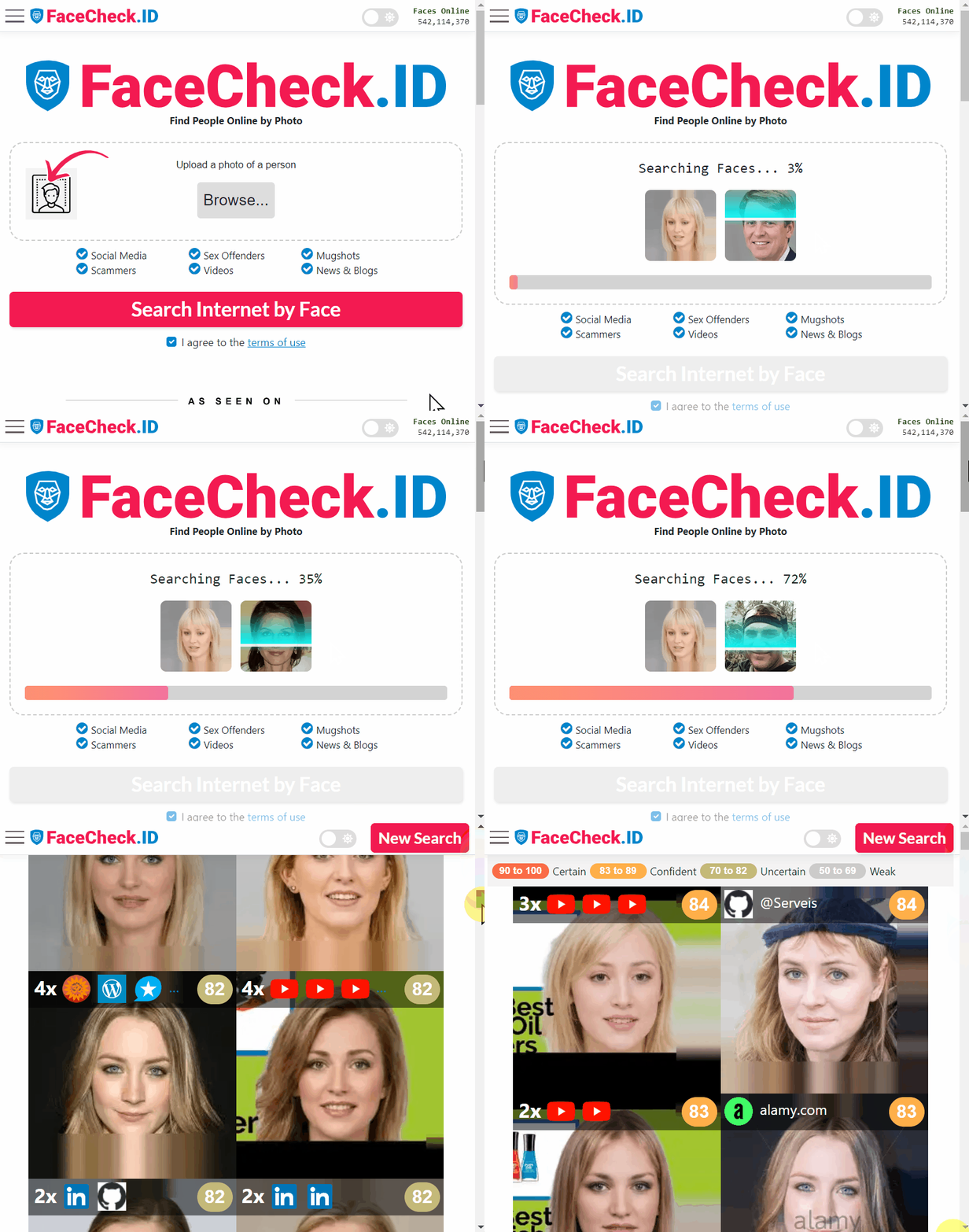
IDV is how platforms confirm that a real, specific person sits behind an account or transaction, and it is one of the few moments online where a face is treated as evidence rather than decoration. Face search tools like FaceCheck.ID work next to IDV, not inside it: IDV proves who someone claims to be at signup, while reverse face search reveals where else that face appears across the public web.
How IDV uses face data
A standard IDV flow captures a government ID, extracts the photo, then asks the user for a live selfie or short video. The system runs three checks at once:
- A face match between the selfie and the document photo
- A liveness check to confirm the selfie is a real person, not a printed photo, screen replay, mask, or deepfake
- A document authenticity check looking at security features, fonts, and tampering signals
Behind the scenes, the same kinds of facial embeddings used in reverse image search are used to compare the selfie to the ID portrait. The difference is scope: IDV compares one face to one document, while a face-search engine compares one face to billions of indexed web images. Both depend on image quality, lighting, and angle, which is why IDV systems force users into specific framing instead of accepting any uploaded photo.
Where face search and IDV solve different problems
IDV answers, “Is the person holding this ID the person it was issued to?” It does not answer, “Is this person who they say they are socially?” That second question is where reverse face search becomes useful.
Examples of the gap:
- A romance scammer can pass IDV using their own real ID, then use stolen photos of a different person on dating apps. IDV verifies the operator. Face search on the profile photos can reveal the stolen identity.
- A recruiter receives a remote-hire candidate who passes a vendor IDV check. A FaceCheck.ID search on the candidate’s LinkedIn headshot may surface a different name, a different country, or a stock-photo source.
- A marketplace seller verifies an ID at signup, then lists products using a second account with a face that appears on unrelated scam reports indexed across forums and consumer complaint sites.
IDV looks inward at one moment. Face search looks outward across time and across sites. Investigators usually need both.
Failure modes investigators should know
IDV is not airtight, and understanding where it breaks helps interpret face-search findings.
- Synthetic and deepfake selfies can defeat weaker liveness systems. If a face appears in a verified account but also shows up in AI-generated image collections, that pattern is worth checking.
- Recycled stolen documents combined with lookalike accomplices can pass face-match thresholds. A reverse face search may find the real owner of the document photo posting normal life updates elsewhere.
- Reused profile photos are common. The same headshot showing up on twelve dating profiles under different names is something IDV cannot detect, but face search will.
- Document-only verification without biometrics proves the document exists, not that the right person is using it.
What IDV does not prove
A green checkmark from an IDV vendor confirms three narrow things: a document looked authentic, a live face matched it, and the data passed available watchlists. It does not prove the person is honest, that the account will be used by them long term, that the photos they post elsewhere are theirs, or that they have not built a parallel persona online. IDV is a snapshot at onboarding. Identity, in practice, is a pattern across platforms over time.
This is why fraud teams, journalists, and individuals checking a new contact often pair IDV records with reverse face search. IDV tells you the person at signup was real. Face search tells you whether the face has a coherent history on the public web, or whether it appears in places that contradict the story being told.
FAQ
When is IDV (Identity Verification) appropriate to use alongside an open-web face recognition search?
IDV is typically appropriate when a decision or transaction depends on knowing that a person is who they claim to be (e.g., account recovery, onboarding, high-risk payments). An open-web face recognition search can be used only as a supporting signal (e.g., to detect possible photo reuse, impersonation, or inconsistent online presence), but it should not be treated as proof of identity on its own.
What does a typical IDV workflow include that a face recognition search engine usually does not provide?
A typical IDV workflow often includes steps like document authenticity checks (ID card/passport validation), selfie-to-document comparison (1:1 verification), liveness or presentation-attack checks, fraud/risk rules, and human review for edge cases. Open-web face search is usually closer to discovery (finding similar/same-face images online) rather than performing these controlled verification steps.
How can open-web face search results be used in IDV without over-identifying someone?
Use face search results as investigative leads, not conclusions: corroborate with multiple independent signals (document checks, verified contact methods, consistent identifiers, and contextual evidence). Prefer decisions framed as risk flags (e.g., “photo appears reused across unrelated profiles”) instead of identity claims (e.g., “this person is X”). Tools like FaceCheck.ID can add value by surfacing where similar faces appear online, but the follow-up validation should happen outside the face search result list.
What privacy and data-minimization practices matter most when using face search in an IDV-adjacent process?
Minimize what you upload and retain: submit the smallest necessary crop (just the face), avoid including IDs, addresses, or other sensitive background details in the image, and use separate images for document checks vs. open-web searching. Prefer services that clearly state retention periods, deletion controls, and whether uploaded photos are stored or used to improve models. Also limit internal access to results and document a lawful/ethical purpose before searching.
If a face search suggests conflicting identities during IDV, what is the safest next step sequence?
Treat the result as an escalation signal: (1) re-check input quality (pose, blur, lighting) and rerun with a cleaner face crop; (2) compare multiple photos of the same claimant, not just one; (3) validate with controlled checks (selfie-to-ID match, liveness, verified contact methods, and consistency of non-biometric attributes); (4) route to trained human review; and (5) avoid making adverse claims about the person based only on face search hits, since look-alikes, reposts, and synthetic/edited images can create misleading trails.

-34.webp "IDV (Identity Verification)")