Liveness Spoofing
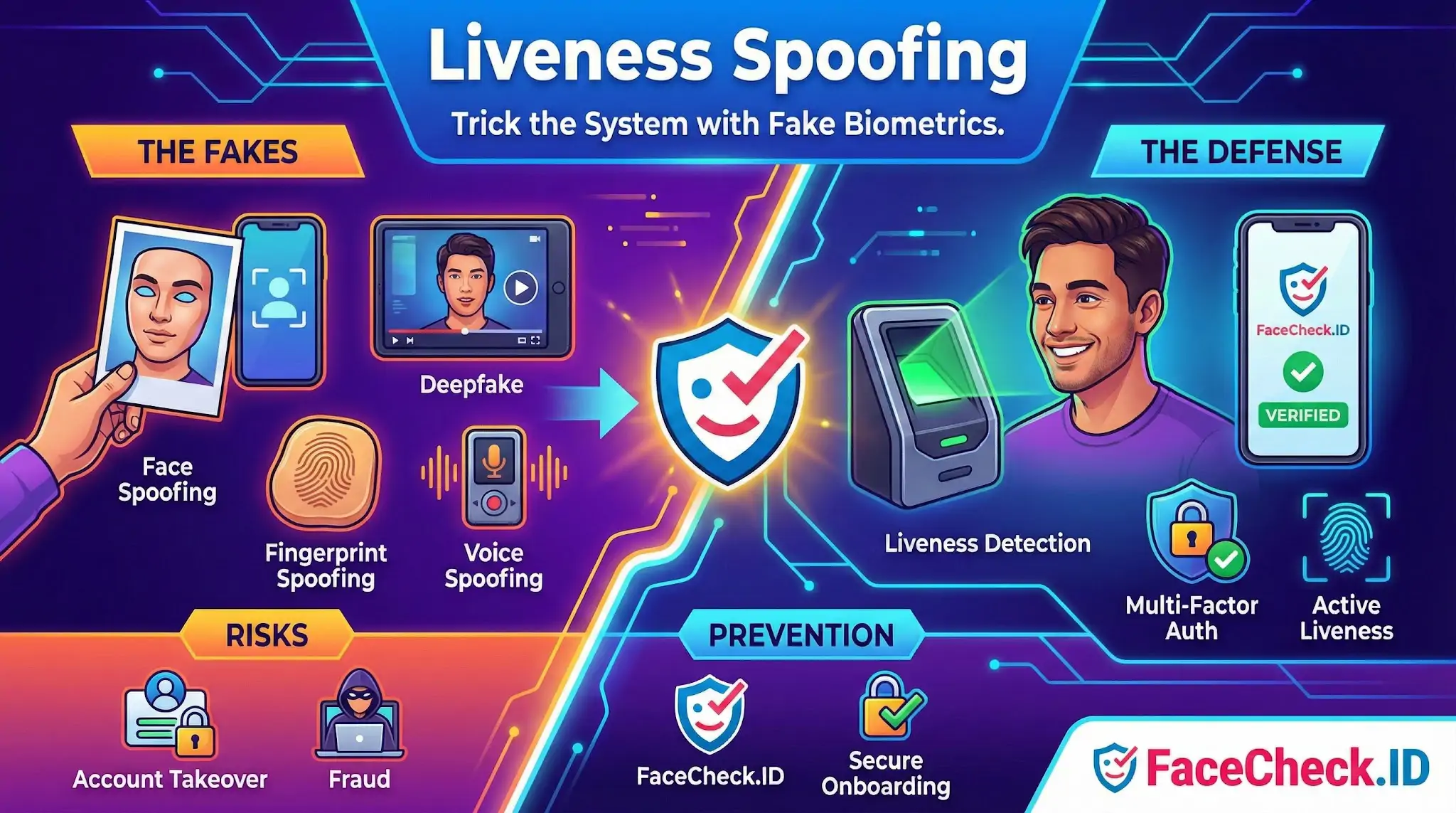
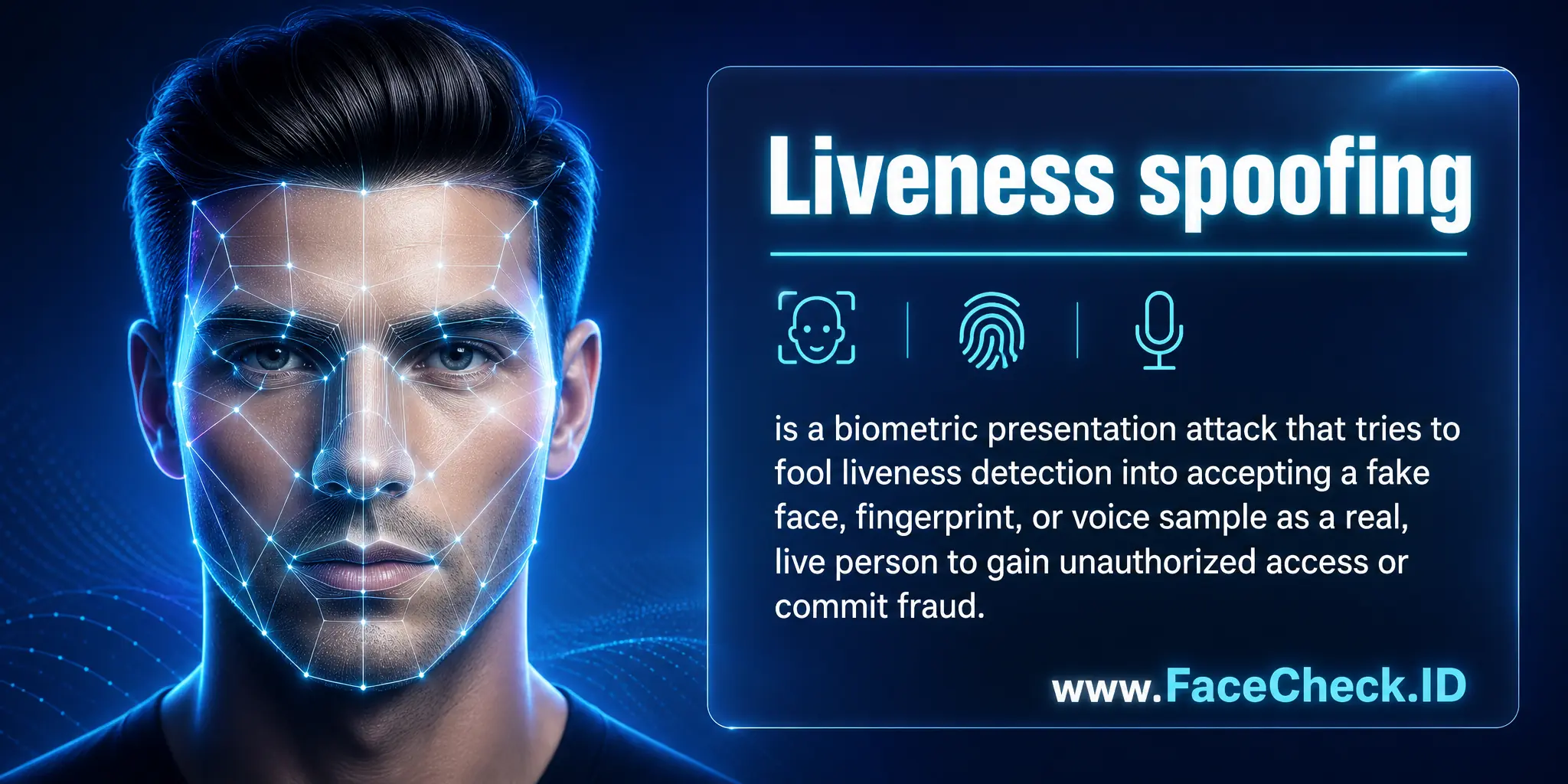
When someone tries to defeat a face-recognition check by holding up a photo, replaying a video, or feeding a deepfake into the camera feed, that is liveness spoofing. It is the active counterpart to passive face search: instead of trying to identify a face, the attacker is trying to convince a system that a face on screen belongs to a real person sitting in front of the camera right now.
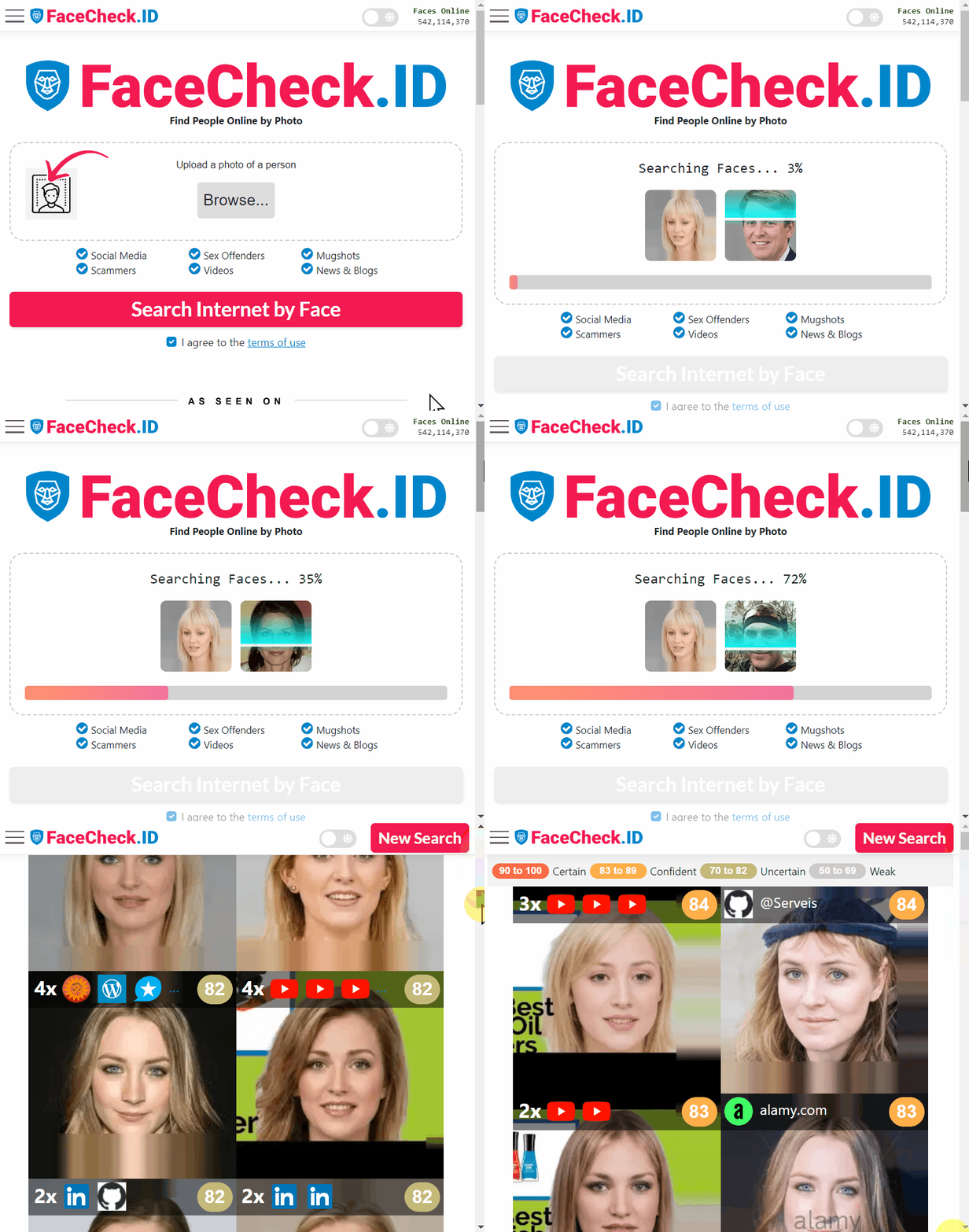
For anyone using FaceCheck.ID to investigate online identities, liveness spoofing is part of the broader picture of how stolen and synthetic faces move through the internet. The same images that get reused on fake dating profiles or scam accounts often end up powering spoofing attempts against KYC and login systems.
How attackers fake a live face
Spoofing attacks fall on a spectrum from cheap and obvious to expensive and convincing.
- Print and replay attacks use a photo on paper or a video on a second phone held in front of the verification camera. The source images are often pulled from public profiles, the same kind of indexed pages a reverse face search returns.
- Screen and mask attacks use high-resolution monitors, 3D-printed masks, or silicone prosthetics modeled from photographs.
- Deepfake injection swaps the camera feed entirely with a generated face. This is the modern threat. A scammer with a few clear photos of a target can drive a real-time face swap that blinks, turns, and responds to prompts.
- Camera emulation uses virtual cameras and rooted devices to bypass the assumption that the video stream came from a physical sensor.
The cheaper the attack, the more it depends on photos that already exist online. That is why face-search tools like FaceCheck.ID matter to fraud teams: if a face submitted to verification is also showing up on stock photo sites, scam reports, or unrelated social profiles under a different name, that is a strong fraud signal even before the liveness model fires.
Where stolen face images come from
Most spoofing attacks start with image collection. Attackers harvest faces from places that face-search engines also index:
- LinkedIn and corporate bio pages, which provide front-facing, well-lit headshots
- Instagram and TikTok, which provide multi-angle video for training deepfake models
- Old forum avatars, dating profiles, and university directory photos that the original owner has forgotten about
- Leaked ID document scans from data breaches
A reverse face search can sometimes show that a "verified" applicant's selfie matches a face already in circulation under different names. That history of reuse is one of the most reliable signals that a liveness pass should not be trusted on its own.
What liveness systems actually catch
Liveness detection looks for evidence that a face is physically present and biologically real. Active checks ask the user to turn their head, blink, or follow a prompt. Passive checks analyze texture, micro-movement, depth cues, screen reflections, moire patterns from displays, and inconsistencies in lighting. Strong systems also watch for emulators, jailbroken devices, and mismatched geolocation.
Common spoofing tells include:
- Flat texture or reflective glare suggesting a screen
- Rigid head movement or unnatural blink timing
- Repeated failed attempts followed by a sudden clean pass
- Audio and lip movement that drift out of sync in deepfakes
- Camera metadata that does not match the claimed device
Limits of liveness detection and face search
Neither liveness detection nor face search is conclusive on its own. A passed liveness check does not prove the person is who they claim to be. It only suggests the camera saw a real face. The face could still belong to a coerced person, a paid stand-in, or a deepfake good enough to slip past the model that day.
A face-search hit also does not prove fraud. The same photo appearing on multiple profiles can indicate identity theft, but it can also reflect a legitimate person whose images were scraped without consent. False positives from lookalikes are real, especially with low-resolution or heavily cropped source images.
The useful posture is layered. Treat liveness as one signal, treat face-search history as another, and reserve confident judgments for cases where multiple independent signals agree. Spoofing wins when any single check is trusted as proof.
FAQ
What does “Liveness Spoofing” mean in the context of face recognition search engines?
Liveness spoofing is the use of non-live or manipulated media—such as a printed photo, a screen replay, a mask, or a deepfake—to make a face-recognition system treat the input as a real, present person. In face recognition search engines (open-web face search), it most often shows up when someone uploads a screenshot or edited image and then misreads the results as evidence of a real-world identity or real-time presence.
Can liveness spoofing “fool” a face recognition search engine into returning the wrong person?
Yes. If the query image is spoofed or heavily manipulated (deepfake, face-swap, aggressive beautification filters, AI upscales), the extracted facial features can shift toward a different person’s facial signature, producing wrong-person matches or mixed results. Even when the engine is working correctly, it is still searching for visual similarity—not proving the image is authentic or that the person was physically present.
What are common liveness spoofing techniques that impact face-search investigations?
Common techniques include: (1) screen replay (capturing a profile photo or video call frame and re-uploading it), (2) printed-photo or “photo-of-a-photo” capture, (3) deepfake or face-swap portraits, (4) AI-enhanced selfies (beauty filters, reshaping), and (5) composite images (splicing a face onto a different body or scene). These can create convincing images that still produce misleading face-search matches.
How can I reduce liveness-spoofing risk when using a face recognition search engine like FaceCheck.ID?
Use the highest-quality, least-manipulated source image you can: avoid screenshots of video calls, avoid heavily filtered/beautified images, and prefer well-lit front-facing photos with natural texture. If you suspect spoofing, run searches using multiple different images of the same person (from different dates/angles) and look for consistent overlap in results. When reviewing FaceCheck.ID (or any face search tool) results, treat hits as leads and verify by cross-checking context (original upload dates, repeated reuse patterns, and whether multiple independent sources corroborate the same identity).
Does liveness spoofing matter if face search engines don’t perform liveness detection?
It still matters because the user can misinterpret search results. Open-web face search is typically not trying to confirm that a person is live in front of a camera; it’s matching a face-like image to other images on the internet. A spoofed query can (a) produce false matches, (b) create a misleading “trail” to unrelated profiles, or (c) incorrectly suggest a real person is behind an image that was generated or altered. The safest approach is to validate authenticity and provenance separately from the face-match output.