Adult Film Star Face Search Matches
When someone runs a face search and a result links a person to adult film work, the stakes change quickly. Reverse image search engines like FaceCheck.ID frequently surface adult performer pages because that content is heavily indexed, widely mirrored, and tied to recognizable on-screen personas, which makes it both useful for verification and easy to misread.
Why adult film star matches show up in face search
Performers in adult films build careers around a stage name and a consistent visual brand. Studios, tube sites, fan wikis, news posts, and social platforms all republish the same headshots, scene stills, and event photos, so a single face can appear across hundreds of indexed pages. That repetition is exactly what reverse image search relies on. A clean, front-facing studio photo of an adult performer often produces stronger matches than a candid snapshot of a private individual, because the performer's images have been crawled, cached, and reposted for years.
This has two practical effects on face search results:
- A real performer is usually easy to identify by stage name, even from low-quality screenshots.
- A private person who happens to resemble a performer can pull adult-industry results as false positives, because the index is saturated with that performer's face.
Common investigation scenarios
Face-search results that point to adult film work tend to come up in a handful of recurring situations:
- Catfishing and romance scams. Scammers frequently steal photos of adult performers to build fake dating profiles. A reverse search on a suspicious match's pictures often returns the original performer's name, studio pages, or fan sites, which is strong evidence the profile is not who it claims to be.
- Identity verification on dating and social apps. A user trying to confirm whether a new contact is real may discover the photos belong to a working performer with a long online history under a different name.
- Background checks and due diligence. Someone may surface adult work in a person's past, sometimes correctly, sometimes through a lookalike.
- Doxxing and harassment. Bad actors use face search to try to link a performer's stage identity to their legal name, which is a serious privacy harm rather than a legitimate use.
Distinguishing the real performer from a lookalike
Adult performers tend to have a heavy, distinctive image footprint, and the structure of the matches usually tells you which scenario you are looking at. Strong indicators that a match is the actual performer include consistent stage name across multiple unrelated sites, matches across years of content, and references to specific studios, scenes, or industry events. Indicators of a lookalike or false positive include matches limited to a single image, mismatched physical details such as tattoos or piercings, or a confidence score that drops sharply outside a narrow range of photos.
Image quality matters here too. Studio lighting, makeup, and post-processing can make two different people look more similar than they are in unedited photos. A face match against a glossy promotional shot is not the same evidence as a match against a candid photo where lighting, angle, and skin texture all line up.
What an adult film star match does and does not prove
A face search hit on adult content is a lead, not a verdict. It can show that a given photo has been used in adult media, or that a face strongly resembles a known performer. It cannot, on its own:
- Prove that a private person and a performer are the same individual, especially when only a few low-confidence matches appear.
- Confirm that a profile using performer photos is run by the performer. The far more common explanation is image theft for scams.
- Establish current involvement in the industry, since indexed images can be a decade old and performers may have left the field.
Legitimate uses of this kind of search focus on detecting stolen photos, exposing fraud, and helping people verify who they are actually talking to online. Using face search to out performers, link stage names to legal identities, or harass individuals crosses into identity misuse, and the same tools that protect potential scam victims can cause real harm when pointed in the wrong direction.
FAQ
What does “Adult Film Star” mean in the context of face recognition search engines?
In face recognition search engines, “Adult Film Star” usually refers to a person who appears to be identified (by a website, caption, or community post) as a performer in adult content. It is not a biometric category, and a face-match result alone cannot reliably confirm someone is an adult performer; it only suggests that similar-looking images appear on pages that label the person that way.
Why might a face search return adult-content pages even when the person in my photo isn’t an adult film star?
Common reasons include look-alike matches, recycled/stolen profile photos used to promote adult sites, mislabeled thumbnails, repost pages that attach the wrong name, and low-quality or heavily edited images that increase confusion. Adult-content pages can also reuse celebrity or influencer photos as clickbait, which can cause a face-search tool to surface adult-related results even when the identity label is incorrect.
If results imply someone is an adult film star, what verification steps should I take before believing or sharing it?
Treat the result as a lead, not proof. Open multiple independent sources (not just one adult site), compare several distinct photos (not a single thumbnail), look for consistent identifiers across pages (same name, same tattoos/marks, same timeline), and check whether the page is a repost/aggregator rather than an original source. Avoid naming or accusing anyone based only on face similarity, because adult-content misassociation can be highly defamatory and harmful.
How can I reduce “adult-content” false matches when using a face recognition search engine (including FaceCheck.ID)?
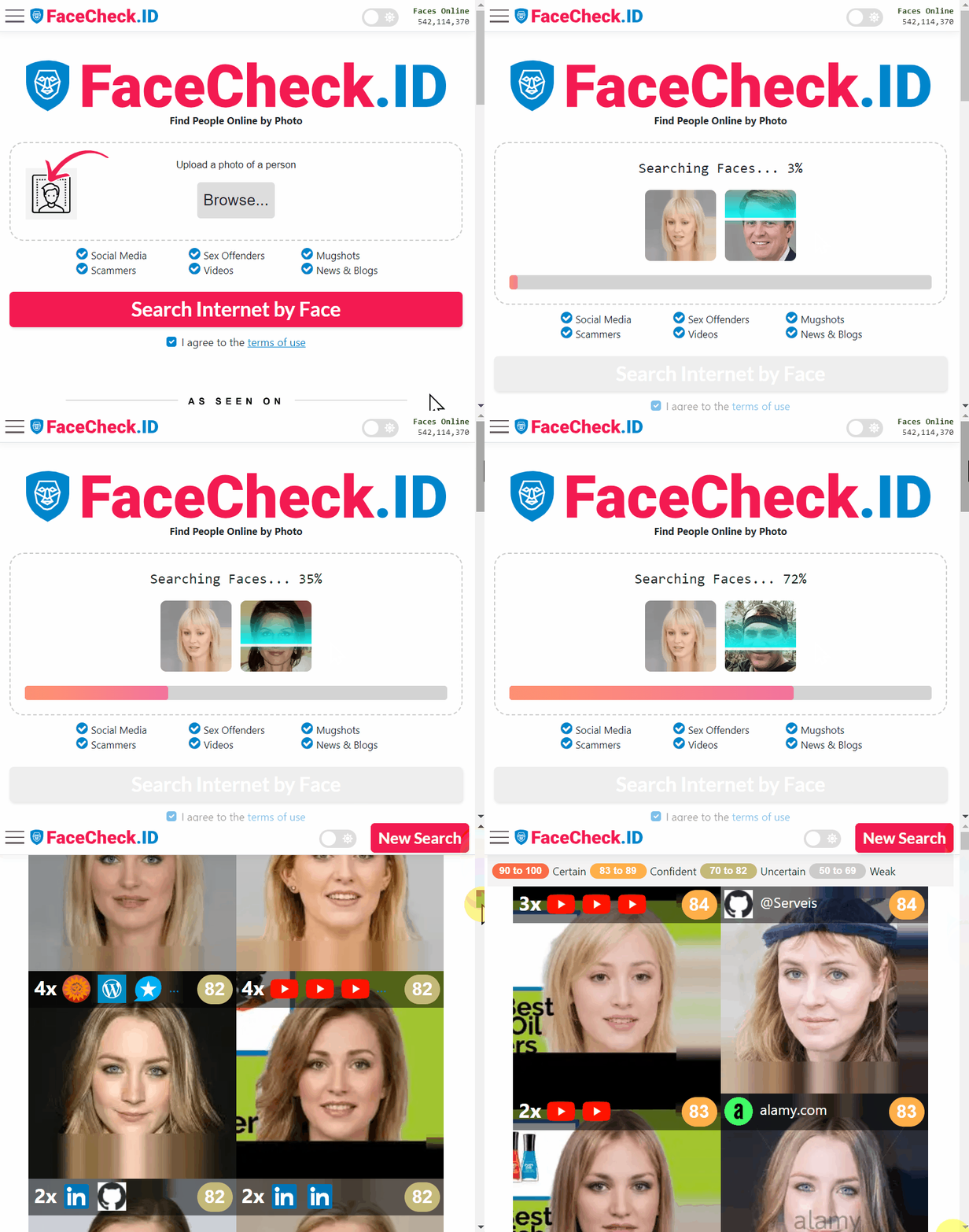
Use a clear, front-facing, well-lit photo; crop to the face; avoid heavy filters and extreme angles; and run more than one query photo (e.g., two different images of the same person) to see if results converge. If the tool provides match-strength indicators or result grouping (for example, FaceCheck.ID-style similarity scoring and clustered sources), prioritize the strongest, most consistent clusters and de-emphasize single, low-confidence adult-site hits that don’t repeat across other sources.
What should I do if a face recognition search engine incorrectly links my face to adult-film-star pages?
Document the issue (screenshots, URLs, timestamps), then use the search engine’s removal/opt-out or report workflow if available. Separately, contact the hosting sites to request takedown or correction, especially if your images were used without consent. If the misuse involves impersonation or stolen photos, report it to the platform where your photos were copied and consider additional steps such as watermarking public images, tightening privacy settings, and seeking legal advice where appropriate.

Recommended Posts Related to adult-film-star
-
Who is She? Reverse Image Search Your Favorite Adult Film Star!
In the ever-growing, steamy world of adult entertainment, discovering new adult film stars can be like opening a treasure chest of guilty pleasures. This reverse image search website is specifically designed to help you identify adult film stars faster than you can say "hubba hubba!". Search Adult Film Stars by Photo.
-
How to Run Background Check Using Face Recognition Search Engine
To see if they are an adult film star.