Biometric Identifier
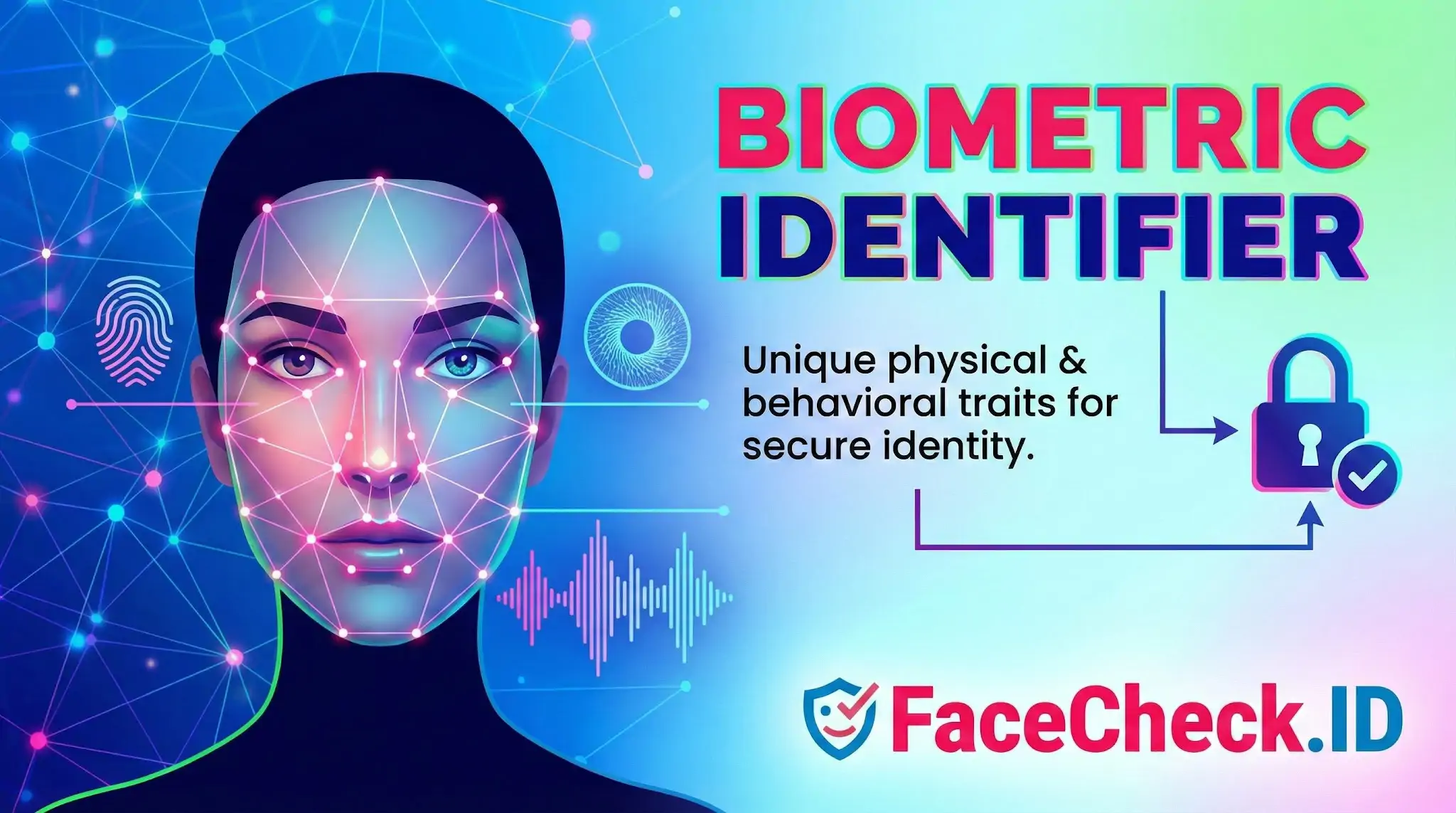
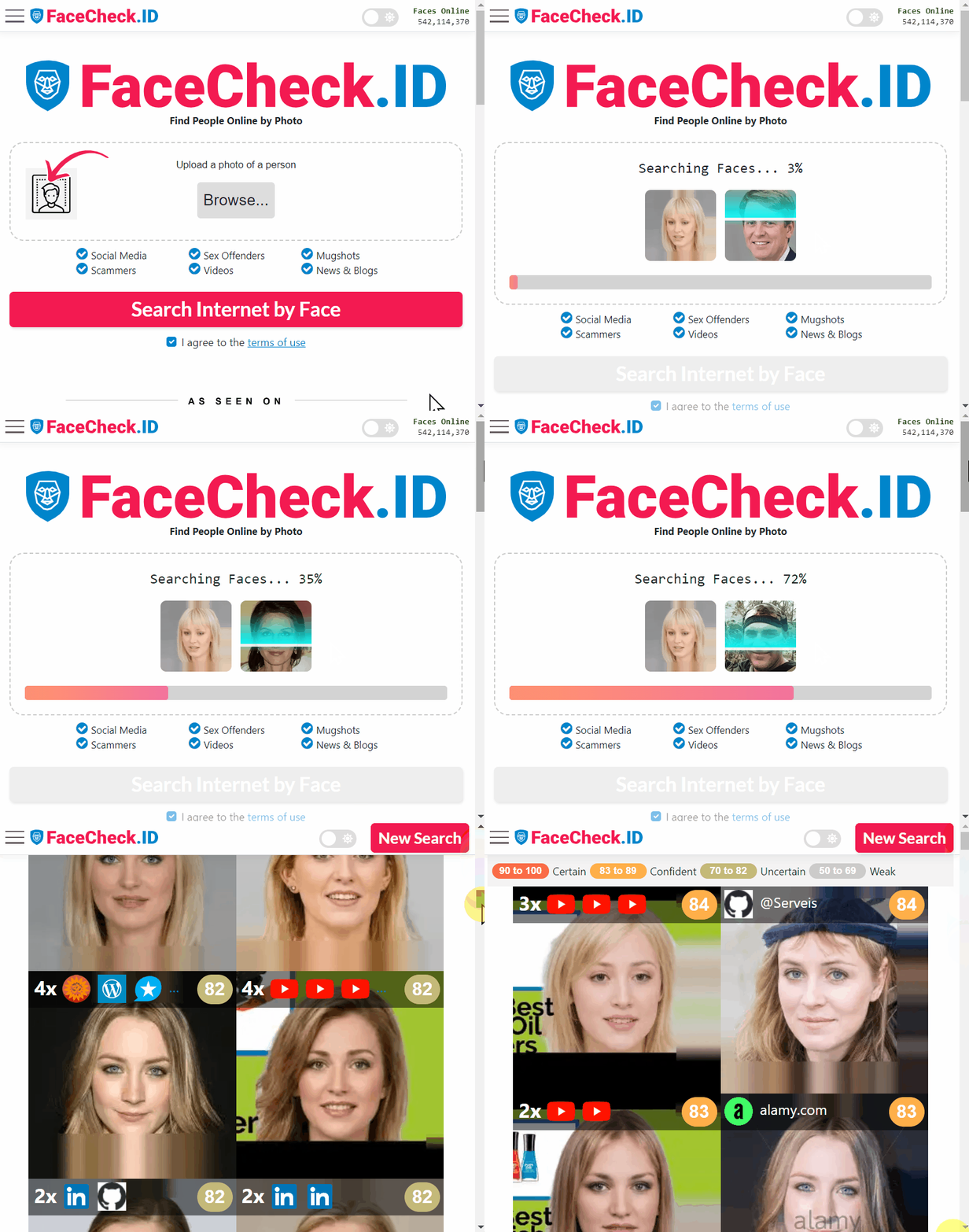
When you upload a photo to FaceCheck.ID, the system does not store your face as a picture. It extracts a biometric identifier, a numerical pattern derived from the geometry of the face, and compares that pattern against patterns extracted from images indexed across the public web. Understanding what a biometric identifier is, and what it is not, helps explain why face search works, where it fails, and why this category of data carries unusual privacy weight.
What counts as a biometric identifier in face search
A biometric identifier is any physical or behavioral trait stable enough to single out one person across many encounters. In a face-search context, the relevant identifier is face geometry: the relative distances and shapes of features such as eye spacing, nose width, jaw outline, and cheekbone structure. A face-recognition system converts these measurements into a vector, sometimes called an embedding or template, and matching is done by comparing vectors rather than pixels.
This distinction matters when interpreting results. Two photos of the same person taken years apart, in different lighting and at different angles, can still match because the underlying geometry is similar. Two strangers who happen to share a hair color and glasses style will not match, because their geometry differs. The identifier is the geometry, not the look.
Other biometric identifiers exist, including fingerprints, iris patterns, voiceprints, and gait, but face geometry is the only one extractable at scale from public images already on the open web. That is why reverse face search exists and reverse fingerprint search does not.
Why biometric identifiers behave differently from passwords
A leaked password can be rotated. A leaked face cannot. Once a photo of you is online and indexed, the biometric identifier embedded in that image is essentially permanent. This has direct consequences for anyone using or appearing in face-search results:
- A single public photo, even one posted years ago on an old forum or a defunct dating profile, can keep surfacing indefinitely.
- Cropped, filtered, or low-resolution images often still produce usable identifiers, just with lower confidence scores.
- Aging, weight changes, beards, and glasses reduce match strength but rarely eliminate it.
- Identical twins frequently produce false positives because their geometry is genuinely close.
For investigators using FaceCheck.ID to verify a dating profile or trace a suspected scammer, this persistence is the whole point. For people worried about their own exposure, it is the core privacy concern.
How identifier quality shapes match confidence
Face search is only as good as the identifiers on both sides of the comparison. A clean LinkedIn headshot, front-facing and well-lit, produces a high-quality identifier that matches reliably. A blurry crowd photo, a heavily filtered selfie, or a profile picture taken at a sharp angle produces a noisy identifier that may match the right person with low confidence or match the wrong person with misleading confidence.
Things that degrade identifier quality include extreme pose angles, sunglasses, masks, heavy makeup, low resolution, motion blur, and aggressive beauty filters. Things that preserve quality include neutral expressions, even lighting, and frontal framing. When reading FaceCheck results, the confidence score reflects identifier similarity, not certainty about identity.
What a biometric match does and does not prove
A high-confidence face match suggests that the same biometric identifier appears in two images. It does not, on its own, prove:
- That the person in both images is the same individual, since lookalikes and twins exist.
- That the account or page where the match appears is genuinely operated by that person, since photos are routinely stolen and reused by catfishers and scammers.
- That the match is current, since indexed pages may be years old.
- That the identity attached to the matched page is real, since names and bios on social profiles can be fabricated around a stolen photo.
Face-search results are leads, not verdicts. The biometric identifier tells you where a face appears online. Confirming who that face actually belongs to, and whether any given page reflects their real identity, still requires human judgment, cross-checking, and sometimes direct verification. Treating a match as proof rather than evidence is the most common way investigations go wrong.
FAQ
What is a “Biometric Identifier” in the context of face recognition search engines?
In face recognition search engines, a “Biometric Identifier” is a measurable feature used to recognize or distinguish a person—most commonly a face-derived representation such as facial geometry or a numeric face template (embedding) generated from a photo. It is used to compare one face against many images to find likely matches, but it does not inherently prove legal identity.
Is a face photo itself considered a Biometric Identifier, or is it the face template/embedding?
A face photo is the source image, while the biometric identifier used for matching is typically the face template/embedding computed from that image. Many systems can discard the photo after processing while retaining a template for search—however, whether the photo, the template, or both are treated as “biometric identifiers” depends on applicable laws and the system’s data practices.
How do face recognition search engines use Biometric Identifiers to search the open web?
They detect a face in the query image, generate a face embedding (a biometric identifier), and then compare it to embeddings indexed from images found online. Results are ranked by similarity, so the engine returns likely matches and near-matches based on how close the biometric identifiers are—not on a person’s name, unless the linked pages contain names that you separately verify.
What privacy risks come with using Biometric Identifiers in face recognition search?
Biometric identifiers can enable persistent matching across different photos and contexts, which increases risks like unwanted identification, stalking, doxxing, or incorrect association with sensitive content. Additional risks include unclear retention of uploads/templates, logging of searches, secondary use of data, and the difficulty of “resetting” biometric identifiers compared with passwords if they are misused or exposed.
How should I handle Biometric Identifier concerns when using a tool like FaceCheck.ID?
Use the minimum-necessary image (crop to the face, remove unrelated people/background if possible), avoid uploading highly sensitive photos, and treat matches as investigative leads rather than proof of identity. If the tool provides options about retention/opt-out/removal, review and use them; and before acting on any FaceCheck.ID match, validate with independent cues (same usernames, consistent provenance, multiple corroborating pages) to reduce wrong-person harm.

Recommended Posts Related to biometric-identifier
-
Is PimEyes Free? What You Get Without Paying, and What to Use Instead
Checking a dating match or finding where your own photos appear is a common use of face search, but the rules differ by place: some US states, Illinois' BIPA among them, regulate how biometric identifiers are collected and stored.