Content Authenticity
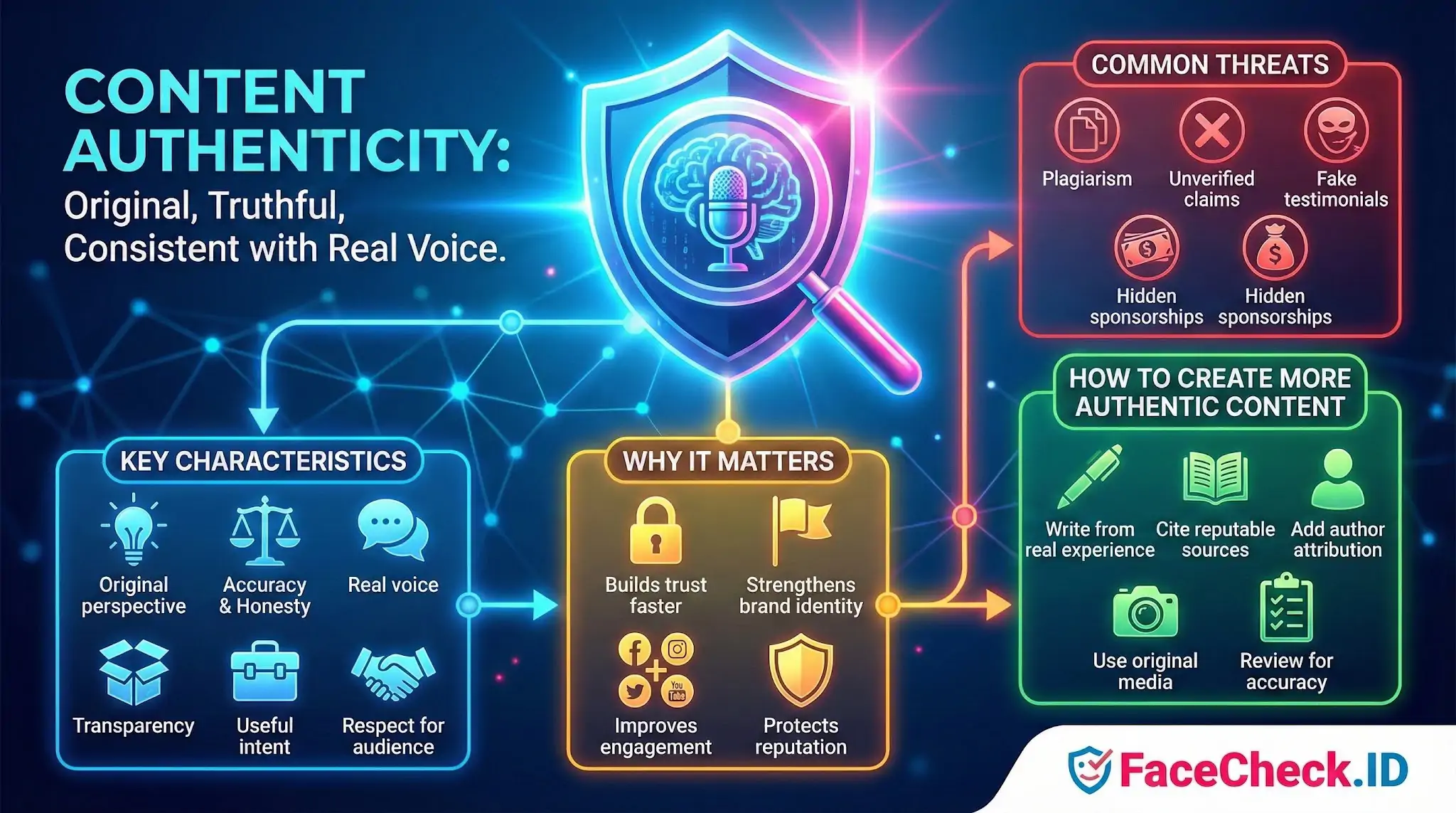
When a face-search result points to a profile photo, a news byline, or a dating app picture, the next question is almost always whether the surrounding content is real. Content authenticity is the layer of judgment that turns a face match into useful information about who someone actually is, who they claim to be, and whether the account or article should be trusted.
What authenticity looks like around a face match
A FaceCheck.ID result usually returns a thumbnail, a source URL, and a confidence score. Authenticity is what you assess after that. The same face might appear on a verified journalist's page, a stolen-photo dating profile, and a stock-photo marketplace. The pixels match in all three cases. The credibility does not.
Signals that suggest the content around a match is authentic:
- The name, bio, and posting history are consistent across years rather than appearing in a recent burst.
- Photos show the same person in varied settings, angles, and lighting, not just a handful of reused headshots.
- The account interacts with real contacts who also have history, mutual connections, and original posts.
- Captions, timestamps, and EXIF data (when present) line up with the claimed location or event.
- The site itself has editorial accountability, such as a masthead, contact information, or a verifiable author.
Signals that the content is likely inauthentic include reused stock images, mismatched names across platforms, AI-generated portraits with subtle asymmetries, and profiles whose photos all trace back to a single original source belonging to someone else.
How inauthentic content distorts face search
Reverse face search depends on what is publicly indexed. When bad actors flood the web with stolen or synthetic images, the index gets polluted, and matches start pointing to people who do not exist or to victims whose photos were taken without consent.
Common patterns that show up in results:
- A romance scammer reuses a real person's vacation photos across dozens of dating sites. A face search returns the scam profiles alongside the original Instagram, and the investigator's job is to figure out which came first.
- An influencer's headshot is repurposed in fake testimonials on supplement sites. The match is real, but the endorsement is fabricated.
- A GAN-generated face appears on a LinkedIn profile used for phishing. Reverse search may surface the same synthetic face on other fraud accounts because the same generator produced near-duplicates.
- A news photo gets miscaptioned and spread, attaching a real person's face to an event they had no part in.
In each case, the face-recognition layer works correctly. The authenticity layer is where things break.
Practical checks before trusting a match
Treat each result as a lead, not a verdict. A few habits help:
- Open the source page and read it. A high-confidence match on a low-credibility site is weaker than a moderate match on a known publication.
- Compare the earliest known appearance of the photo to the account claiming it. Scammers usually post later than the rightful owner.
- Look for the same face across multiple independent sources with consistent identity details. One profile is a data point. Five aligned profiles across different platforms is a pattern.
- Note when something looks too clean. A profile with only professional headshots, no candid photos, and no tagged friends is worth a second look.
- Watch for AI artifacts in the image itself: melted earrings, irregular pupils, garbled background text, hairlines that blur into the background.
What authenticity cannot prove
Authenticity assessment narrows uncertainty. It does not eliminate it. A polished, long-running account can still be operated by someone other than the person in the photos, especially when accounts are bought, hacked, or jointly run. A sparse profile is not automatically fake, since many real people post rarely. Lookalikes exist, and twins routinely defeat both human and algorithmic identity checks.
Face search plus authenticity review can tell you that a photo has been used in a specific context, that an identity claim is or is not consistent with public history, and that something deserves further scrutiny. It cannot confirm that the person behind the screen is the person in the picture. That step still requires direct verification, such as a live video call, government ID review through a proper channel, or contact through a known trusted source.
FAQ
What does “Content Authenticity” mean for face recognition search engines?
In face recognition search engines, “Content Authenticity” means confidence about where an image came from, whether it was altered, and whether it truthfully represents the real person shown. It focuses on provenance (source and history), integrity (edits/manipulation), and context (whether the image is being reused or miscaptioned) so face-search results are interpreted as leads with appropriate caution.
Why does Content Authenticity matter when reviewing face search matches?
Because face-search results can include reposts, screenshots, memes, composites, AI-edited portraits, or deepfakes, which can create misleading “identity trails.” Authenticity checks help you avoid treating a manipulated or out-of-context image as evidence that the person truly appeared on a specific site, used a specific account, or is associated with a claim.
What are practical ways to evaluate Content Authenticity in face search results?
Use a verification workflow: (1) open the source page and check whether it looks like the original uploader or a repost/scrape, (2) compare timestamps across multiple sources to find the earliest appearance, (3) look for consistency across different photos of the person (same setting, age, features), (4) watch for manipulation signs (warped edges, inconsistent lighting, odd reflections, uncanny skin texture), and (5) corroborate with non-image signals (username history, cross-linked profiles, archived versions, and independent mentions).
How do AI-generated or heavily edited images affect Content Authenticity in face recognition search?
AI-generated or heavily edited images can produce false confidence: they may match look-alike faces, create mixed results across multiple people, or seed many reposts that look like “evidence” but originate from synthetic content. In these cases, treat matches as weak signals, seek multiple independent photos from credible sources, and prioritize results that show a consistent real-world trail rather than a cluster of near-identical edited images.
How should I use FaceCheck.ID (or similar tools) with a Content Authenticity mindset?
Use FaceCheck.ID to gather candidate links, then shift immediately to authenticity validation: prefer results that point to primary sources (original posts or official pages), inspect whether the same image is widely reposted without attribution, and confirm with multiple distinct photos rather than one viral image. Avoid concluding identity from a single high-similarity hit; instead, build confidence only when several independent, authentic-looking sources align.