Credential Stuffing
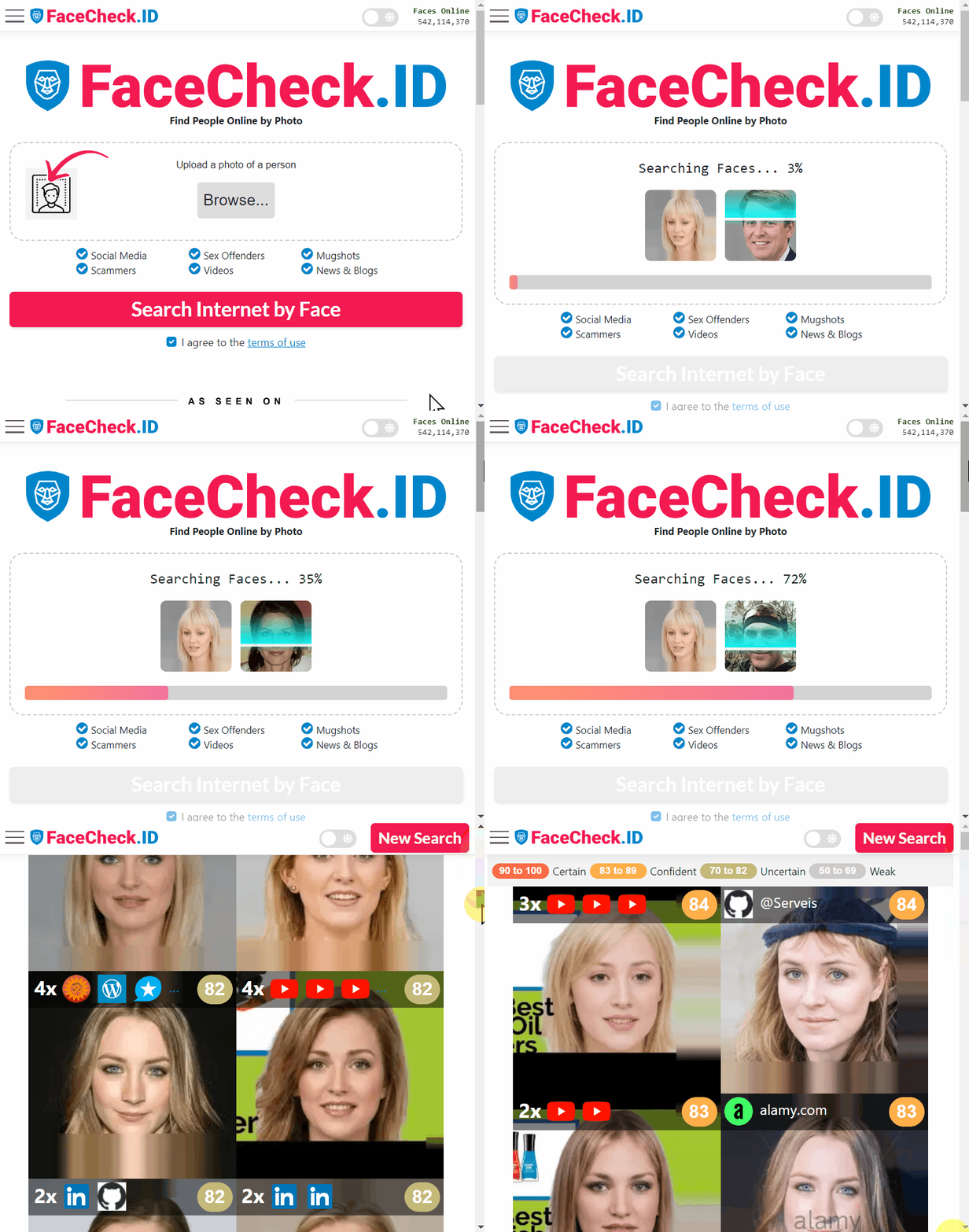
Credential stuffing is one of the quietest ways an online identity gets hijacked, and it matters to face search because a stolen account often becomes the starting point for impersonation, catfishing, or scam profiles built around someone else's photos. Once attackers control a real account, they can scrape its images, repost them elsewhere, and create lookalike profiles that show up later in reverse face-search results.
How stolen logins fuel fake identities online
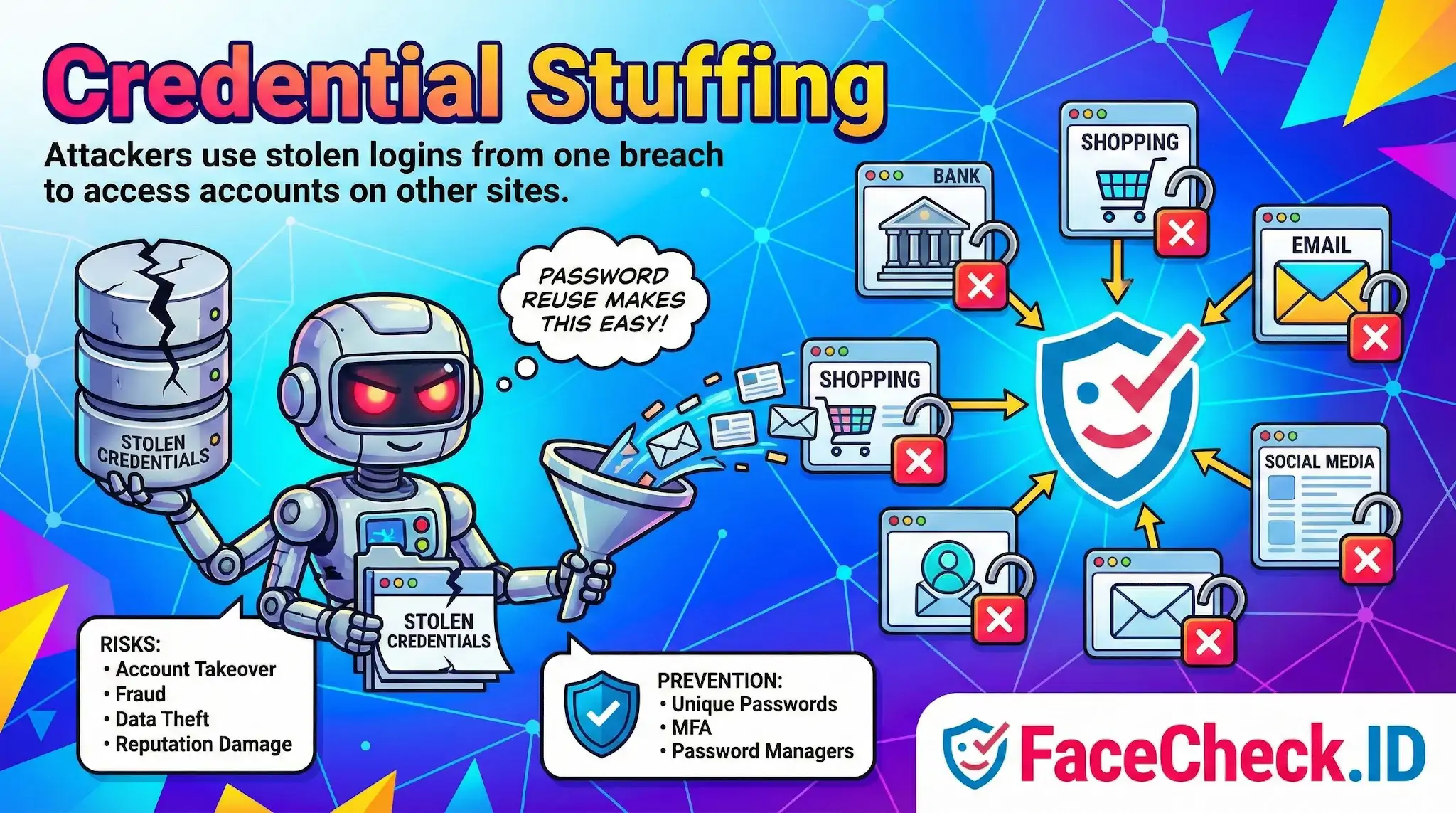
A credential stuffing attack begins with leaked username and password pairs from unrelated breaches. Bots replay those pairs against other sites at scale, looking for matches. When one works, the attacker inherits everything tied to that account, including private photos, saved selfies, message history, and the social graph that makes the account look authentic.
That inheritance is what connects credential stuffing to face-recognition concerns. A hijacked Instagram, dating app, or cloud storage account is a goldmine of front-facing, well-lit photos that will index cleanly in reverse face search later. Attackers extract those images and use them to:
- Build catfish profiles on dating sites under different names
- Pad fake LinkedIn accounts with real-looking headshots
- Run romance and investment scams using someone's stolen face
- Open new accounts on platforms that use selfie verification, by submitting photos pulled from the original victim
A face-search result that ties one face to multiple unrelated identities is sometimes the first signal that an account takeover happened months earlier.
Why face search picks up the aftermath
When FaceCheck.ID returns matches showing the same face across mismatched names, locations, or professional backgrounds, credential stuffing is one plausible upstream cause. The original owner may still control their primary account, unaware that their photos were copied during a brief takeover window or scraped after a successful login from a leaked password.
Patterns that often appear in face-search results after a credential stuffing incident:
- The same face on a verified personal account and on several profiles using different names on dating or escort sites
- Headshots from a corporate or LinkedIn page reused on cryptocurrency or trading scam accounts
- Selfies from a private cloud or social account surfacing on forums, reposts, or marketplaces the subject never used
These patterns do not prove an account was breached through credential stuffing specifically. Photos get reused for many reasons, including simple image theft from public profiles. But when a victim insists they never created the accounts their face appears on, a prior credential breach is worth checking against services that track exposed passwords.
Defenses that reduce face misuse downstream
Stopping credential stuffing protects more than account balances. It limits how many high-quality photos of a person leak into the broader web in contexts they never agreed to.
For individuals:
- Use a unique password on every account, especially those holding personal photos
- Turn on multi-factor authentication, ideally passkeys, on email, social, and cloud accounts
- Run a periodic face search on yourself to catch image misuse early
- Audit account activity logs for unfamiliar logins after any reported breach
For platforms that hold user photos:
- Block known-breached passwords at signup and password change
- Apply rate limiting and bot detection on login endpoints
- Require step-up verification before bulk photo downloads or profile exports
- Flag impossible-travel logins and unusual device fingerprints
Limits of what a face match can tell you
A reverse face-search hit tied to a suspicious account does not confirm credential stuffing, identity theft, or any specific attack path. The same face can appear on multiple legitimate profiles run by the same person, on parody accounts, on press coverage, or on lookalikes who share strong facial similarity. False positives are real, especially with low-resolution crops, heavy filters, or extreme angles.
Treat face-search results as leads, not verdicts. A cluster of mismatched identities tied to one face is a reason to investigate further: check breach databases, contact the platforms hosting the suspicious profiles, and verify with the apparent subject directly. Credential stuffing explains some of these patterns, but image scraping, deepfakes, and ordinary photo theft explain others, and the response differs depending on which actually happened.
FAQ
What is credential stuffing in the context of face recognition search engines?
Credential stuffing is an automated attack where criminals use large lists of leaked username/password pairs to try logging into many accounts until they find reused credentials. For face recognition search engines, the risk is usually not the face-matching algorithm itself, but attackers attempting to take over user accounts (or admin panels) that can access searches, results history, saved cases, billing data, or API keys.
How can credential stuffing impact a face recognition search tool (including FaceCheck.ID) and its users?
If an attacker successfully logs in using reused credentials, they may be able to run searches under your account, view prior searches or reports (if the service stores them), change account settings, steal API keys or credits, and potentially access any personal or investigative notes you saved. Even when the tool’s face recognition is accurate, an account takeover can expose sensitive queries and create serious privacy, legal, and reputational harm.
What are common signs of credential stuffing or account takeover on a face recognition search engine account?
Common signs include unexpected password reset emails, login alerts from unfamiliar locations/devices, searches or “recent activity” you didn’t perform, suddenly missing credits or changed subscription/billing details, and new linked emails/2FA changes you didn’t authorize. Any unexplained activity should be treated as potentially automated credential stuffing until proven otherwise.
How do I reduce the risk of credential stuffing when using face recognition search engines?
Use a unique, long password for the face search service (never reused elsewhere) and store it in a password manager. Enable multi-factor authentication (preferably an authenticator app or security key). Monitor login/activity history if the service provides it, review connected emails and recovery options, and avoid using the same password across OSINT, email, and social platforms—because a compromise of any one of those can enable credential stuffing against the face search account.
What should I do immediately if I suspect credential stuffing on my FaceCheck.ID (or similar) account?
Immediately change the password to a unique one, revoke/rotate any API keys or tokens, and enable or reset multi-factor authentication. Sign out other sessions (if available) and review account activity, saved searches, exports, and billing details for unauthorized changes. If you reused the old password anywhere else, change it everywhere it was used, and contact the service’s support to report suspected account takeover and request an audit or forced logout.