Deepfake Interview: Spotting Stolen Headshots
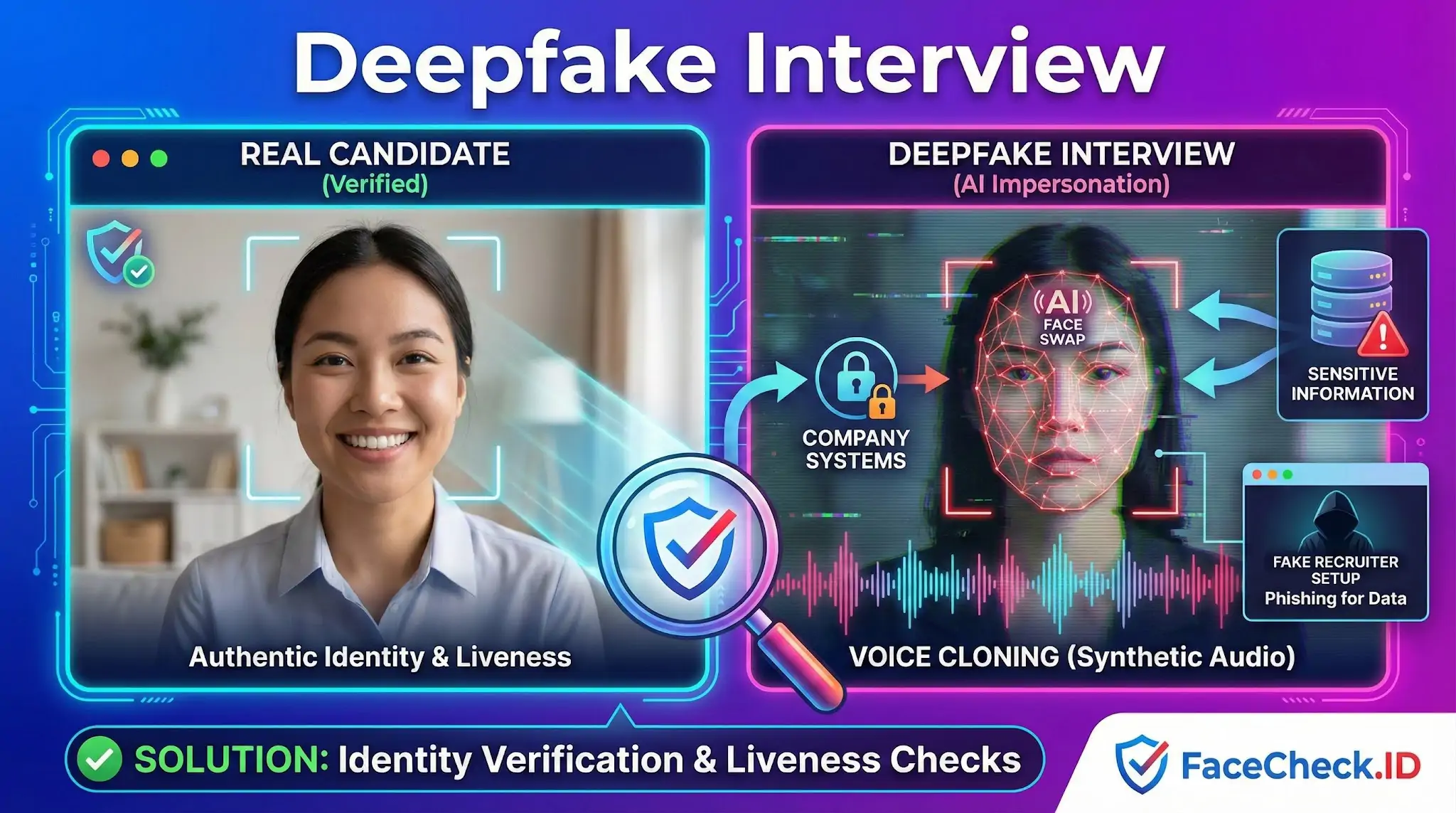
A deepfake interview is a remote job interview where AI-generated face or voice is used to impersonate someone, often a real person whose photos and resume have been scraped from public profiles. For investigators and recruiters, this is where reverse face search becomes a frontline check: if the person on the call doesn't match the person whose identity they're using, the trail usually starts with the face.
How deepfake interviews exploit reused photos
Most deepfake candidates don't invent a face. They borrow one. The fake identity is built around a real headshot pulled from LinkedIn, GitHub, a university directory, a conference speaker page, or a stock photo site. The attacker then uses that face as the base for either a static fabricated profile or a live face-swap during video calls.
This is why a reverse face search at the resume stage matters. If a single headshot returns hits across unrelated names, multiple LinkedIn accounts in different countries, or profiles in languages the candidate doesn't claim to speak, the identity is almost certainly stolen or synthetic. Common patterns recruiters see:
- The same face appearing under two or more names on professional networks
- A polished headshot that traces back to a stock photo seller or an AI-generated face gallery
- Matches on a real engineer's social media, but with contact details that don't match anything that person has ever published
- Faces that appear in scam-warning posts, fraud forums, or breach dumps
What to check before and during the call
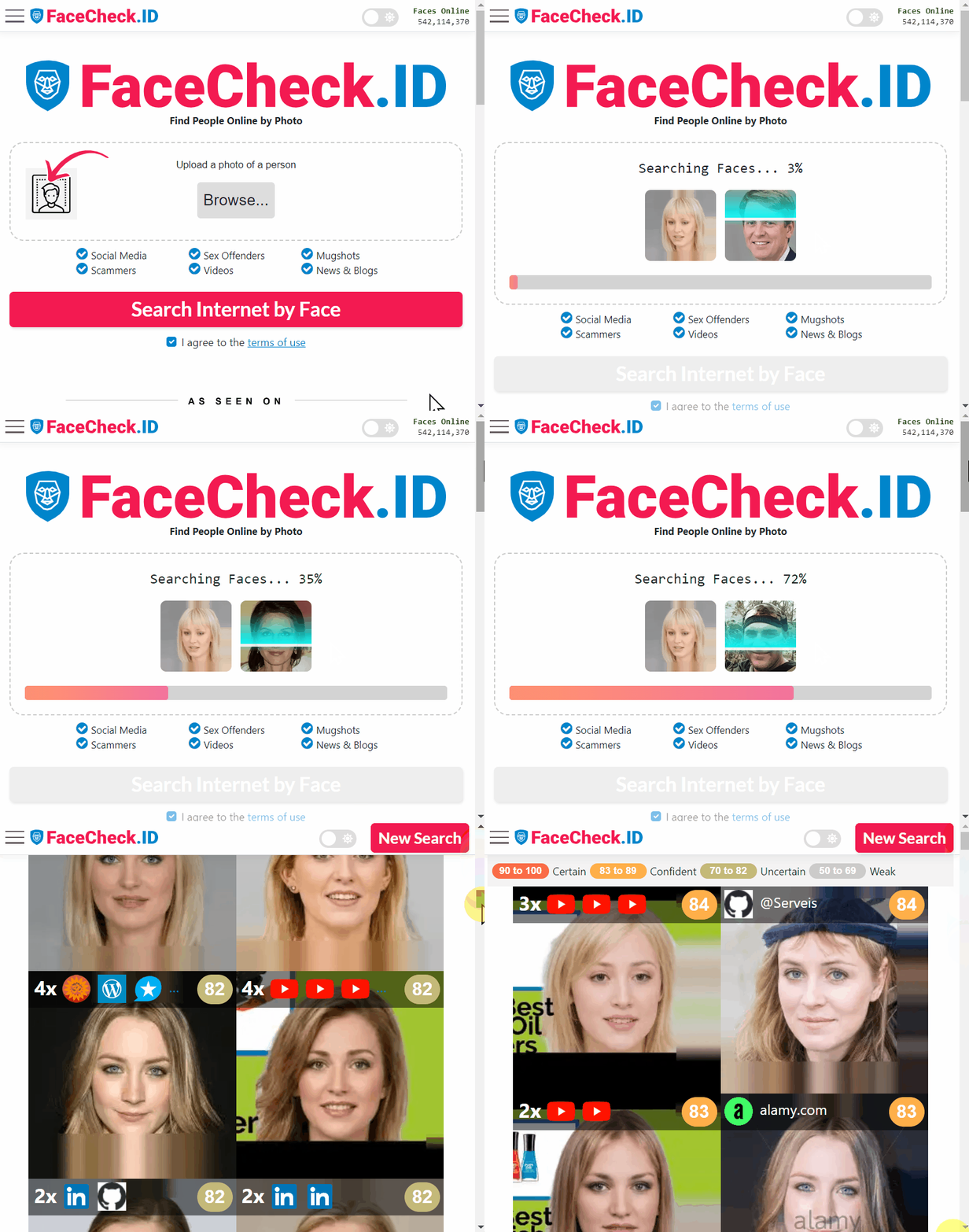
Face search is most useful before the interview, when there's time to review results carefully. Take the candidate's submitted photo and run it against the public web. Look at where the face appears, when those pages were indexed, and whether the surrounding context is consistent with the resume.
During the call itself, the deepfake question shifts from identity to liveness. Real-time face-swap tools struggle with sharp head turns, hand passes in front of the face, sudden lighting changes, and unusual angles. Asking the candidate to hold a piece of paper next to their face, turn fully sideways, or stand up will often expose warping at the jawline, hairline, or ears. Voice clones tend to lose prosody on long unscripted answers and stumble on personal anecdotes that require genuine recall.
Useful in-call checks:
- A wide-angle view that shows hands and shoulders, not just a tight head crop
- A short follow-up call scheduled on short notice, which defeats setups that require time to prepare
- Specific technical questions that match the claimed background, asked out of order
- A request to share a screen while answering, which forces attention away from filter alignment
Where face search helps and where it doesn't
Reverse image search is strong at one specific thing: showing whether a face has a public history that matches the story the candidate is telling. If a claimed senior developer with ten years of experience has zero indexed appearances anywhere on the web, that's a signal. If the same face appears under three names, that's a stronger signal. If the face matches a real person whose verified accounts contradict the application, the case is close to closed.
It is weaker at confirming the person on the live call is the same person in the photo. A clean face-search result on the submitted headshot tells you the photo is real and belongs to a real identity. It does not tell you that the candidate using that photo is that identity. That gap is where liveness checks, government ID verification, and follow-up calls fill in.
Limits and honest interpretation
A face match is evidence, not proof. Twins, lookalikes, and people who happen to share strong facial features can produce confident matches that are wrong. A candidate whose photo appears on a few unrelated sites might be a victim of scraping rather than the perpetrator. A candidate with no online presence might simply be private, early in their career, or from a region with less indexed content.
The goal is not to disqualify anyone whose face produces unexpected results. It is to spot the patterns that distinguish a real person with a normal digital footprint from a fabricated identity stitched together from someone else's photos. Face search narrows the field. Human judgment, structured verification, and access controls do the rest.
FAQ
What is a “Deepfake Interview” in the context of face recognition search engines?
A “Deepfake Interview” typically refers to a job or media interview where someone uses AI-generated or AI-altered face imagery (and sometimes voice) to impersonate another person. In face recognition search engines, this matters because screenshots or frames from the interview may be indexed or searched, potentially linking to the impersonated person, the deepfake source material, or unrelated look-alikes.
Can a deepfake interview cause a face recognition search engine to return the wrong person?
Yes. If the deepfake convincingly overlays one person’s facial features onto another’s performance, a face search may retrieve results connected to the target identity, the actor/source identity, or visually similar people—especially when the input is a low-quality screenshot, compressed video frame, or heavily filtered capture. Treat matches as investigative leads, not proof of identity.
What kind of image should I extract from a deepfake interview video to get the most reliable face-search results?
Use a sharp, front-facing frame with neutral expression, minimal motion blur, and high resolution; avoid frames with strong compression artifacts, face filters, extreme angles, or partial occlusions (hands, hair, microphones). If possible, test multiple frames from different moments—deepfakes can vary frame-to-frame, and some frames may match the underlying source person more strongly than others.
How can I tell whether a face-search match is from the deepfake content rather than a real photo of the person?
Open the matched pages and look for contextual signals: identical video frames across many reposts, watermarks, “interview clip” thumbnails, or references to AI/deepfake content. Compare timestamps and provenance: the earliest appearances may be a video platform, repost aggregator, or forum rather than the person’s own accounts. Also compare multiple frames—if different frames point to different identities or clusters of sources, that inconsistency is a warning sign that the interview imagery may be synthetic or manipulated.
How can FaceCheck.ID add value when investigating a suspected deepfake interview, and what precautions should I take?
Tools like FaceCheck.ID can help by surfacing where the face (or similar-looking faces) appears across the web, which may reveal reused source images, repost networks, or earlier instances of the same interview frames. Precautions: (1) run searches using multiple frames and compare result consistency, (2) verify each hit by checking the destination page context (not just the thumbnail), (3) avoid sharing unverified “identity” claims based on a match, and (4) document provenance (first-seen sources, dates, and whether the page is a repost) before taking action.