Doppelgänger Effect in Face Search
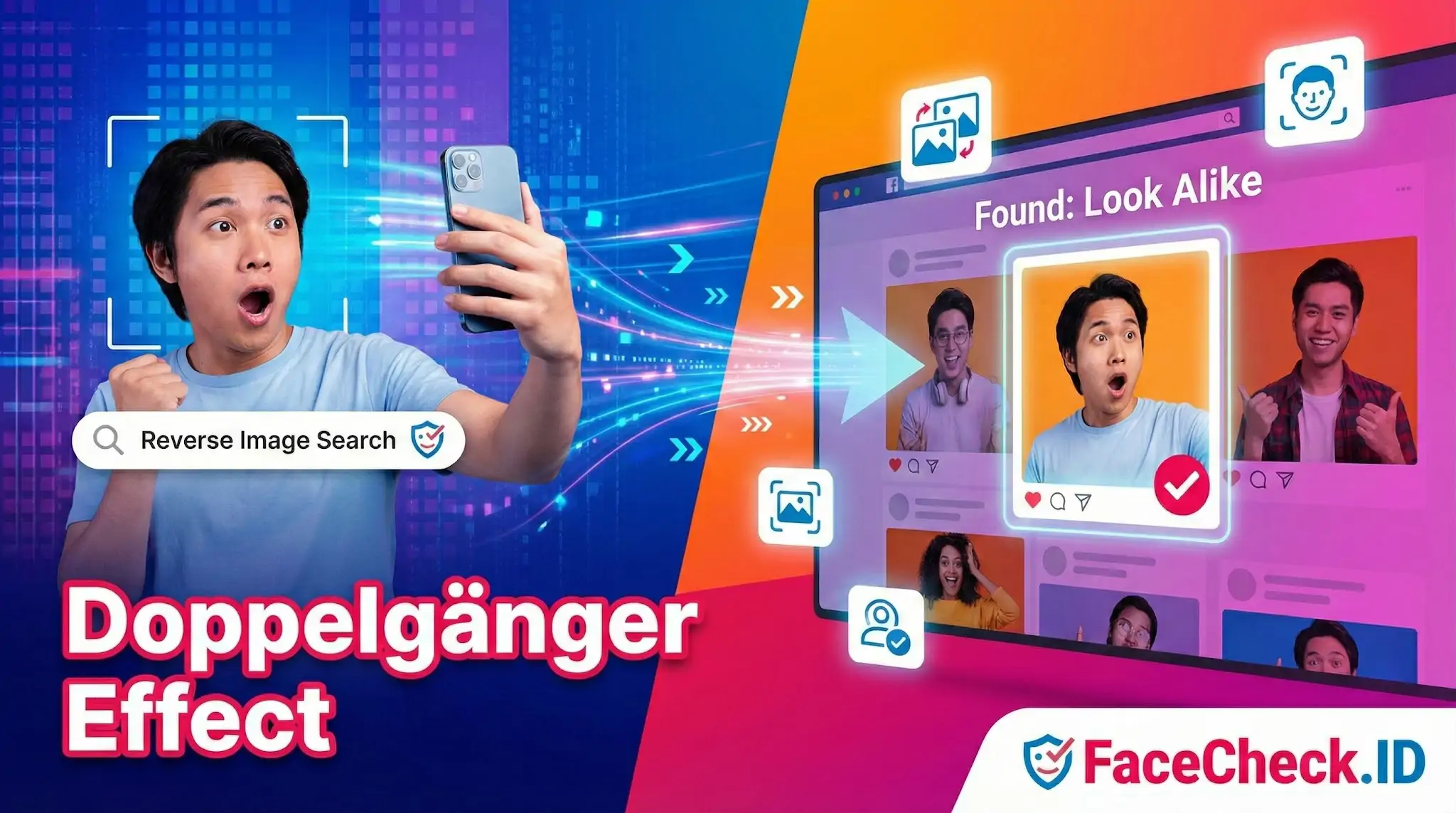
Anyone who runs a face search long enough eventually hits it: a result that looks unmistakably like the target, ranked with high confidence, but turns out to be a complete stranger living on another continent. That is the doppelgänger effect, and for face-recognition engines it is one of the most persistent sources of false positives — and one of the most fascinating signals about how human faces are distributed across a planet of eight billion people.
Why doppelgängers show up in face-search results
Face recognition does not "see" a person. It converts a face into a numerical embedding — a vector describing the geometry, proportions, and texture patterns the model considers identity-relevant. Two unrelated people can produce embeddings that sit close together in that vector space, especially when they share the traits the model weights most heavily: interocular distance, jawline angle, nose bridge shape, brow structure, and skin tone.
This is why doppelgänger hits cluster around certain types of faces. Symmetrical faces with average proportions tend to generate more near-matches than highly distinctive ones. Identical twins are an extreme case, but unrelated lookalikes are more common than most users expect. A 2022 study in Cell Reports found that genuine human doppelgängers often share measurable genetic variants influencing facial structure, even with no familial relationship — which means the resemblance is real, not just an artifact of the algorithm.
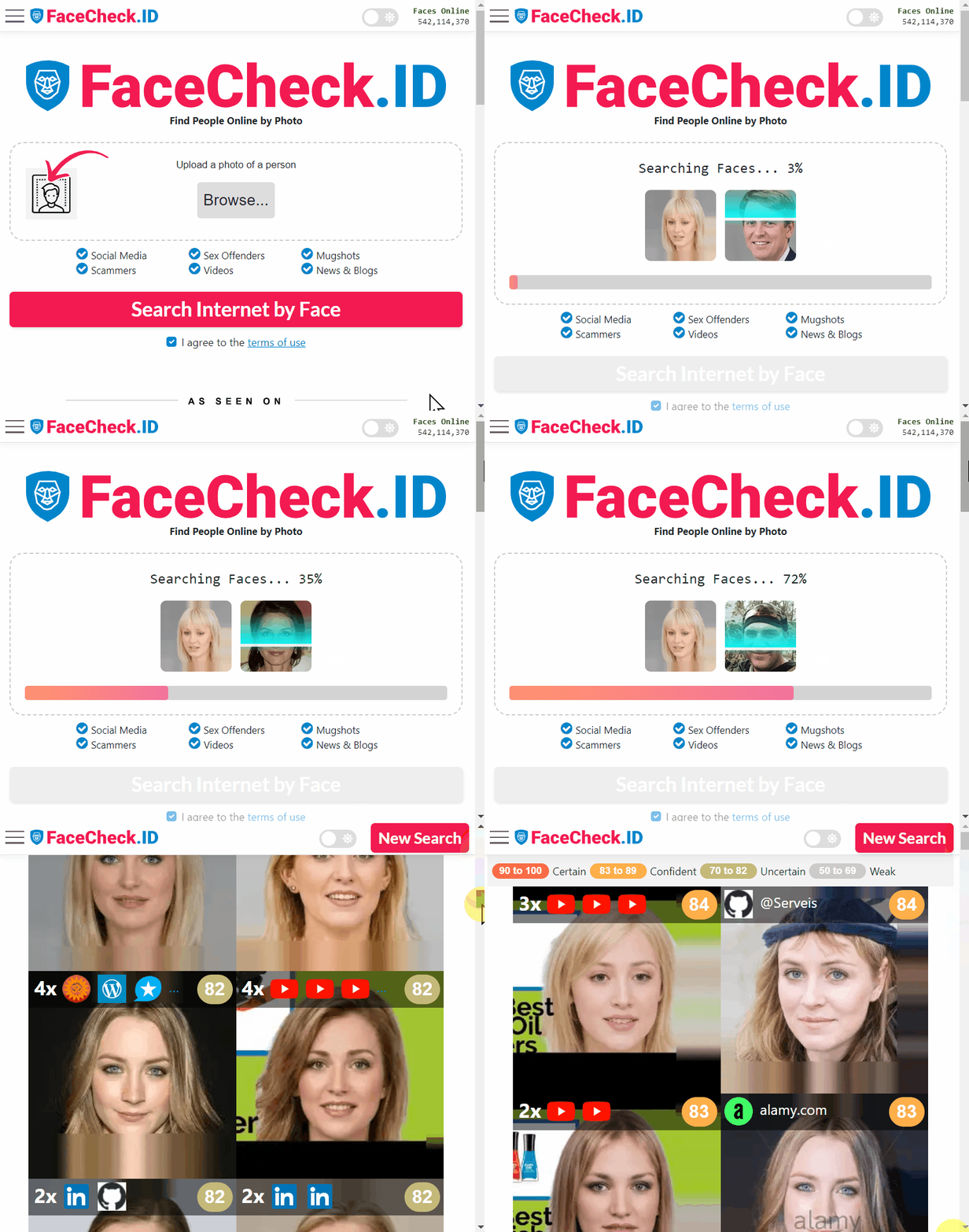
When FaceCheck.ID returns a high-confidence result that the user insists is not them, the doppelgänger effect is usually the explanation. The match is honest; the people are simply different.
How image conditions amplify the effect
Doppelgänger false positives spike under predictable conditions:
- Low-resolution source images. Fewer pixels mean fewer distinctive features for the model to lock onto, so generic facial geometry dominates the score.
- Frontal, neutral-expression photos. LinkedIn-style headshots strip away the asymmetries — a crooked smile, a raised brow — that normally separate one person from a lookalike.
- Heavy filters or beauty smoothing. Instagram and TikTok filters push faces toward a homogenized template, collapsing distinguishing detail.
- Sunglasses, masks, or partial occlusion. With the eye region or lower face hidden, the remaining features may match dozens of unrelated people.
- Shared demographic and styling cues. Same haircut, same age range, same lighting setup, same ethnicity — the model has less to work with.
Investigators using face search professionally learn to discount any single high-confidence result and instead look for corroboration across multiple independent images. One match from a stock-photo site and one from a regional news article showing the same person in different contexts is far stronger evidence than a single 95% score.
Why doppelgängers matter for identity and scams
The effect cuts both ways. Catfishers and romance scammers exploit it deliberately, stealing photos of real people whose faces happen to resemble a targeted demographic — a "wholesome dad-bod" lookalike for a romance scam, or a generic corporate headshot for a fake LinkedIn recruiter. When the victim later runs a reverse face search, they may find the genuine owner of the stolen photos and several unrelated lookalikes, complicating the investigation.
Conversely, innocent people occasionally surface in face searches connected to crimes, mugshots, or scandals they had nothing to do with — purely because their face sits near a guilty party's in embedding space. This is why responsible face-search workflows treat results as leads, not conclusions.
What a doppelgänger match does not prove
A high similarity score is not an identification. It is a statement that two images are visually close according to a model trained on a finite dataset. It does not confirm shared identity, family relation, or even that both photos depict real people — AI-generated faces increasingly produce doppelgänger hits against real individuals.
Before drawing any conclusion from a face-search result, verify with context: the surrounding text on the page, the account history, the photo metadata, and ideally a second image of the same subject from an unrelated source. The doppelgänger effect is a reminder that faces are statistical, not unique — and that the difference between a real identification and a coincidence often lives in the details around the photo, not the photo itself.
FAQ
What is the “Doppelgänger Effect” in face recognition search results?
In face recognition search engines, the “Doppelgänger Effect” refers to the tendency of an algorithm to surface visually similar-looking people (look-alikes) when searching for a specific person—especially when the available photo is low quality or ambiguous. These results can appear convincing because the face embeddings (feature vectors) are close, even though the identity is different.
What factors make the Doppelgänger Effect more likely in a face search engine?
The effect is more likely when the input face image has poor lighting, blur, heavy compression, extreme angles, occlusions (masks, sunglasses, hair), strong facial expressions, or significant age differences. It also increases when only a small face region is visible, when the person’s appearance is generic (common facial features), or when the search index contains many near-duplicate photos of other similar-looking people.
How can I reduce Doppelgänger Effect results when doing a face recognition search?
Use a high-resolution, front-facing photo with neutral expression and minimal occlusion, and try multiple photos from different times/angles. Prefer images where the face occupies a larger portion of the frame. If the service provides similarity thresholds or confidence filtering, increase the strictness and prioritize matches that are consistent across several input photos and across multiple independent result sources.
Can the Doppelgänger Effect be amplified by look-alike photos, filters, or AI-generated faces?
Yes. Beautification filters, face-altering apps, cosplay, and AI-generated or heavily edited images can push different identities toward similar-looking feature patterns, making look-alike matches more frequent. Synthetic or stylized faces may also create clusters of similar embeddings that increase false look-alike hits, particularly when the query photo is itself edited or low fidelity.
If I suspect a Doppelgänger Effect result on FaceCheck.ID, what practical checks should I perform?
Treat the match as a lead, not proof. Compare stable identity cues across results (ear shape, moles/scars, hairline, facial asymmetry), and verify context (names, locations, timelines, known associates) on the source pages. Re-run the search with additional photos of the target person and see whether the same URLs consistently reappear. On FaceCheck.ID, prioritize higher-confidence matches and cross-check multiple results rather than relying on a single close-looking image.

Recommended Posts Related to doppelgänger-effect
-
Doppelgänger Effect in Facial Recognition Technology
This uncanny experience is known as the "Doppelgänger Effect.". The Doppelgänger Effect has been a subject of fascination for centuries, with many cultures believing that seeing your double was a bad omen or a sign of impending death. In some cases, the Doppelgänger Effect can be a manifestation of our subconscious desires or fears.
-
FaceCheck No Results? Why Face Search Comes Back Empty (and How to Fix It)
People look alike more often than you'd think (the doppelgänger effect is real), so check any match against other information before acting on it.