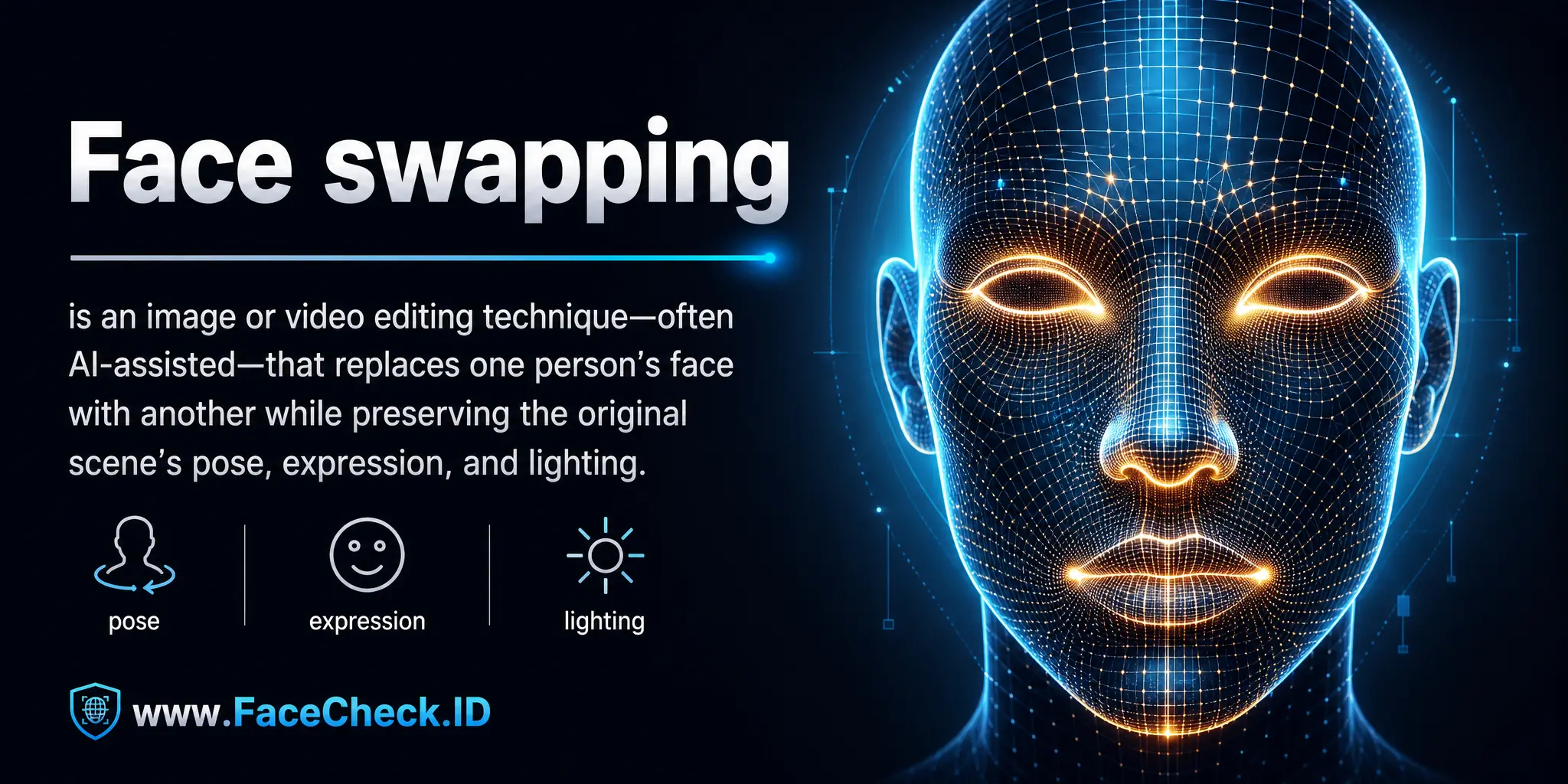
Face Swapping
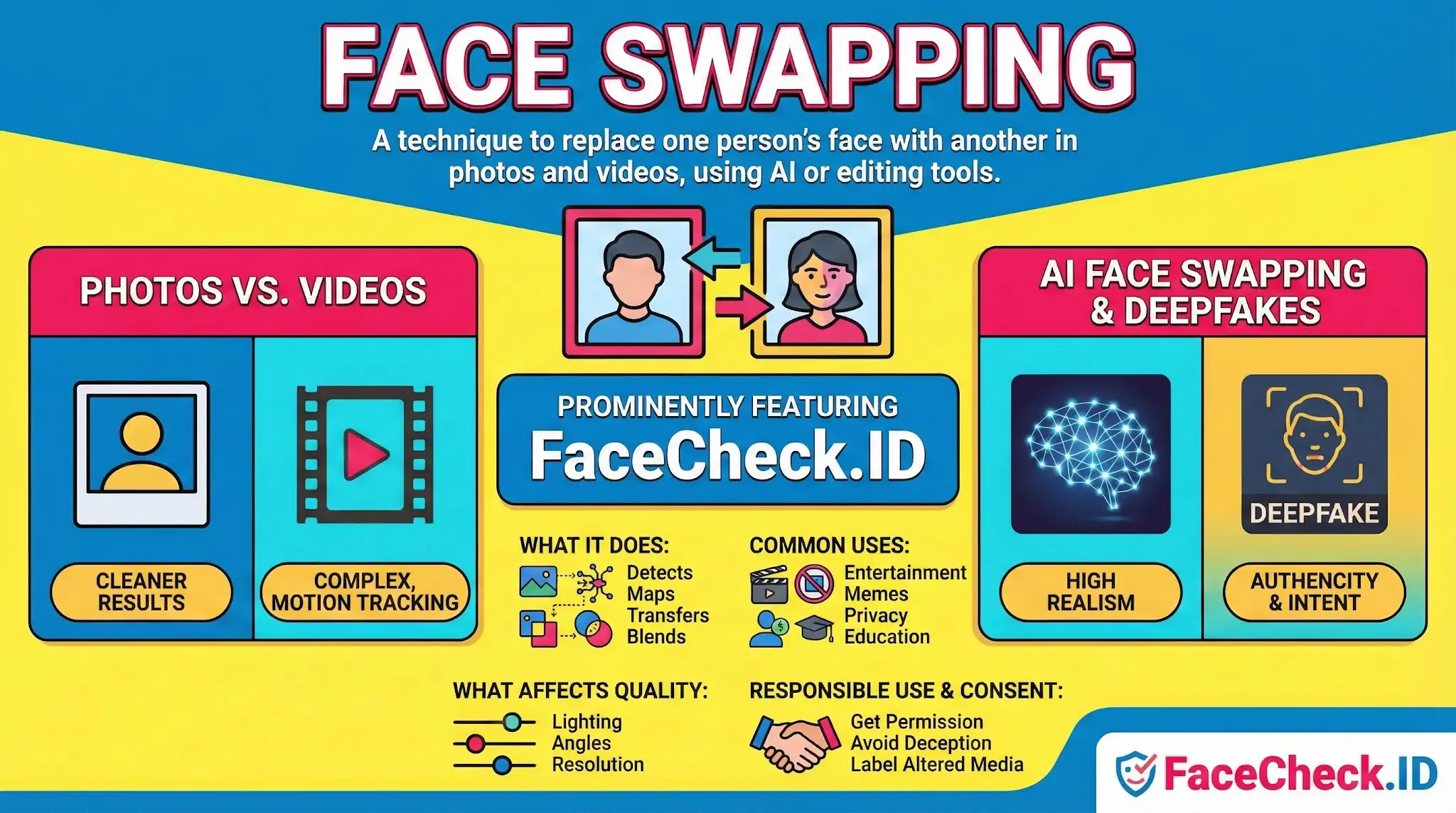
Face swapping is one of the main reasons reverse face search exists in its current form. When someone can paste a stranger's face onto another body, or swap a celebrity's face into a dating profile photo, the question "is this person real?" stops being rhetorical and becomes something you actually need tools to answer.
How face swapping breaks normal identity checks
A face swap keeps the original head pose, lighting, and background but replaces the face itself. To a human scrolling past, the photo looks consistent. To a face-search engine, the swapped face is a new identity grafted onto an old scene, and that mismatch is often what gives it away.
Modern AI swaps detect facial landmarks on both source and target, warp the source face to match the target's geometry, then blend skin tone and edges. The output usually preserves enough of the source person's bone structure, eye shape, and feature spacing to register as that person in a face-search index. This is why a celebrity face swapped onto a random profile picture will often surface matches to the celebrity's real photos, not to the body or background in the image.
What face swaps look like in face-search results
When you run a swapped image through FaceCheck.ID, several patterns tend to appear:
- Matches cluster around one well-known person whose face was used as the source, even though the surrounding image looks unrelated to that person's life
- The same body, outfit, or background shows up in matches tied to a different face entirely
- Confidence scores are unusually high for the face region but the contextual pages, such as profile bios or article topics, do not line up
- Reverse image search on the full photo finds the original unedited version with a different person's face
Investigators looking into romance scams, fake dating profiles, or impersonation accounts run into this constantly. A scammer pulls a stock photo or stolen Instagram shot, swaps in a face that does not exist or belongs to someone unrelated, and posts it. Face search can usually still trace the source identity because the swap rarely removes every distinguishing trait.
Quality cues that suggest a swap
Swaps degrade in predictable ways. Things that often signal manipulation in a photo you are checking:
- Sharp face against a softer or differently lit background
- Slight color mismatch along the jawline, hairline, or ears
- Earrings, glasses, or hair strands that cut across the face oddly
- Teeth, eyes, or skin texture that look smoother than the rest of the image
- Identical face geometry across multiple "different" profiles you find in matches
Video swaps add flicker, frame-to-frame warping, and lag in expressions. Stills are harder to flag visually, which is why cross-checking against face-search results matters more than eyeballing alone.
Where face-search interpretation gets tricky
A face-search match on a swapped image does not prove the matched person made the image, posed for it, or has any connection to the account using it. In most cases the matched person is the victim, their real photos were used as source material without consent. Reading the match as "this is them" will lead you to the wrong conclusion.
Equally, a clean face-search result on a suspicious photo does not prove the image is authentic. AI-generated faces that were never trained on a specific real person can produce zero strong matches, which is itself a signal worth noting. And lookalike matches can muddy the picture: two unrelated people with similar features can both register against a swap, especially at lower confidence thresholds.
Use face search to map where a face appears across the public web, then weigh that against the rest of the image, the account history, and the context. Face swaps are designed to fool quick visual judgment. They are much less effective at fooling a search that compares the underlying face to thousands of indexed photos at once.
FAQ
How does face swapping differ from deepfakes, and why does the difference matter for face recognition search?
Face swapping typically replaces one person’s face onto another person’s head/body within an image (often keeping the target’s pose, background, and context). “Deepfakes” is a broader umbrella that can include full synthetic video, lip-sync, reenactment, or entirely generated faces. The distinction matters because face recognition search engines rely heavily on facial geometry and texture; a simple swap can produce an embedding that partially matches the swapped-in identity while the surrounding context still points to the original source—creating misleading investigative leads.
What result patterns can suggest an image was face-swapped when you run a face recognition search?
Common patterns include: (1) top matches span two very different “clusters” of identities (e.g., some results resemble Person A while others resemble Person B); (2) the same background/photo-session appears across results but with different faces; (3) strong facial similarity but inconsistent non-face cues (ears, hairline, neck, tattoos, age, or lighting direction); and (4) multiple sites hosting the same picture with noticeably different face details. Treat these as manipulation signals, not proof.
How can a face swap create “mixed identity trails” across the web, and how should you interpret them?
When a swapped image spreads, reposts may attach the swapped face to captions, usernames, or biographies belonging to someone else, creating a trail where the face seems linked to unrelated identities. In a face recognition search engine, this can look like a person “has multiple names” or “multiple profiles.” The safer interpretation is: the results are leads about where similar face pixels appear—not a reliable statement about who the person is—until you validate original sources, posting timelines, and consistent corroborating details.
What is the safest workflow to investigate suspected face-swapped content using face recognition search engines?
Use a multi-step approach: (1) extract several frames/crops (full face, left/right half-face, and a wider crop including hairline/ears); (2) run searches with each crop and compare whether the same identity cluster persists; (3) separately run a traditional reverse image search on the full image (to track the background/body/photo set); (4) prioritize earliest-known postings and higher-quality originals; and (5) only draw conclusions when face matches and non-face evidence align. If they diverge, assume manipulation is plausible.
How can FaceCheck.ID (or similar tools) be used to reduce confusion when face swapping is suspected?
FaceCheck.ID can add value by quickly surfacing where visually similar faces appear across many sites, helping you spot identity “clusters” and conflicting contexts. To reduce confusion, run multiple queries (different crops/frames) and compare whether the top results converge on one consistent person. If results split into two strong clusters or the same underlying image appears with different faces, treat the case as potentially face-swapped and avoid using any single hit as identification.


Recommended Posts Related to face-swapping
-
How to Find and Remove Nude Deepfakes With FaceCheck.ID: A Step-by-Step Guide
Face-swapping apps (way too easy to access).
-
Find & Remove Deepfake Porn of Yourself: Updated 2025 Guide
Face swapping and "nudifying" tools are everywhere, sometimes sold on shady sites or shared in online communities.