Fake Id: Spotting Reused Photos
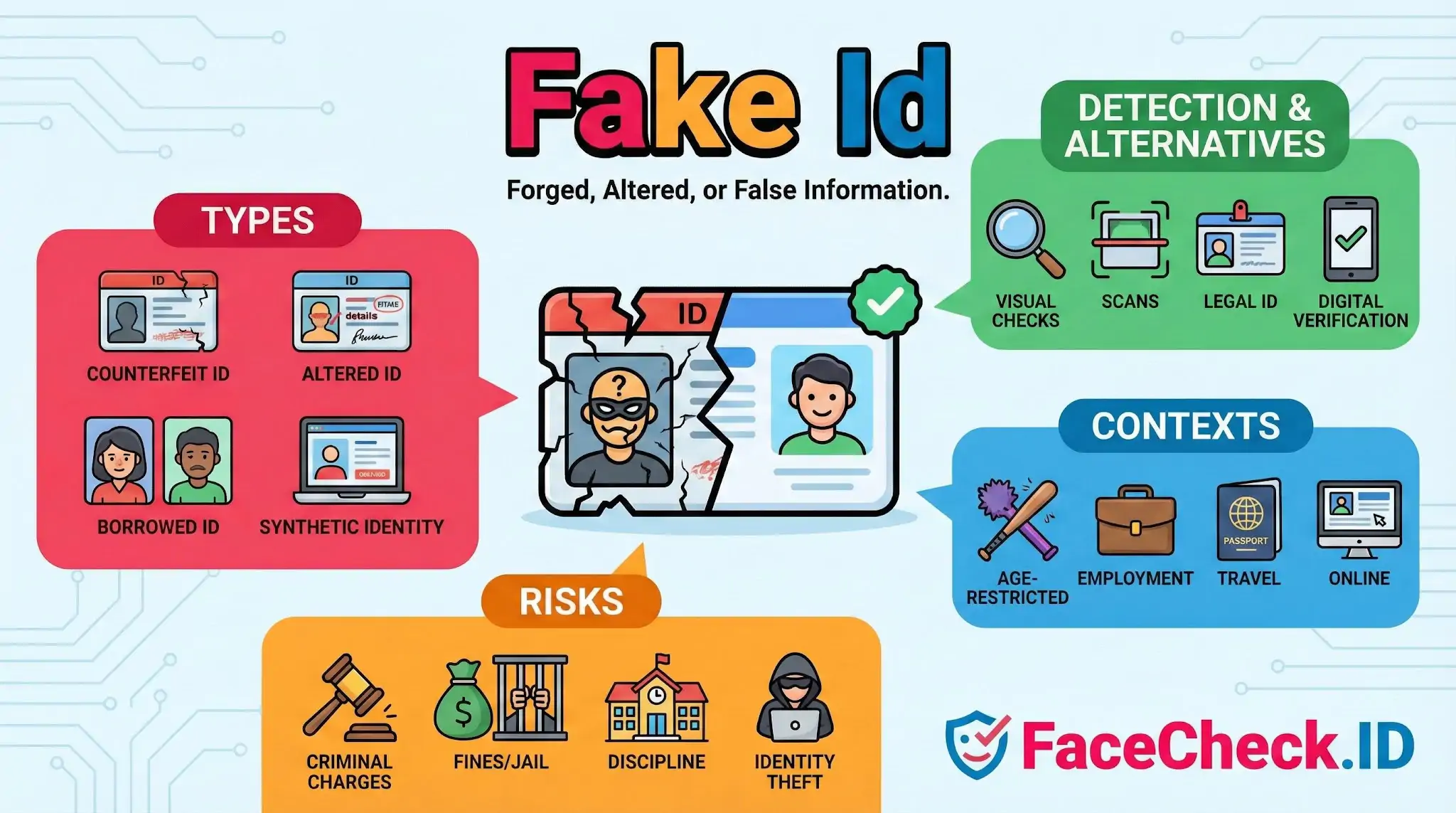
A fake Id is any identification document or fabricated identity used to misrepresent who someone is, how old they are, or where they belong. On a face-search platform, fake Ids matter less as physical cards and more as the photos attached to them, the synthetic personas built around them, and the patterns those personas leave across the public web.
How fake Ids surface in face-search results
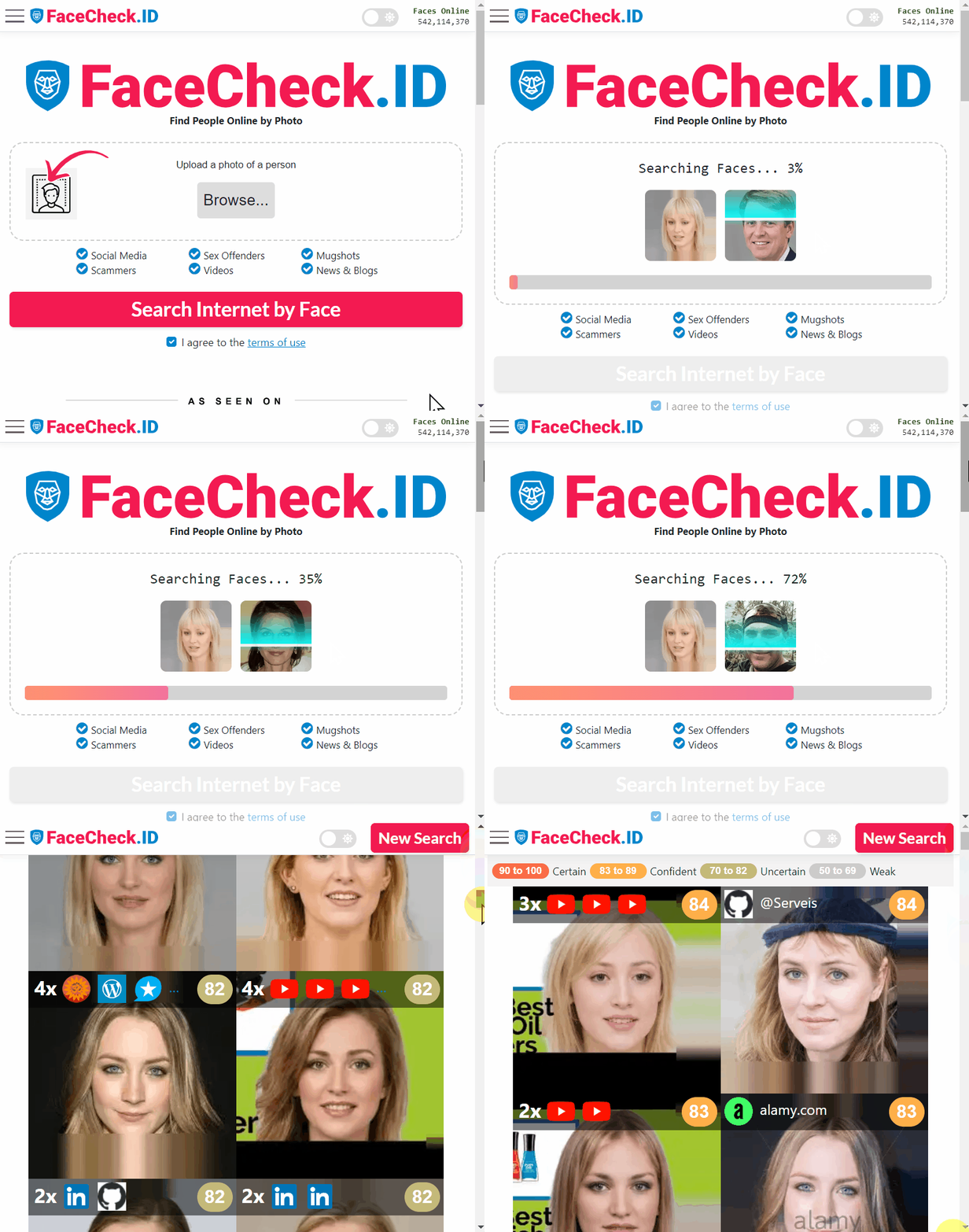
When someone runs a reverse image search on a face, the goal is usually to learn who that person actually is. Fake Ids complicate this in two directions.
In the first direction, the photo on a fake Id is often a real person's headshot pulled from social media, a stock site, or an old yearbook scan that was indexed years ago. A face search on that image can quickly reveal that the "John Smith, age 24" on the card is actually a German fitness model whose photos have been reused on dozens of profiles. Reused images are one of the strongest signals that an identity has been fabricated.
In the second direction, a fake Id can be tied to an entirely synthetic identity built across the web, with profile pictures generated by GAN models or assembled from cropped fragments of real people. These faces sometimes match poorly or inconsistently, returning hits on stock-photo collections, AI-generated face galleries, or scam-warning forums rather than ordinary social profiles.
Patterns investigators watch for
Face search is most useful when paired with context about how the image is used elsewhere online. Common signals that point to a fake Id or fabricated persona include:
- The same face appearing under multiple names, ages, or nationalities across dating apps, escort sites, or fundraising pages
- Profile photos that trace back to a real person whose verified accounts contradict the claimed identity
- Images appearing on scam-report sites, romance-scam blacklists, or anti-fraud forums
- Headshots cropped to hide jewelry, tattoos, or backgrounds that would identify the original source
- Pictures with telltale GAN artifacts such as asymmetric earrings, mismatched eye reflections, or warped backgrounds, which often return weak or fragmented matches
Why image quality on a forged document changes the search outcome
The face crop available from a fake Id often comes from a low-resolution scan, a phone photo of a card, or a poorly lit selfie. These conditions reduce match confidence in any face-recognition system. Lighting flattens facial geometry, compression blurs distinguishing features, and steep angles distort the proportions a model relies on.
A clean front-facing portrait pulled from LinkedIn or a professional headshot site will almost always produce stronger, more numerous matches than a face cropped from a counterfeit license. Investigators working from a suspect ID image sometimes get better results by searching adjacent photos from the same person rather than the ID photo itself, because reused stolen images tend to come from a small set of sources that an indexer has already seen.
Limits of using face search against fake Ids
A face search can show that a photo is reused, that an identity claim is inconsistent, or that an image originated somewhere other than where it now appears. It cannot, by itself, prove that a specific physical card is forged, that the person holding it is the impostor, or that fraud has occurred. Lookalikes are real, twins exist, and false positives appear especially with low-quality ID scans.
Legitimate identity verification still relies on document inspection, database checks, and trained human review. Face search adds a useful layer when the question is "is this person who they claim to be online" rather than "is this card authentic." Treat strong matches as leads worth confirming with other evidence, and treat weak or contradictory matches as a reason to slow down rather than a verdict. The most damaging mistake in this kind of work is assuming that a single match, or a single non-match, settles the question.
FAQ
What does “Fake ID” mean in the context of face recognition search engines?
In face recognition search engines, “Fake ID” usually refers to an identity claim that is supported by misleading or fabricated evidence—such as a stolen profile photo, an impersonation account, a mismatched name/biography, or a forged-document image circulating online. A face search can sometimes help detect photo reuse across different names, but it cannot prove someone’s real identity.
Can a face recognition search engine confirm whether someone is using a fake ID?
No. Face recognition search engines typically provide matches to visually similar faces found on indexed webpages; they do not verify government documents or authenticate a person’s legal identity. At best, results can provide leads (e.g., the same face appearing under multiple names) that you should corroborate with independent, reliable sources.
What face-search patterns can suggest a “Fake ID” situation (without proving it)?
Common higher-risk patterns include: (1) the same face appearing across many unrelated profiles with different names, locations, or ages; (2) matches that cluster around scam-report pages, repeatedly reposted “too good to be true” profile photos, or stock-model imagery; (3) the face showing up on multiple newly created accounts with minimal history; and (4) heavy use of edited, filtered, or AI-generated-looking images that produce inconsistent matches. These are signals to investigate further, not proof of wrongdoing.
How do deepfakes or AI-generated faces relate to “Fake ID” findings in face recognition search results?
Deepfakes and synthetic (AI-generated) faces can create misleading trails: a fake persona might use a synthetic face that has no real-world owner, or a deepfaked/edited face may partially resemble multiple people and produce mixed matches. If results look inconsistent, try searching with several different frames/photos, look for original sources (earliest uploads), and treat matches as tentative until corroborated.
How can FaceCheck.ID add value when investigating a possible “Fake ID” while reducing misidentification risk?
FaceCheck.ID (like other face search tools) can help you quickly check whether a profile photo appears elsewhere online under different contexts, which may reveal reuse or impersonation patterns. To reduce misidentification risk, compare multiple photos of the same person, verify matches by checking surrounding page context (dates, usernames, cross-links), and avoid treating a single high-similarity result as identity proof—use the findings only as investigative leads.