Image Forensics
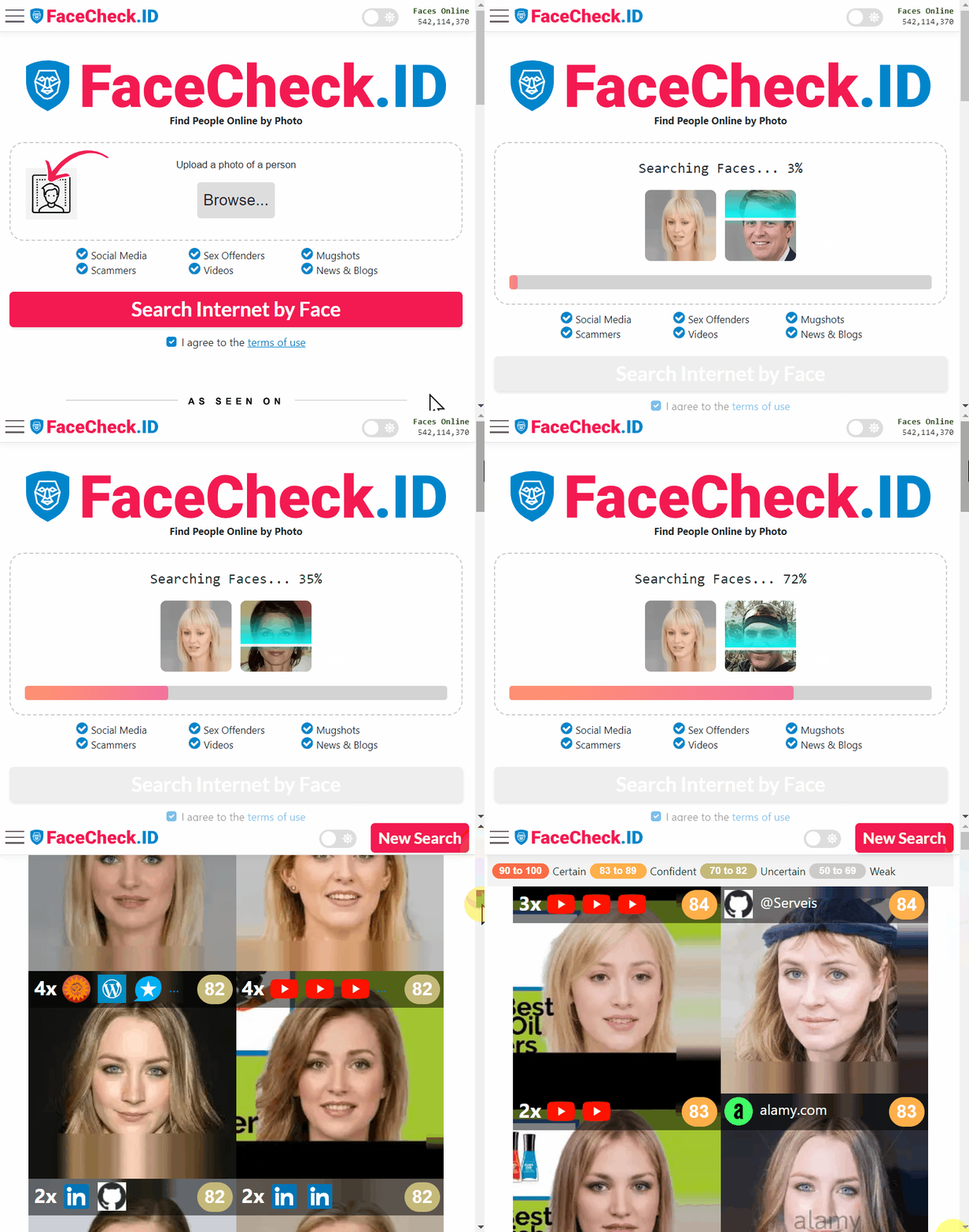
When a face-search match returns a profile photo that looks slightly off, image forensics is what helps decide whether you are looking at a real person, a recycled photo, or a generated face. For anyone interpreting FaceCheck.ID results, basic forensic awareness separates a credible identity match from a manipulated image that should not be trusted at face value.
How forensic signals shape face-search interpretation
A face-recognition match tells you that two images contain similar facial geometry. It does not tell you whether either image is authentic. Image forensics fills that gap by examining the pixels, the file structure, and the history of an image to estimate how it was produced and whether it has been altered.
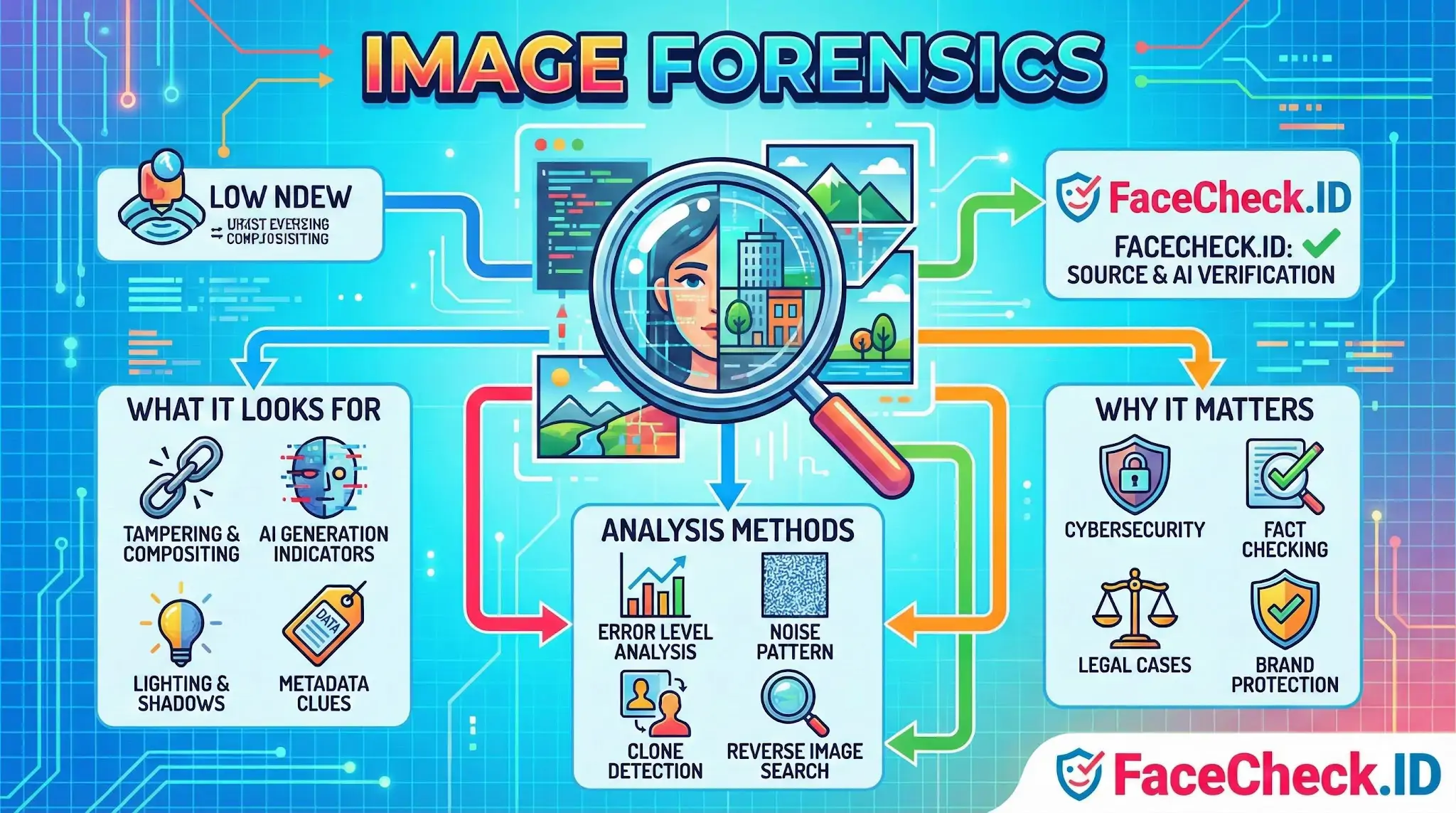
Common signals worth checking on a suspicious match include:
- Recompression patterns that suggest the photo was saved, edited, and re-saved across multiple platforms, which is normal for social media but unusual for a "fresh" photo allegedly taken yesterday.
- Cloning or splicing artifacts around the face, hairline, ears, or background, which can indicate a face was pasted onto another body.
- Lighting and shadow direction that disagrees between the face and the surrounding scene, a frequent giveaway in composite catfish photos.
- GAN and diffusion model artifacts such as warped earrings, mismatched eye reflections, irregular teeth, or background text that dissolves into noise.
- Metadata fragments in EXIF fields showing editing software, suspicious timestamps, or a camera model that does not match the claimed source.
These checks matter because reverse face-search systems index whatever is publicly visible, including manipulated images that have circulated long enough to appear on multiple sites.
Forensics applied to face-search investigations
Forensic analysis becomes useful at specific points in a typical FaceCheck workflow.
When verifying a dating profile, forensic checks help confirm whether the photos were taken by the person or pulled from a model, influencer, or stock source. Reused images often show telltale recompression and resolution drops compared to original uploads. Pairing this with reverse image search helps locate the earliest version of the photo, which is usually closer to the truth than later copies.
When evaluating a possible scam account, the question is often whether the face is a real person at all. Synthetic faces from generators tend to produce matches with low confidence and few corroborating pages, or matches only to other suspected fake accounts. Forensic indicators in the image itself, such as overly symmetric features, smooth skin texture, or distorted accessories, support a synthetic-origin hypothesis even when face matching alone is inconclusive.
When investigating reputation or impersonation cases, forensics helps determine whether a damaging photo has been edited. Splice detection and error level analysis can flag pasted faces in screenshots, doctored ID images, or fabricated "evidence" used in harassment campaigns.
Forensics and AI generated faces
Synthetic media is the area where image forensics intersects most directly with face search. A generated face will sometimes match other generated faces in a database, producing results that look meaningful but trace back to nothing real. Forensic clues that point toward generation include:
- Pupils that are slightly different shapes or reflect inconsistent light sources.
- Earrings, glasses, or collars that do not align symmetrically.
- Backgrounds with text-like shapes that are not actually readable.
- Hair edges that blend unnaturally into the background.
- Skin texture that lacks pore-level detail at high resolution.
If a face-search subject returns no matches except on accounts with similar synthetic markers, the most defensible conclusion is that the image is generated rather than that the person is private or new online.
What image forensics cannot prove
Forensic analysis narrows possibilities. It rarely produces certainty from a single image. Compression strips evidence. Screenshots discard metadata. Reuploads through social platforms re-encode files in ways that mimic editing artifacts. A photo that fails one forensic test might still be authentic, and a clean-looking image can still be a skilled forgery.
For face-search work specifically, forensics cannot tell you who someone is. It can only tell you whether the image you are searching with, or the image you found, deserves trust as a representation of a real person at a real moment. Identity conclusions still require multiple matches, consistent context across sources, and judgment about whether the surrounding pages, names, and accounts hold up to scrutiny.
FAQ
What is “Image Forensics” in the context of face recognition search engines?
Image forensics is the set of techniques used to assess whether a face photo (or a result image) is authentic, altered, or taken out of context. In face recognition search workflows, it helps you judge the trustworthiness of the query image and the matched images before treating any hit as meaningful.
What forensic signs suggest a face image may be edited, AI-generated, or face-swapped before running a face search?
Common warning signs include inconsistent lighting or shadows on the face versus the background, unnatural skin texture (over-smoothing or repeating patterns), mismatched edges around hair/ears/jawline, warped glasses or jewelry, asymmetrical reflections in eyes, and compression artifacts concentrated around the face area. These issues can cause misleading matches or “mixed identity” trails in face search results.
How can image forensics reduce false conclusions when a face search returns alarming sources (e.g., adult content, mugshots, scam reports)?
Use forensics to separate “visual similarity” from “same person.” Check whether the face region looks composited onto a different body/background, whether the image is a repost/screenshot with added text, and whether the matched page is a scraper or secondary repost site. Then corroborate with multiple independent sources (different sites, different photos, consistent biographical details) before drawing any conclusion.
What practical image-forensics checks should I do on the top matches from a face search tool (including FaceCheck.ID) before acting on them?
Verify that multiple photos on the result page show the same consistent facial features (not just one cropped headshot), look for an original-upload context (account history, timestamps, consistent usernames), and compare distinctive non-face cues (tattoos, scars, moles, hairstyle over time, location hints). Prefer primary sources over aggregators, and treat single-image matches—especially heavily edited or watermarked images—as weak evidence.
Can metadata (EXIF) or file history be relied on for image forensics in face recognition search cases?
Not reliably. EXIF and other metadata are often stripped by social platforms, altered during editing, or lost through reposting and screenshots. In face-recognition-search investigations, stronger forensic indicators usually come from visual consistency, provenance (who posted it first), cross-site corroboration, and whether the same image appears in multiple independent contexts rather than from metadata alone.