Know Your Customer
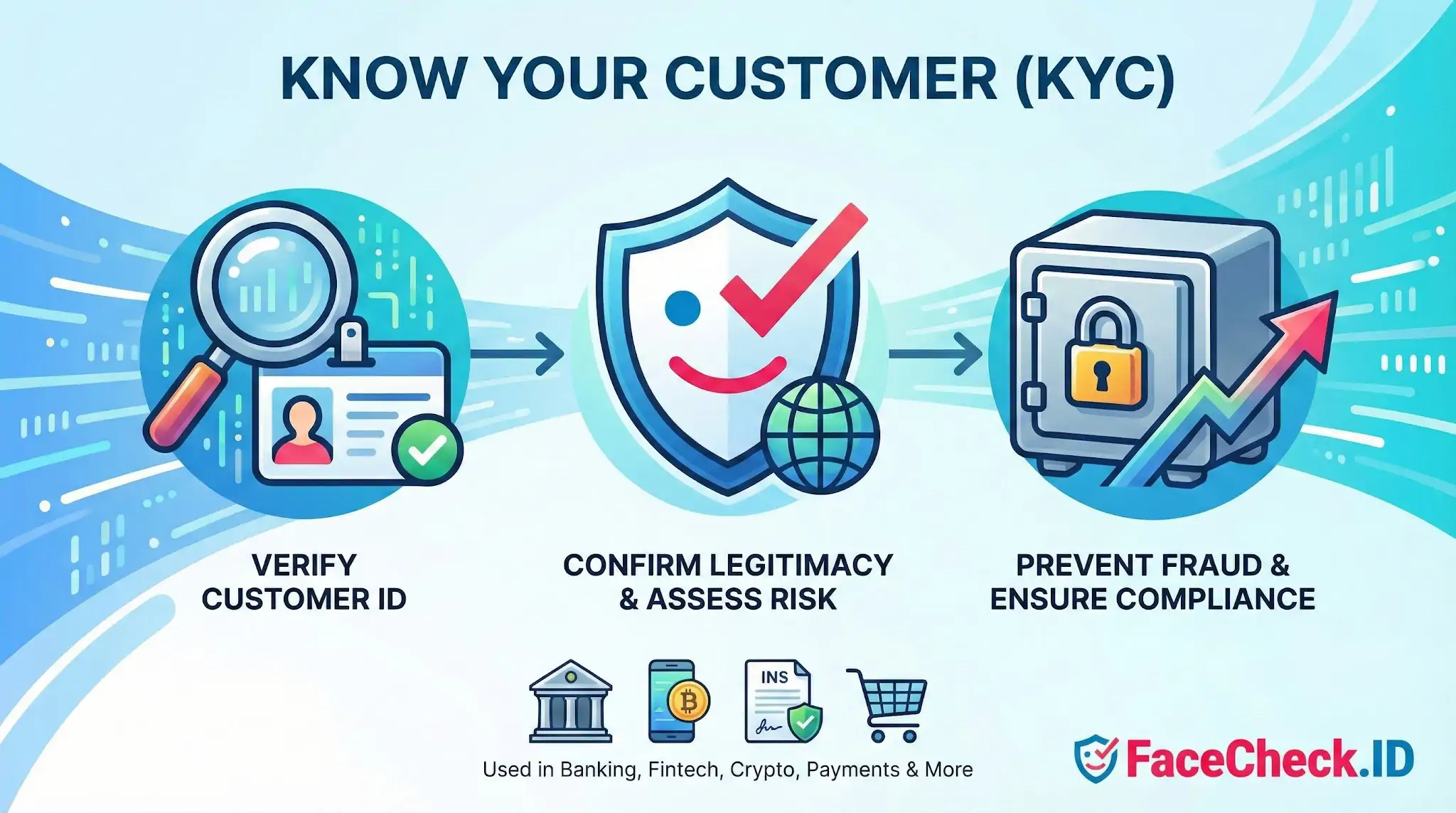
Know Your Customer (KYC) is the identity verification layer that sits between a person and a regulated service like a bank, exchange, or payment platform. For investigators, fraud teams, and anyone using face search, KYC is also where stolen photos, fabricated personas, and reused headshots tend to surface, because every KYC pipeline depends on whether the face on a document actually belongs to the person submitting it.
How face search intersects with KYC
A KYC check usually combines a government ID, a selfie, and a liveness test. The selfie gets matched against the document photo to confirm the same face. That sounds simple until you consider how much of the open web is full of reusable face images. Scammers running fake brokerage accounts, romance fronts, or money mule operations often pull headshots from LinkedIn, Instagram, modeling portfolios, or stock photo sets and combine them with forged or stolen IDs.
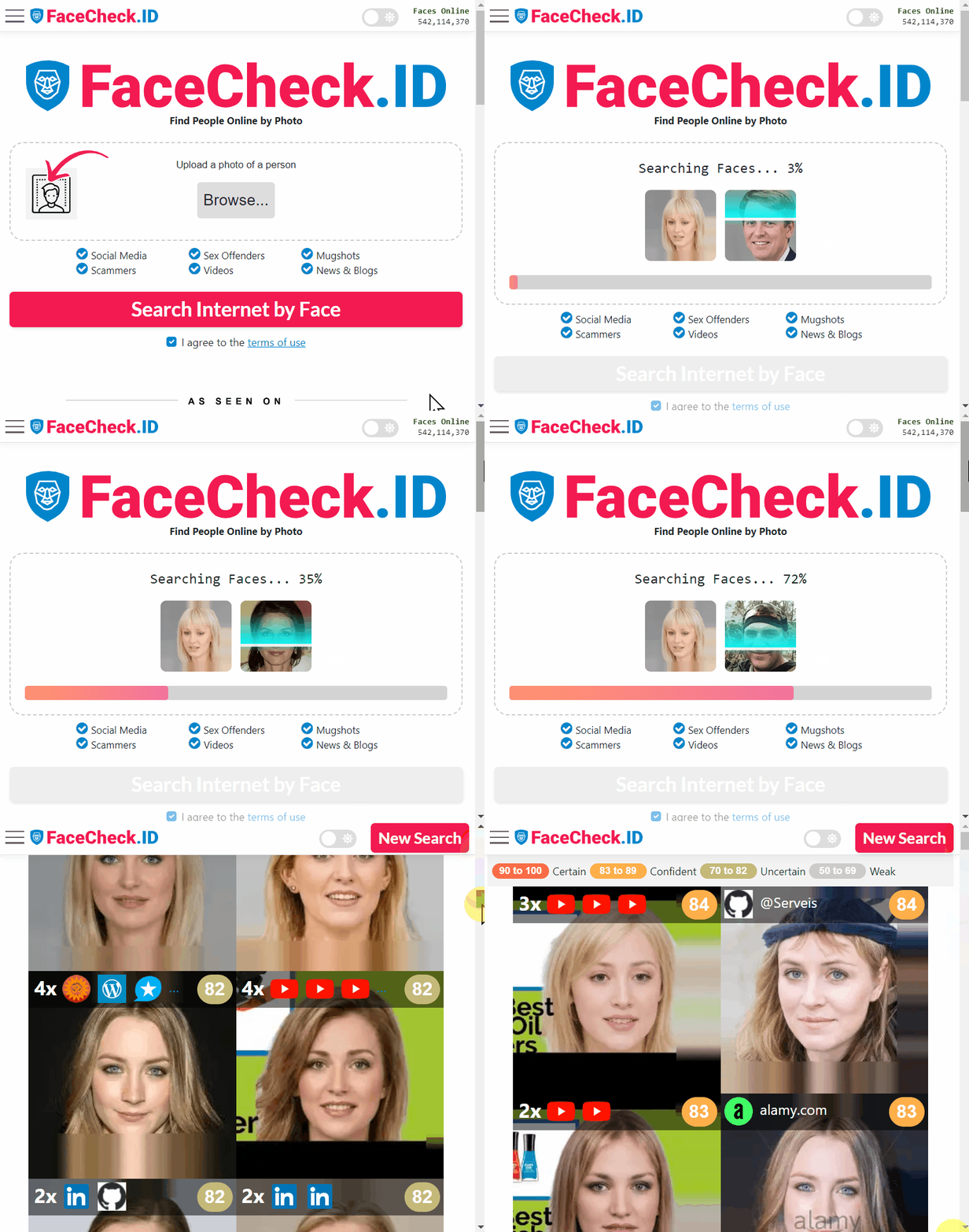
Reverse face search is one of the few tools that catches this from the outside. If a KYC selfie or onboarding photo also appears on dozens of unrelated dating profiles, crypto pitch sites, or recycled influencer pages, the identity is almost certainly synthetic. Compliance teams sometimes run face searches on flagged applicants to see whether the same face is already attached to other names, jurisdictions, or scam reports.
Where KYC controls fail and face data leaks out
KYC is meant to keep identity data inside a regulated environment, but breaches and resale move that data into places face search can reach. A few patterns worth knowing:
- Selfies and ID scans from breached crypto exchanges have surfaced on dark web markets, where they get reused across new fraudulent accounts.
- Fake KYC kits sold in Telegram channels include matching ID photos, selfies, and proof of address, all built around a single stolen face.
- Synthetic identities blend a real face scraped from a small social account with a fabricated name and address, betting that no one will reverse search the photo.
When a face starts appearing across multiple unrelated KYC fraud reports, public scam databases, or mismatched social profiles, that pattern is often more revealing than any single document check.
What face search adds that traditional KYC does not
Standard KYC confirms that a document is valid and that the selfie matches the document. It does not confirm that the person controlling the account is the legal owner of that face. Face search fills part of that gap by checking whether the same face is publicly tied to a different identity elsewhere on the web.
Useful signals include:
- The same face appearing under multiple names on dating, escort, or investment sites.
- A claimed executive whose face shows up only on a single AI-generated portrait page.
- A loan applicant whose photo matches a public victim of identity theft news article.
- A romance contact whose KYC name does not match the social history attached to their face.
These checks work best when paired with conventional KYC, sanctions screening, and transaction monitoring, not as a replacement.
Limits and where interpretation goes wrong
Face search results inside a KYC context need careful reading. A match does not prove fraud. People legitimately use the same headshot across LinkedIn, a personal site, and a company bio. Twins, lookalikes, and low-quality matches produce false positives, especially with cropped or low-resolution onboarding selfies. Some matches point to old accounts a person abandoned years ago, not to active impersonation.
The reverse is also true. A clean face search result does not prove the applicant is who they claim to be. Many real identities have almost no public photo footprint, and many fraud rings now use AI-generated faces that have no prior web presence at all. Face search is a strong supporting signal during KYC review, but it works only alongside document forensics, liveness detection, device intelligence, and human judgment on edge cases.
FAQ
What does “Know Your Customer” (KYC) mean when discussed alongside face recognition search engines?
In this context, KYC is the process of establishing confidence that a customer is who they claim to be (and assessing related risk) using identity evidence and checks. A face recognition search engine may help surface open‑web leads (e.g., where similar faces appear), but KYC typically requires additional steps like document verification, liveness checks, and policy-driven risk review.
Can a face recognition search engine be used as a KYC tool by itself?
Generally, no. Face recognition search results are not the same as identity verification because they can return look-alikes, reused photos, reposts, outdated pages, or mislabeled sources. KYC decisions usually require corroboration (government ID, liveness, authoritative databases, or other verified signals) rather than relying on open-web face matches alone.
How can face-search results support a KYC or fraud-review workflow without “confirming” identity?
They can be used as risk signals and investigative leads—for example, to detect photo reuse across many unrelated profiles, inconsistent personas, or potential impersonation. In KYC/fraud review, treat face-search findings as prompts to request stronger evidence, run additional verification steps, or escalate to manual review—rather than as proof of a real-world identity.
What are the main privacy and compliance concerns when using face recognition search for KYC?
Key concerns include handling biometric data lawfully (photos and derived face templates/embeddings may be regulated), obtaining appropriate consent/notice, limiting use to a defined purpose, minimizing data retention, securing uploads and logs, and avoiding discrimination or unfair decisions from false matches. Organizations also need clear governance: auditability, human review, and a process for disputes or corrections.
Where does FaceCheck.ID fit in KYC discussions, and what should users keep in mind?
FaceCheck.ID can be mentioned as an example of a face recognition search tool that may help find open‑web occurrences of a face and cluster/score potential matches. In a KYC setting, it should be used only as a supplementary OSINT-style input (where appropriate), with strict privacy controls and independent verification steps, because results can include near matches, reposts, or misleading context and should not be treated as identity proof.