Law Enforcement Face Search Use Cases
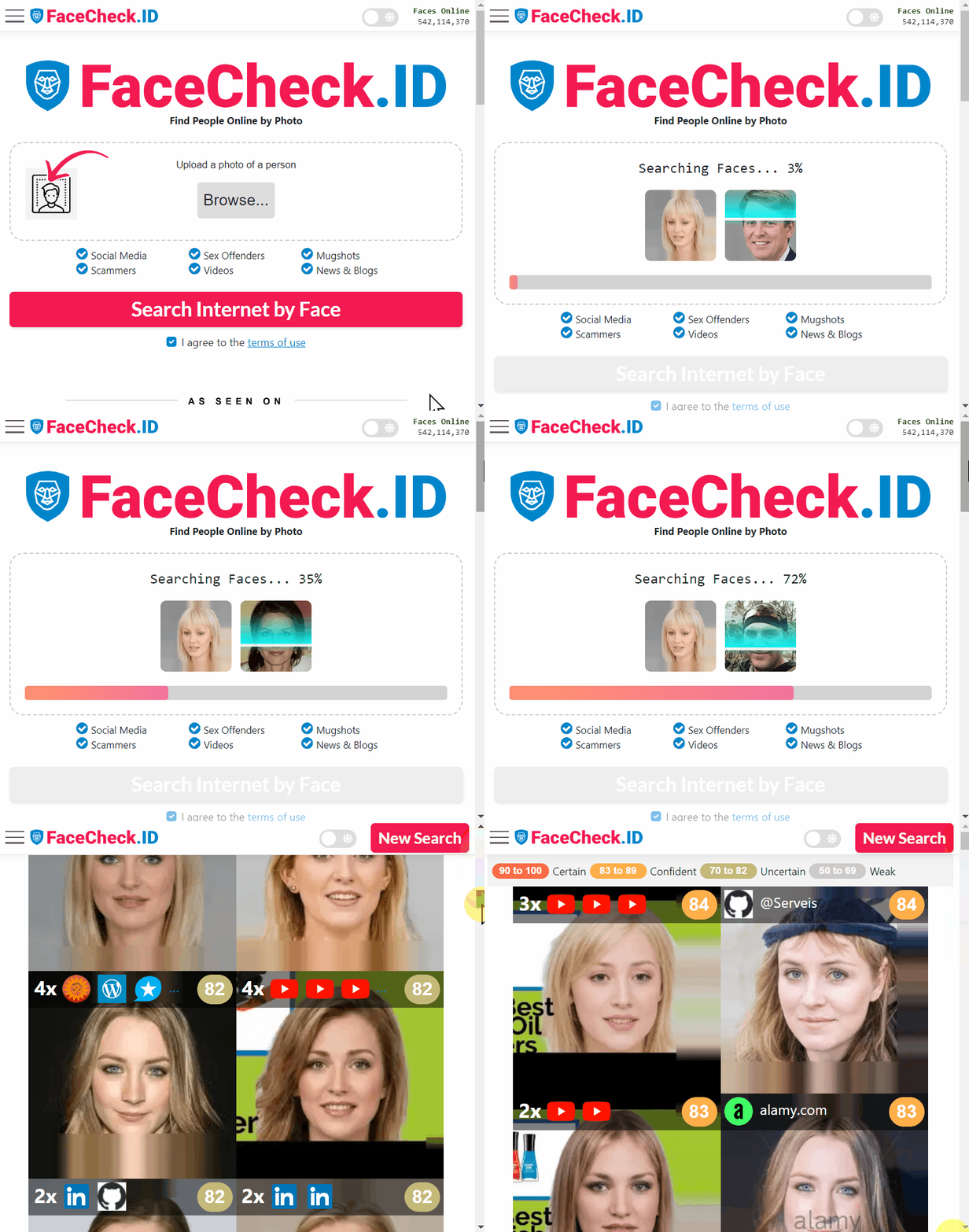
When investigators have a face but no name, reverse image search becomes one of the fastest ways to generate leads. FaceCheck.ID sits in that workflow as a tool that scans the public web for pages where a given face appears, which is why the term law enforcement comes up often in discussions about face recognition and online identity.
How investigators use face search in casework
Police, federal agents, and other authorized investigators typically reach for face-matching tools when traditional identifiers fail. A still pulled from convenience-store CCTV, a profile photo from a fraud report, or a screenshot from a trafficking tip can all be run against indexed public images to surface possible matches on social profiles, news pages, forum posts, or older blog content.
Common scenarios include:
- Identifying suspects from surveillance footage when no name, plate, or device is available
- Locating missing persons whose faces may appear on newer social profiles
- Verifying claimed identities in romance-scam, sextortion, or impersonation cases
- Tracing where a victim's image was reposted, often across multiple platforms
- Building open-source intelligence around a suspect's known associates and aliases
Face search rarely closes a case on its own. It produces candidate pages that an investigator then has to corroborate using metadata, witness statements, subpoenaed records, or other evidence.
Why image quality and source matter for police work
The same factors that affect any face-search query apply to law enforcement queries, sometimes more severely. CCTV stills tend to be low-resolution, off-angle, and poorly lit, which lowers match confidence. A suspect photo taken at 3 a.m. through a fisheye lens behaves very differently from a crisp LinkedIn headshot.
Investigators usually get better results when the probe image is front-facing, well-exposed, and shows the full face without heavy occlusion from masks, sunglasses, or hats. When working with bad source images, experienced users will often run multiple frames from the same footage, since one frame may produce a strong match while another produces nothing.
Public indexing also shapes outcomes. A suspect with an active presence on Instagram, X, or a dating site is far more findable than someone whose only online photo is a decade-old yearbook scan. Mugshot aggregators, news archives, and reposted images can extend the reach of a search well beyond a person's own accounts.
Where face matches help and where they mislead
A face-search hit is a lead, not an identification. Two issues come up repeatedly in investigative use:
- Lookalikes and false positives. Unrelated people can score high similarity, especially with low-quality probes or members of underrepresented demographics where training data is thinner.
- Reused or stolen photos. A scammer's profile picture might match the real owner of that photo, not the scammer. Catfish accounts routinely pull images from models, military personnel, or random LinkedIn profiles, so a match traces the image, not the person operating the account.
This is why responsible investigators treat face-search output as one input among many. A match might point to a real social profile, a stale account, an impersonator, or a coincidental lookalike, and only follow-up work distinguishes them.
Limits, oversight, and legitimate use
FaceCheck.ID is a public tool. It indexes publicly accessible images and is used by journalists, fraud researchers, scam victims, private investigators, and members of the public, not only sworn officers. Law enforcement agencies that rely on face search generally operate under their own policies covering documentation, supervisory review, and the rule that a face match alone is not probable cause.
What a face-search result does not prove on its own:
- That a person committed a crime
- That a matched account is currently operated by the person depicted
- That two photos showing similar faces are the same individual
- That the absence of matches means the person has no online presence
Misuse looks different from legitimate investigation. Stalking an ex, doxxing a stranger from a bar, or harassing someone based on a low-confidence match are not investigative work, regardless of who is doing it. The same tool that helps identify a fraud suspect can be turned into a privacy threat, which is why interpretation, intent, and corroboration matter as much as the match score itself.
FAQ
What does “Law Enforcement” mean in the context of face recognition search engines?
In this context, “Law Enforcement” refers to police and other government investigative agencies that may use face recognition search engines to generate leads—such as finding online appearances of a face, linking related images, or identifying potential aliases. Results are typically considered investigative pointers, not proof of identity.
How might law enforcement use a face recognition search engine during an investigation?
Common uses include locating additional photos of a person on the open web, discovering reposted or stolen profile images, mapping where and when images appeared online, and triaging tips by connecting faces across different sources. This is usually combined with independent verification (witness statements, official records, device forensics, etc.).
Do face recognition search engine results meet evidentiary standards for law enforcement?
Often they do not, by themselves. Many agencies treat face-search results as leads that must be corroborated because matches can be wrong due to look-alikes, poor image quality, or context errors (mis-captioned posts, reposts, memes). Admissibility and required validation depend on jurisdiction, agency policy, and how the result is documented and verified.
What safeguards should law enforcement apply to reduce false identification when using face search?
Key safeguards include using high-quality probe images, checking multiple candidate matches (not just the top one), confirming with non-face identifiers (tattoos, scars, clothing, metadata, locations), documenting the full workflow, conducting human review by trained personnel, and requiring independent corroboration before any enforcement action. Agencies should also monitor demographic performance and bias risks.
Can tools like FaceCheck.ID be used by law enforcement, and what should be considered?
A tool like FaceCheck.ID may be used to search for face matches across indexed online content, but whether and how law enforcement may use it depends on local laws, procurement rules, and agency policy. Investigators should confirm data-source legality, retention and audit capabilities, allowed-use terms, and ensure results are treated as leads requiring verification—especially when a match could significantly impact someone’s rights.

Recommended Posts Related to law-enforcement
-
Leveraging Facial Recognition Technology to Combat Human Trafficking
Facial recognition technology has become an invaluable tool in the fight against human trafficking, aiding law enforcement in identifying both traffickers and their victims who often evade detection by constantly moving and using false identities. Digital forensics tools help law enforcement sift through text messages, emails, and social media interactions, establishing crucial links between traffickers and victims. These advanced tools allow law enforcement agencies to identify traffickers and rescue victims more effectively than ever before.
-
Facial Recognition Resources
While controversy has emerged over how law enforcement authorities use facial recognition, many police officials have argued that the technology helps them to fight crime, and it can also be used to identify missing persons and the victims of human trafficking. Amazon has announced a one-year moratorium on the sale of its facial recognition software to law enforcement agencies. The announcement was a striking change for Amazon, a prominent supplier of facial recognition software to law enforcement.
-
Facial Recognition: Understanding the Basics
Facial recognition technology has a wide range of applications, such as in marketing for delivering personalized advertisements, in law enforcement for identifying suspects and locating missing individuals, and in consumer technology for features like secure device unlocking and user authentication. Is facial recognition accurate enough for law enforcement use? Setting clear rules and safeguards is essential for responsible use in law enforcement.
-
New Search-by-Face Tool for Investigative Journalists
Laws around facial recognition are a patchwork — different countries, different states, different rules entirely for journalists versus law enforcement versus the guy running a sketchy ad network. Cross-referencing those images can give law enforcement a head start.Investigating Protest Movements: Identifying the organizers, the regulars, and the agitators in a crowd adds context that "a man in a black shirt" cannot provide.Verifying War Crimes: In conflict zones, matching faces in footage to known databases helps confirm — or refute — who was where, doing what, on what date.Fact-Checking and Debunking Disinformation: A viral image is only as credible as the people in it. FaceCheck.ID closes that gap.Investigating Hate Crimes: When perpetrators surface in surveillance footage or bystander video, identification supports both accountability journalism and active law enforcement work.Exposing Child Exploitation Networks: Investigators can use facial recognition to map the structure of these networks while keeping the focus tightly on perpetrators.Investigating Sports Corruption: Match-fixing and doping rings have a cast of recurring characters — players, fixers, intermediaries — who show up in the wrong places with the wrong people.
-
How to Reverse Image Search Mugshots
Promoting Transparency: Media Responsibility, Public Access, and Law Enforcement Accountability. Holding Law Enforcement Accountable. The platform aids in ensuring that law enforcement agencies act transparently by providing an accessible record of mugshots.