Lip-Sync Deepfake
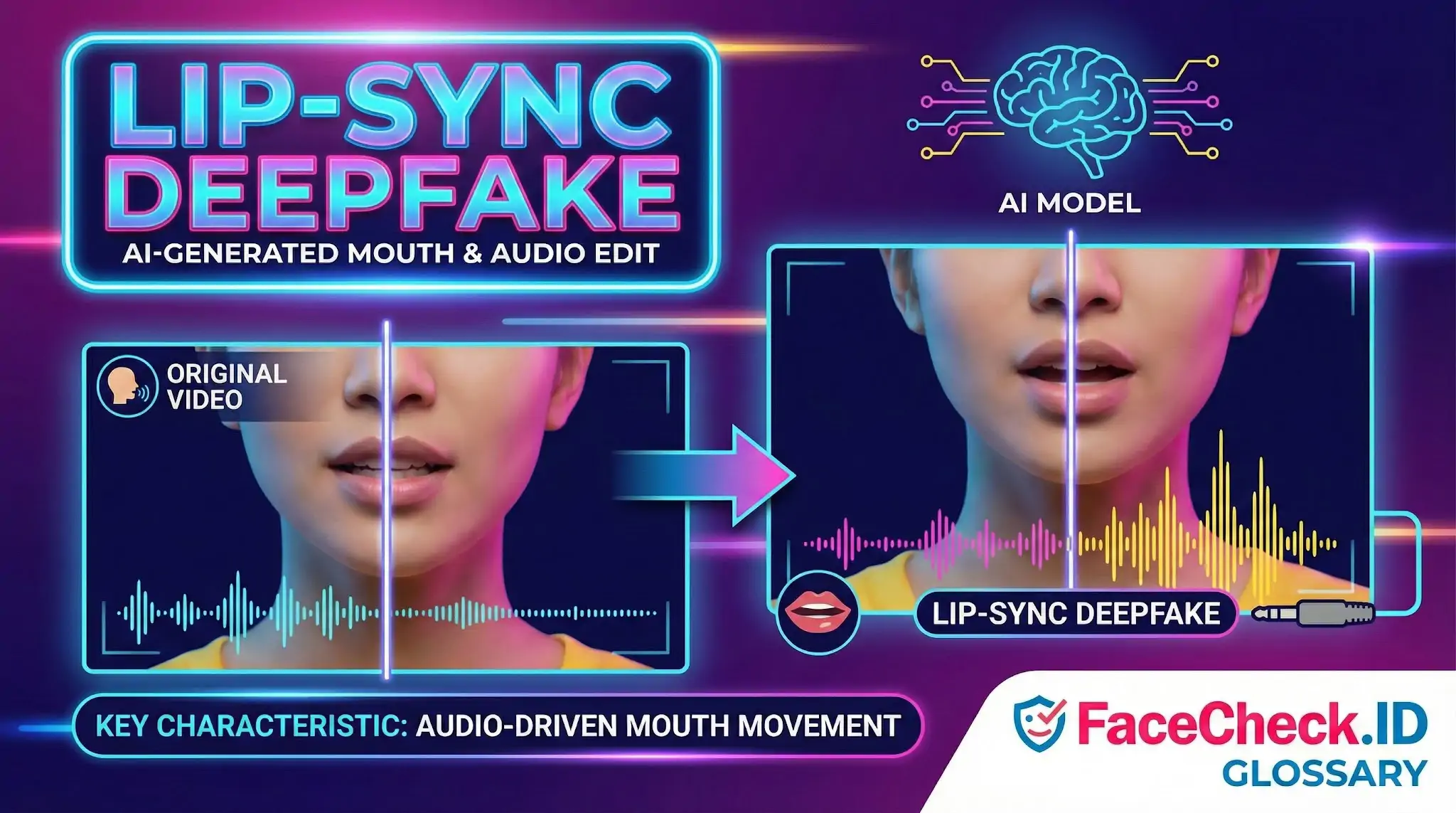
A lip-sync deepfake is a manipulated video where a real person's mouth and lower face are altered so they appear to say words they never spoke. For anyone running a face search on a suspicious clip or profile photo, these fakes complicate identity verification because the face is genuine, the identity is real, but the speech is fabricated.
How lip-sync deepfakes interact with reverse face search
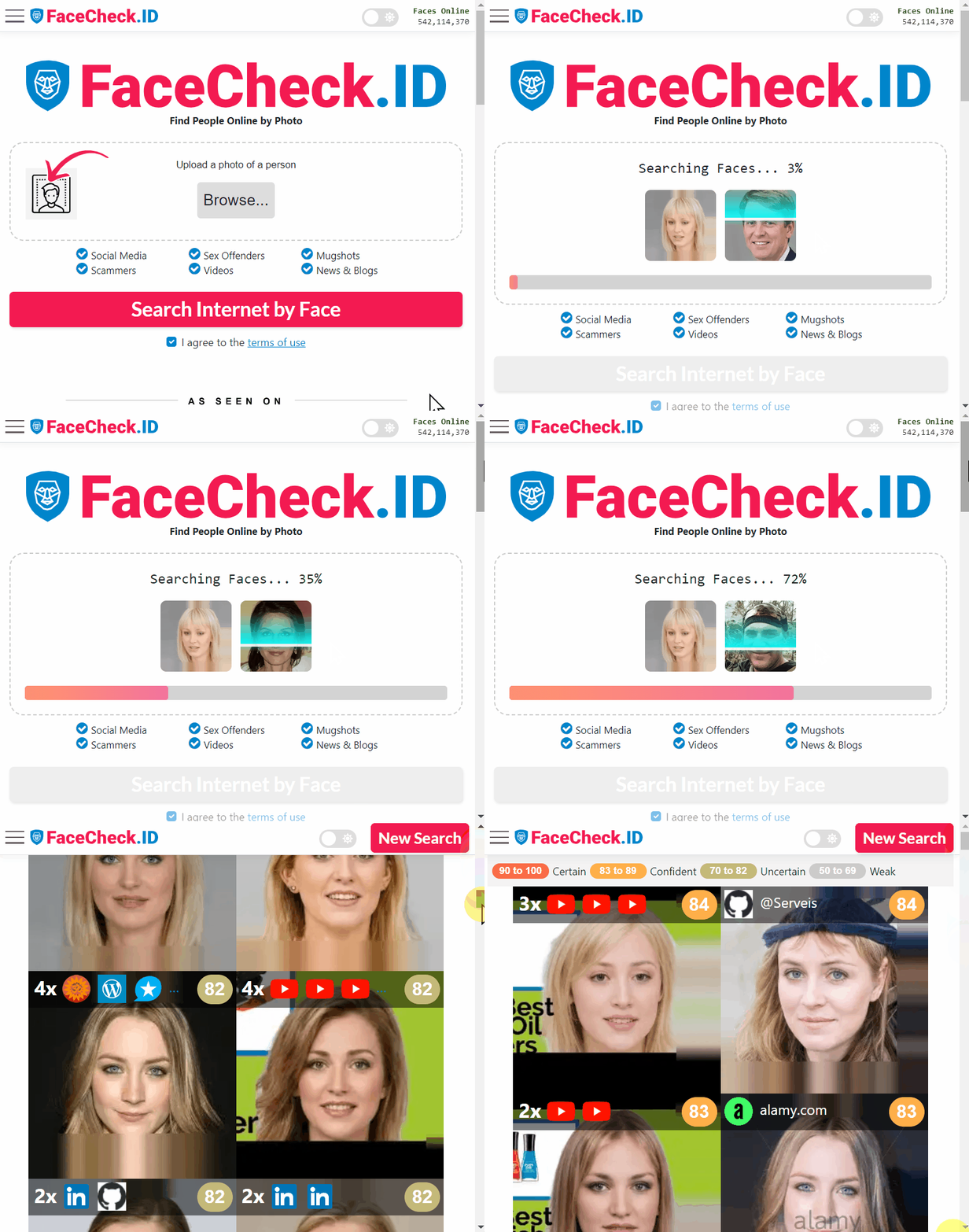
Face-recognition engines like FaceCheck.ID match faces, not voices or mouth movement. That means a lip-synced video of a public figure or private individual will still produce accurate identity matches, since the underlying face geometry is preserved. Pulling a still frame from the clip and running it through reverse image search will often return the original, unaltered source video alongside the manipulated copy.
This is useful for investigators. If a circulating "interview" or "endorsement" video shows someone making an unusual statement, capturing a frame and searching it can:
- Surface the original footage the deepfake was built from
- Reveal whether the same face appears across legitimate news sources saying something entirely different
- Show timestamps and contexts that contradict the manipulated version
- Identify people whose likenesses are being reused in scam ad campaigns
The face search itself does not detect the fakery. It detects the person, which then lets you compare the suspicious clip against authentic appearances of that face online.
Why lip-sync fakes are harder to catch than face swaps
Face swaps replace identity entirely, and they often leave seams along the jaw, hairline, or ears that show up clearly in still frames. Lip-sync deepfakes are narrower edits, usually confined to the mouth region, so the rest of the frame is untouched real footage. A reverse image search on a frame from a face-swapped video may return no matches because the composite identity does not exist anywhere else online. A frame from a lip-sync deepfake will often return many matches, because the face is real and likely already indexed.
Visual artifacts to look for in the clip itself:
- Teeth that smear, duplicate, or change shape between frames
- Lip edges that shimmer or warp, especially during plosives like p, b, and m
- Tongue movement that looks painted on rather than physical
- A mouth region with slightly different lighting or skin texture than the cheeks
- Facial emotion that stays flat while the words convey strong feeling
Bilabial sounds and labiodental sounds (f, v) are especially difficult for these models. Frame-by-frame review of those phonemes often exposes the edit.
Common scenarios where face search helps
Lip-sync deepfakes show up in fake celebrity endorsements for crypto schemes, fabricated political statements, romance scam videos where a stolen identity appears to "talk" to the victim, and harassment campaigns built around real people's faces. In each case, the face is genuine and traceable.
Running the face through FaceCheck.ID can confirm whether the person in the clip is who they claim to be, locate their authentic public profiles for comparison, and surface other instances where the same face has been reused, sometimes in unrelated scams. A romance scammer who lip-syncs over a stranger's vacation video will still leave that stranger's real social profiles indexed and findable.
What face search cannot resolve
Identifying the person in a lip-sync deepfake does not prove the video is fake. It only proves the face exists and has an online presence. The reverse is also true: a clean face match to a real public figure does not mean the audio or the statement is authentic.
Confirming a deepfake usually requires comparing the suspect clip against verified original footage, checking the source channel, looking for forensic artifacts in the mouth region, and considering context such as where the video was first posted and who benefits from it. Face search is one input. It tells you who is on screen. The harder question, whether they actually said what you are hearing, still requires human judgment and corroborating evidence.
FAQ
What is a “Lip-Sync Deepfake” and how does it differ from a face-swap when using a face recognition search engine?
A Lip-Sync Deepfake is manipulated media where a person’s mouth movements (and sometimes facial expressions) are altered to match different audio or speech, while much of the rest of the face may remain the same. A face-swap replaces one person’s face with another. For face recognition search engines, lip-sync edits can still disrupt matching because the mouth region is part of the facial features used in a face embedding—so even if it “looks like the same person,” the algorithm may treat it as a weaker or different match.
Can a lip-sync deepfake cause a face recognition search engine to match the wrong person?
Yes. Lip-sync deepfakes can shift key facial cues around the mouth, jawline, and cheeks, which may change the face embedding enough to produce near-matches to other people (or reduce matches to the real person). This can create misleading results, especially if the video frame is low-resolution, heavily compressed, or captured mid-expression.
If I upload a screenshot from a lip-sync deepfake video, what kind of results should I expect from a face search tool?
Expect more uncertainty than with a clean, original photo: fewer strong same-person hits, more “similar-looking” results, or mixed results across multiple identities. The best practice is to extract several frames (neutral expression, straight-on, sharp) and compare results across them, treating outputs as leads rather than confirmation.
How can I reduce misidentification risk when a lip-sync deepfake might be involved in face recognition search results?
Use multiple frames and prioritize neutral, high-quality ones; crop to include the full face (not just the mouth); compare results across different images of the same subject; and validate matches using non-face context (original posting source, timeline consistency, accompanying usernames, and other corroborating evidence). Avoid concluding identity from a single deepfake-derived frame.
How does FaceCheck.ID add value when investigating a suspected lip-sync deepfake, and what should I watch out for?
FaceCheck.ID can help by finding other occurrences of the same or similar face across indexed web sources, which may reveal whether the face appears elsewhere in a more natural photo or in different contexts. Watch out for over-trusting a top match if the input image is a manipulated video frame—use multiple frames, compare match consistency, and verify via the linked source pages before making any real-world decision.