Media Authenticity
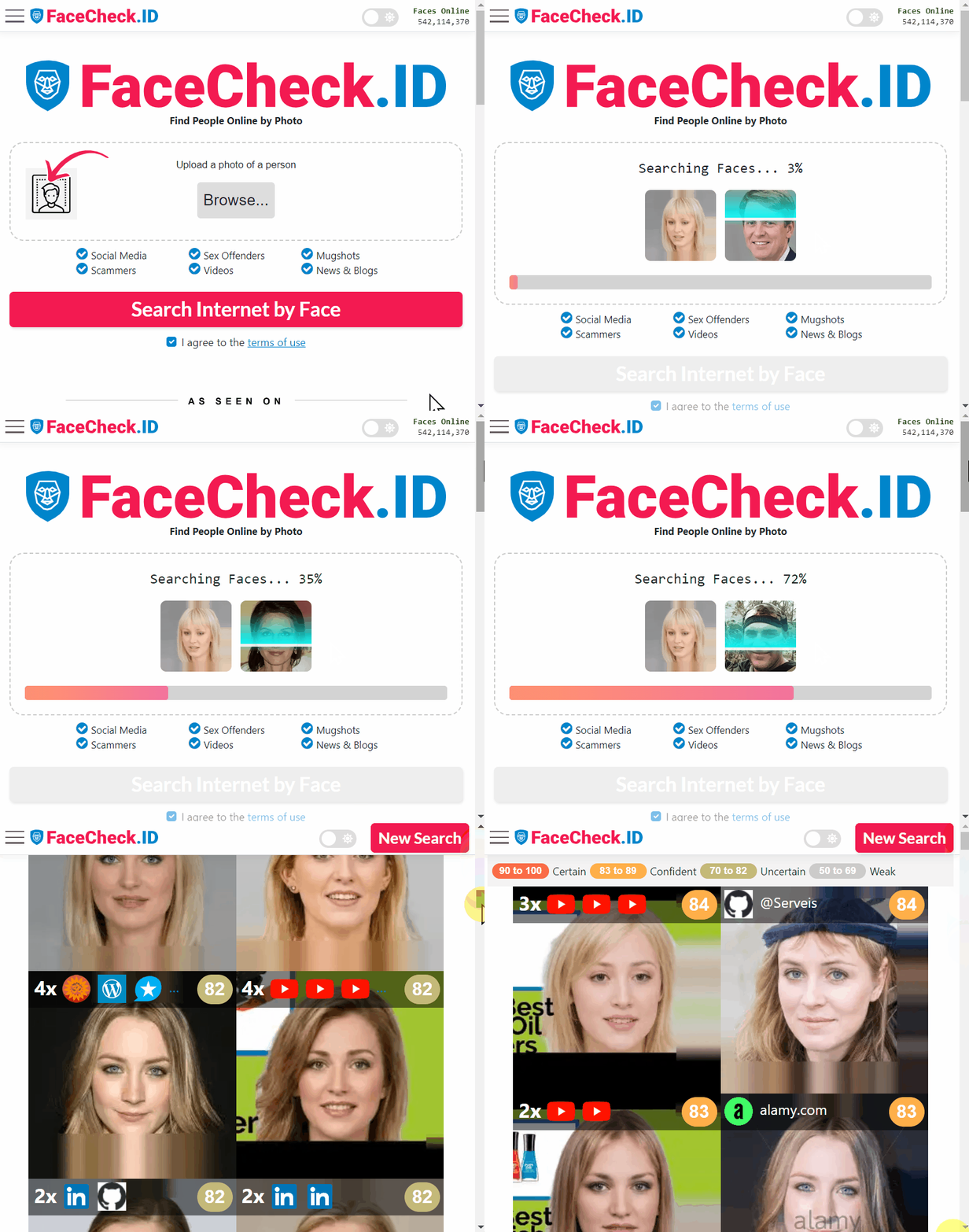
When a face-search result surfaces a photo, the next question is almost always whether that image can be trusted. Media authenticity is the discipline of deciding whether a photo, video, or audio clip is what it claims to be, and it sits at the center of every serious investigation that starts with a face match.
Why authenticity matters when interpreting face-search hits
A reverse face search returns pages where a face appears, but it does not tell you whether each image is genuine, edited, or synthetic. Someone running a romance scam may use a stolen LinkedIn headshot pasted onto a fake dating profile. A harassment campaign might attach a real face to a fabricated event photo. A deepfake video of a public figure can spread across blogs and forums, producing dozens of "matches" that all trace back to the same manipulated source.
Treating every hit as equally real leads to bad conclusions. A face-match result is a starting point. Authenticity assessment is what turns that result into evidence.
Practical questions to ask about each match:
- Is this the original posting of the image, or a downstream copy?
- Has the photo been cropped, color-shifted, or face-swapped?
- Does the surrounding page context match the apparent age of the photo?
- Is the account that posted it consistent with the person depicted?
Threats to authenticity that affect face search
Several patterns regularly distort face-search results:
- Stolen photos on fake profiles. A real face shows up on accounts the actual person never created. The image is genuine, but the identity claim attached to it is not.
- AI-generated faces presented as real people. Synthetic portraits from diffusion models can be indexed across the web and produce false leads in lookalike searches.
- Deepfake video frames. A single manipulated clip can produce many indexed thumbnails, inflating the appearance of corroboration.
- Reposted images with wrong dates or captions. The face is real, the photo is real, but the attached story is fabricated.
- Heavy compression and re-encoding. Repeated reposts strip metadata and soften the artifacts that forensic tools rely on.
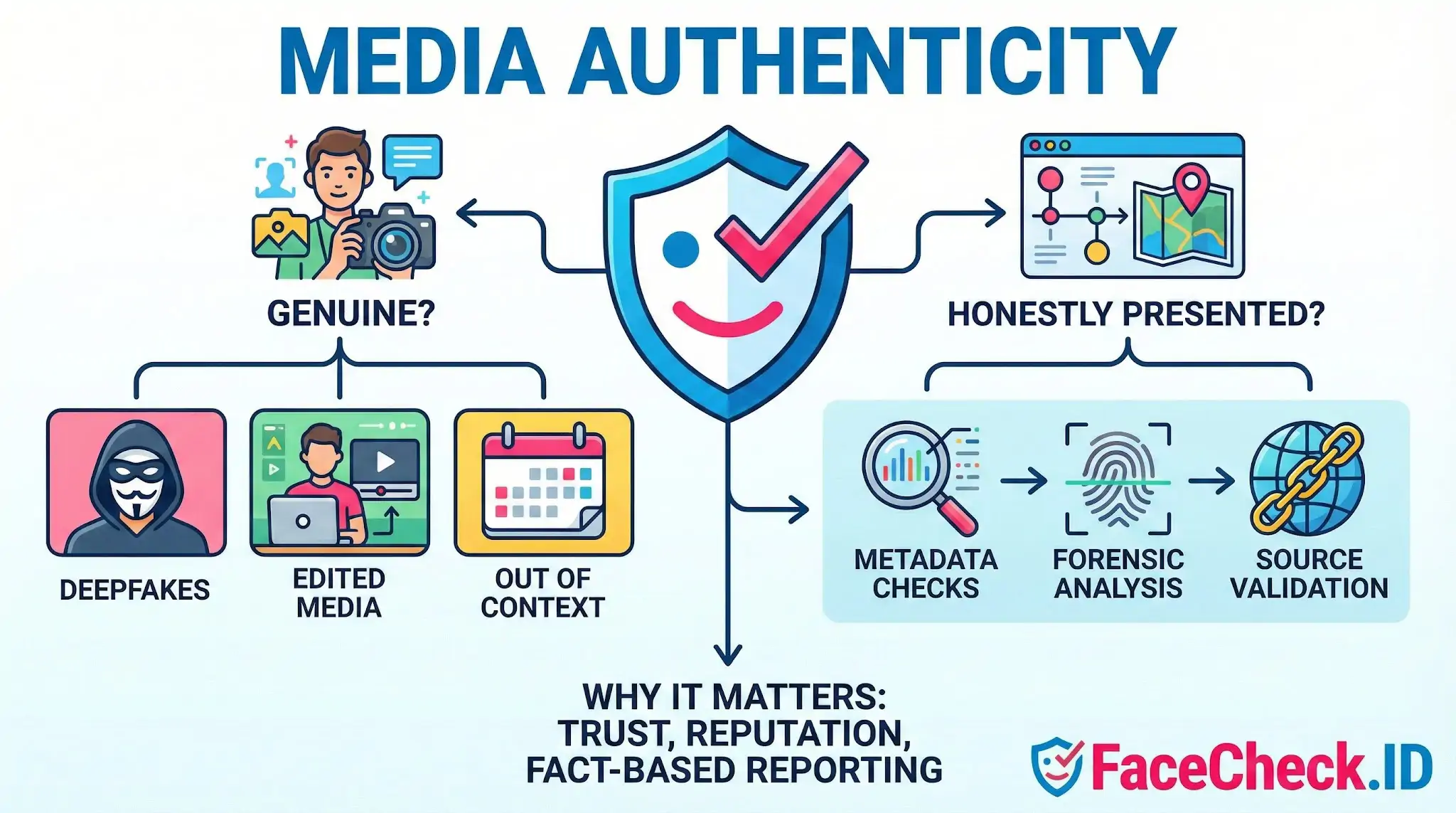
How authenticity is checked alongside a face match
Investigators usually layer several techniques rather than trusting one signal.
Provenance and metadata. EXIF data, capture device, and upload timestamps can sometimes be recovered, though most social platforms strip this information. Where Content Credentials or C2PA signatures exist, they show capture and edit history, but coverage is still thin.
Source tracing. Reverse image search can locate the earliest indexed copy of a photo. If the oldest version sits on a stock site, an unrelated person's old social account, or a known scam database, the current use is suspect.
Forensic indicators. Inconsistent lighting across a face and its background, mismatched skin texture, warped earrings or glasses, and unnatural blink or mouth movement in video are common signs of manipulation. AI-generated faces often show subtle errors in teeth, ear shape, or hairline edges.
Cross-reference with face matches. If FaceCheck.ID surfaces the same face on a verified news article from years earlier, a current dating profile claiming a different name becomes much harder to defend.
What authenticity checks cannot prove
Authenticity work has real limits, and overstating its results is its own failure mode.
A photo can be technically authentic, with intact metadata and no editing, while still being used to deceive. The reverse also holds: a heavily compressed or edited image is not automatically fake, since normal sharing pipelines re-encode everything.
Face-search matches plus authenticity signals can establish that a particular face appears across particular pages. They do not prove who controls those accounts, who took the original photo, or whether the person depicted consented to its use. Lookalike faces, twins, and high-confidence false positives still occur, especially with low-resolution or partially occluded images.
The honest standard is convergence. When provenance, forensic analysis, source history, and face-match results all point the same direction, confidence is reasonable. When they conflict, the right answer is usually to keep investigating rather than to publish, accuse, or act.
FAQ
What does “Media Authenticity” mean in the context of face recognition search engines?
Media Authenticity refers to whether the photo or video frame you search (and the matching results you review) are genuine, unmanipulated representations of a real person and context—rather than AI-generated, face-swapped, heavily edited, mislabeled, or taken from a different time/place than implied. In face recognition search, authenticity is about validating both the source media and the claims people attach to it.
Why does Media Authenticity matter when using a face recognition search engine like FaceCheck.ID?
Because face search tools typically match visual facial features, not truth. A convincing deepfake, face swap, or mislabeled repost can produce highly plausible matches and lead you to the wrong conclusion about who is shown, where the image came from, or what it “proves.” Treat results from FaceCheck.ID (or any face search engine) as investigative leads that require independent verification of the media and the linked pages.
What are common signs that a face-search query image or result page may be inauthentic or misleading?
Common red flags include: inconsistent facial details across versions of the same image (ear shape, teeth, moles), unnatural skin texture or lighting, distorted accessories (glasses/jewelry), mismatched reflections, warped backgrounds near the face, repeated “too perfect” portraits, abrupt changes in age/appearance across posts without explanation, and pages that reuse the same face across many unrelated names or stories. Also treat screenshots, memes, and repost aggregators as higher-risk sources than original uploads.
How can I evaluate Media Authenticity after I get face recognition search results?
Use a verification workflow: (1) open multiple top results and look for an original source (earliest post, creator profile, or primary publisher); (2) compare several images of the person from independent sources, not just reposts; (3) check context signals on the page (date, location, account history, captions, and whether other photos on the account match the same person); (4) cross-check with a traditional reverse image search for near-duplicate crops and repost trails; and (5) if stakes are high, assume manipulation is possible and seek corroboration beyond imagery (e.g., official statements, direct contact, or trusted records).
Can authentic media still produce confusing face-search matches, and what should I do?
Yes. Even authentic photos can yield misleading matches due to look-alikes, low-quality images, extreme angles, makeup, lighting, or partial occlusion. If results are mixed, rerun the search with a clearer, front-facing image, avoid heavily filtered screenshots, and prioritize matches that have consistent identity signals across multiple independent pages. Use FaceCheck.ID-style similarity as a starting point, then confirm by checking whether the same identity appears consistently across different sources and dates.