Proxy Interview Detection With Face Search
A proxy interview is hiring fraud where one person sits the interview while another person's name, resume, and identity get used. Face search has become one of the few reliable ways to catch it, because the imposter on the call rarely matches the photos tied to the candidate's real online presence.
How face search exposes a proxy interview
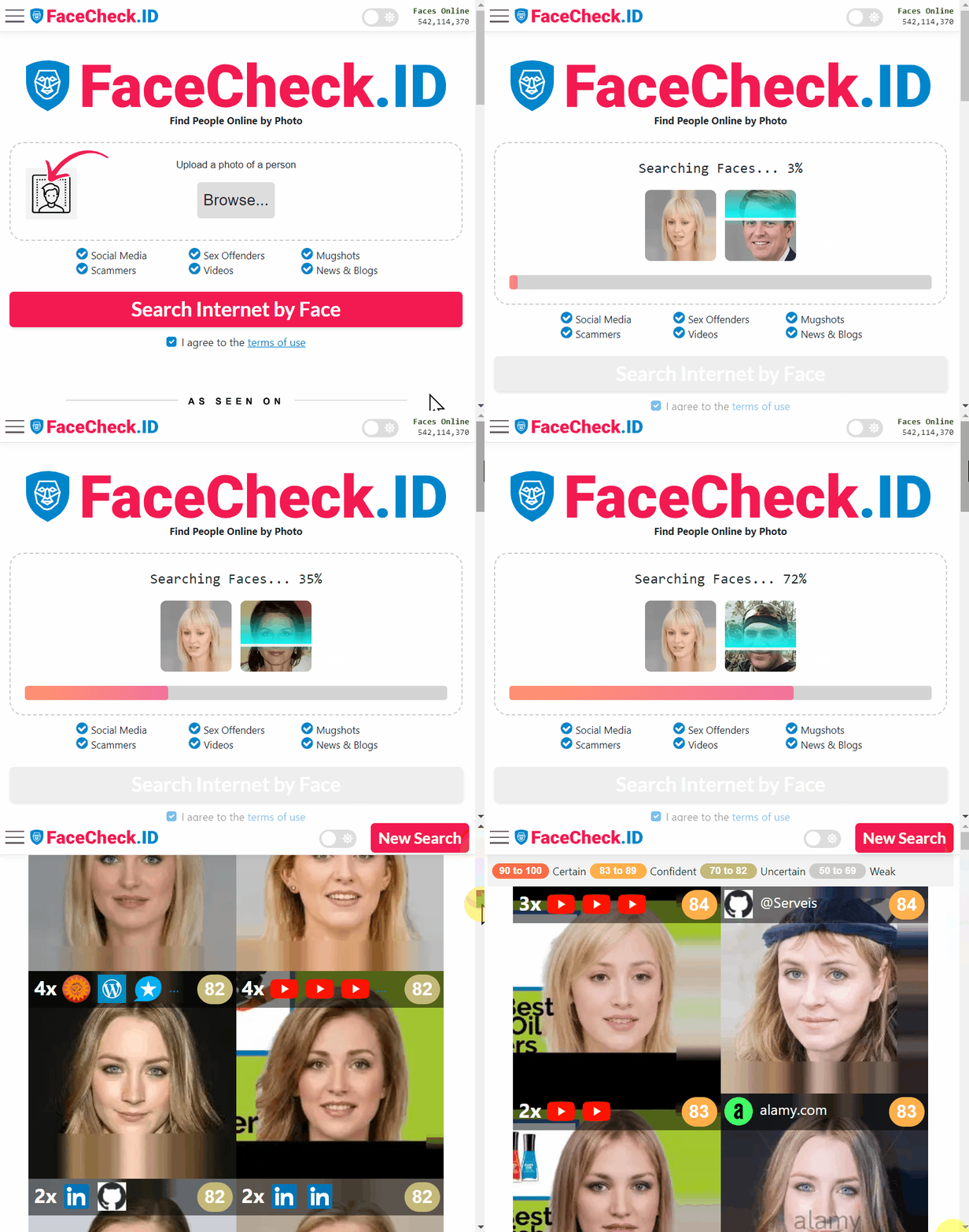
Recruiters increasingly screenshot the interviewee mid-call and run a reverse face search against the public web. The goal is simple: confirm the person on camera is the same person whose LinkedIn, GitHub, conference photos, or company bio they've already reviewed.
The signal patterns to watch for:
- The interview screenshot returns matches under a different name, a different country, or a different employer than the candidate claimed
- The interview face matches no public profile at all, while the named candidate has a strong online footprint
- Multiple unrelated job applications, sometimes across different recruiters, return the same proxy face attached to different identities
- The face appears on freelance gun-for-hire forums, low-quality stock-style portrait dumps, or aggregator sites unrelated to any of the candidate's claimed employers
A clean LinkedIn headshot is usually the strongest reference image: front-facing, well-lit, and reused across professional sites, which means a proxy interview screenshot of the same person should match it with high confidence. When the confidence drops sharply or the top results point elsewhere, that is the investigative lead.
Capturing usable images during the interview
Face matching only works when the input image is good enough. Proxies often exploit poor capture conditions to stay ambiguous.
Practical capture tips for hiring teams:
- Take screenshots when the candidate is looking near the camera, not down at notes
- Avoid frames where the face is half-shadowed, motion-blurred, or cropped at the forehead
- Capture from more than one moment in the call, since one bad frame can produce a false negative against an otherwise legitimate candidate
- If the candidate keeps the camera off during technical rounds but on during HR rounds, run face searches on both, the two faces should match
A proxy who knows about face-matching may use lower video resolution, sit further from the camera, or stay backlit. Those behaviors are themselves a soft signal.
Reading the results without overreaching
Face search results in a proxy-interview context can suggest fraud, but they rarely prove it on their own. A few traps to avoid:
- Lookalike matches happen, especially for younger candidates or for faces with common features. A single moderate-confidence hit on a stranger's profile is not evidence of impersonation
- A candidate with no online photos at all is not automatically suspicious. Privacy-conscious engineers, recent immigrants, and people in restrictive jurisdictions often have minimal public image footprints
- Old or heavily edited photos on the claimed candidate's profiles can produce real mismatches against a current, accurate live face. Aging, weight change, glasses, and beards all reduce match scores
- Mugshot or scam-database hits should be verified by name and date before being treated as relevant, since face-only matches can collide
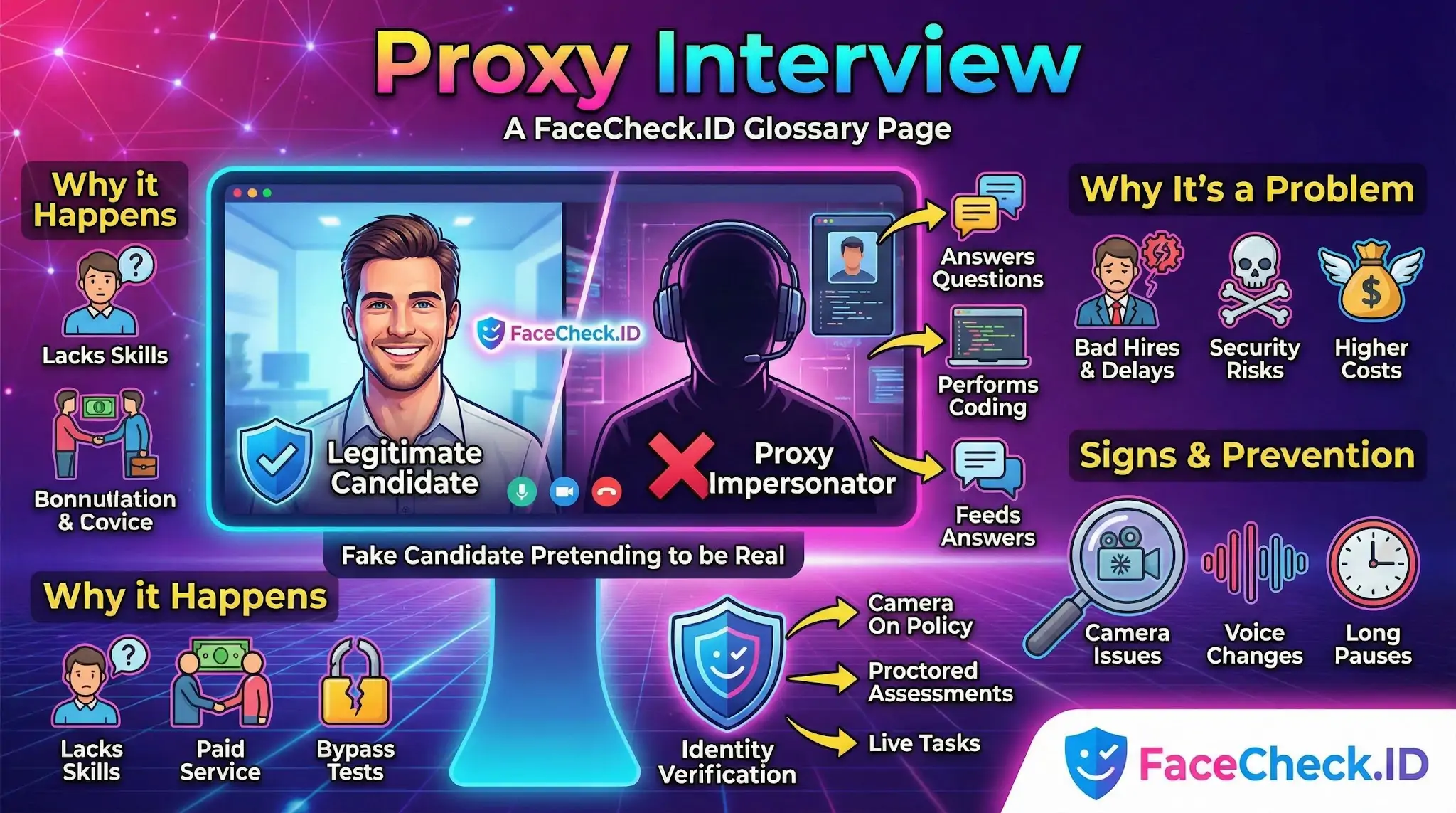
The strongest case for a proxy interview combines face-search findings with behavioral signals: voice or accent shifts between rounds, long unexplained pauses, weak follow-up answers about specifics on the resume, or sudden performance drops once the camera is required and screen sharing is monitored.
What face search cannot settle
Face search confirms whether a face appears elsewhere on the indexed web under different identities. It does not prove intent, employment history, or skill. It cannot distinguish a proxy from an identical twin, a stolen but unused identity from a coordinated fraud ring, or a candidate using an old photo on their profile from one hiring an imposter. Treat the results as one input into a structured review that also includes identity document verification, live technical work, and reference checks. A face-search hit should trigger a conversation with the candidate, not an automatic rejection, because legitimate explanations exist and the cost of falsely accusing a real applicant is high.
FAQ
What does “Proxy Interview” mean in the context of face recognition search engines?
In this context, a “Proxy Interview” is when someone other than the real candidate appears on camera (or provides the profile photo) during a remote interview, often to misrepresent identity or qualifications. A face recognition search engine can be used to check whether the on-camera face or submitted headshot seems to belong to a different online persona than the claimed candidate.
How can a face recognition search engine help detect a suspected Proxy Interview without “proving” it?
It can surface leads such as the same face appearing under different names, usernames, or countries across multiple sites, or a “professional headshot” showing up in many unrelated profiles. These are consistency checks that may raise or lower suspicion, but they do not prove who attended the interview or establish intent—only that the image/face has an online trail that may not match the claimed identity.
Which images should I search if I suspect a Proxy Interview (live video, selfies, ID photos, or screenshots)?
Use the clearest, most front-facing frames available: (1) a still frame captured during the live interview with a neutral expression, (2) the candidate’s submitted headshot, and (3) any other publicly shared profile images the candidate provided. Avoid using ID-document photos unless you have a lawful basis and strong data-handling controls, because they can contain sensitive personal data and increase privacy and compliance risk.
What result patterns are common in Proxy Interview checks, and which ones are most misleading?
Common patterns include: the same face tied to many unrelated profiles, the face appearing on stock-photo or scraped “bio” pages, or the face matching a different person’s long-established social profile. Misleading patterns include near-look-alike matches (doppelgänger-like results), matches driven by heavy filters/beauty edits, and AI-generated or face-swapped content that can create a convincing but false “identity trail.”
How can FaceCheck.ID add value in a Proxy Interview investigation, and what precautions should I take?
FaceCheck.ID (like other face recognition search tools) can help by quickly surfacing where a face appears online so you can compare identity signals (names, timelines, locations, and the oldest/most authoritative sources). Precautions: treat hits as investigative leads, not identity proof; document the verification steps you used; and avoid acting on a single match—corroborate with non-face evidence (controlled verification, references, or standard hiring checks) before making decisions that could harm someone.