Romance Scammers: Spotting Stolen Photos
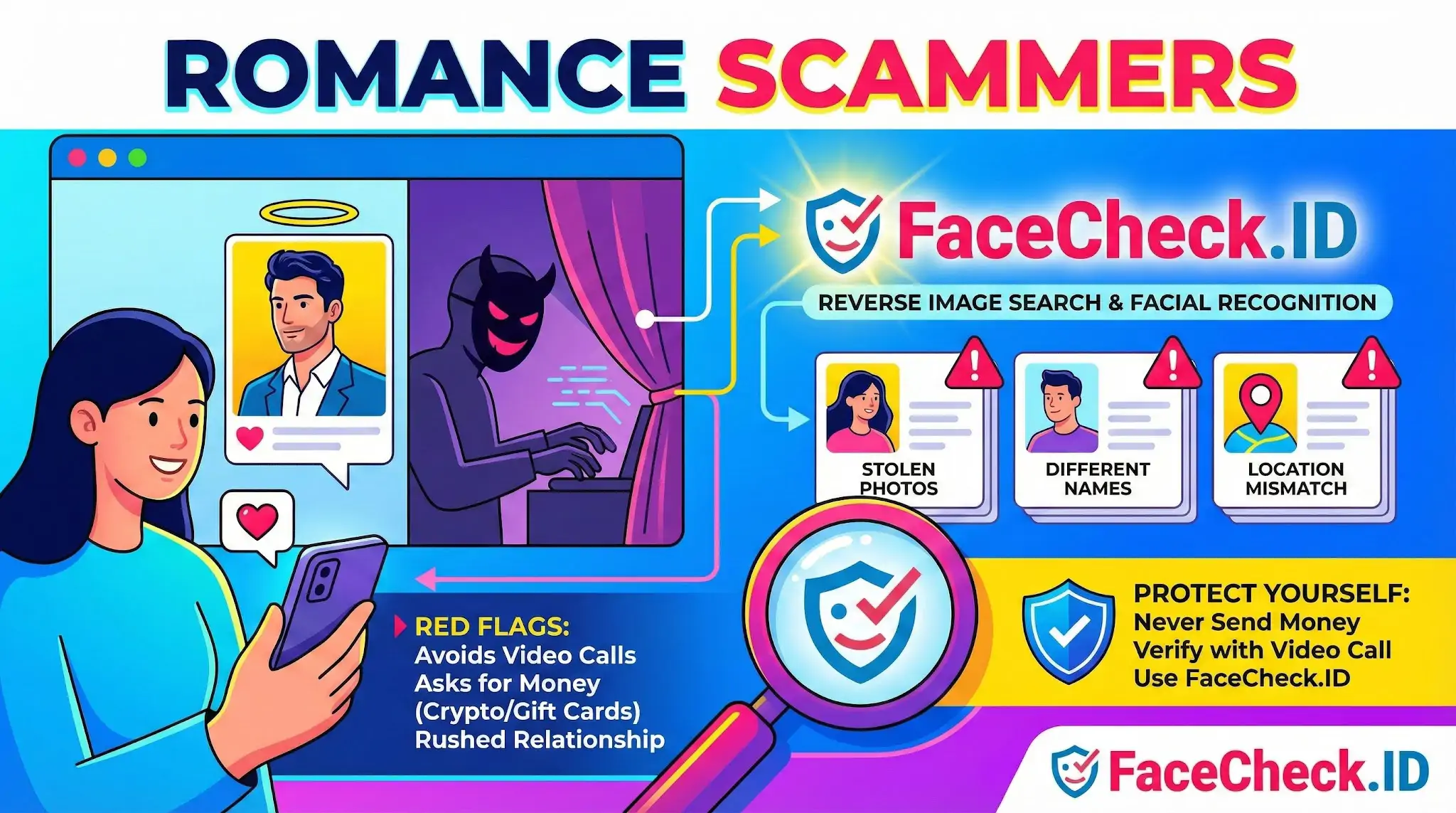
Romance scammers run one of the most common identity-misuse schemes that face search is built to expose. Because nearly every romance scam relies on stolen photos of a real, unrelated person, a reverse face search across public web pages is often the fastest way to confirm that the "soldier deployed overseas" or "oil rig engineer" you have been chatting with does not exist.
How romance scammers build a fake identity
A scam profile is a stitched-together identity. The photos almost always come from someone else, usually scraped from public Instagram accounts, LinkedIn, fitness influencer pages, model portfolios, or military social media. The scammer pairs those images with a script: a sympathetic backstory, a high-status job that justifies absence, and a reason video calls are difficult.
Operators often run dozens of profiles in parallel using the same image set. That is why a single face can show up under different names on Tinder, Hinge, Facebook, Instagram, Telegram, WhatsApp, and obscure dating sites at the same time. The mismatch between a face and the names attached to it is the core signal a face search reveals.
Common patterns inside the photo set itself:
- A small batch of 4 to 10 photos reused across every platform
- Images that look professionally shot or unusually polished for a casual dating profile
- Cropped or mirrored versions of the originals to defeat exact-match image search
- Photos of military personnel, doctors, oil workers, or engineers in uniform or on location
Why face search beats traditional reverse image search
Standard reverse image search engines look for the exact pixels of an uploaded image. Scammers know this and edit photos to break that match. They crop, mirror, change brightness, add filters, or screenshot the image to strip metadata.
Face recognition search works differently. It indexes the face itself, so a mirrored crop of a LinkedIn headshot still matches the original LinkedIn page. This matters in romance scam investigations because the goal is not to find one identical image, it is to confirm whether the same face appears under a different name somewhere on the public web.
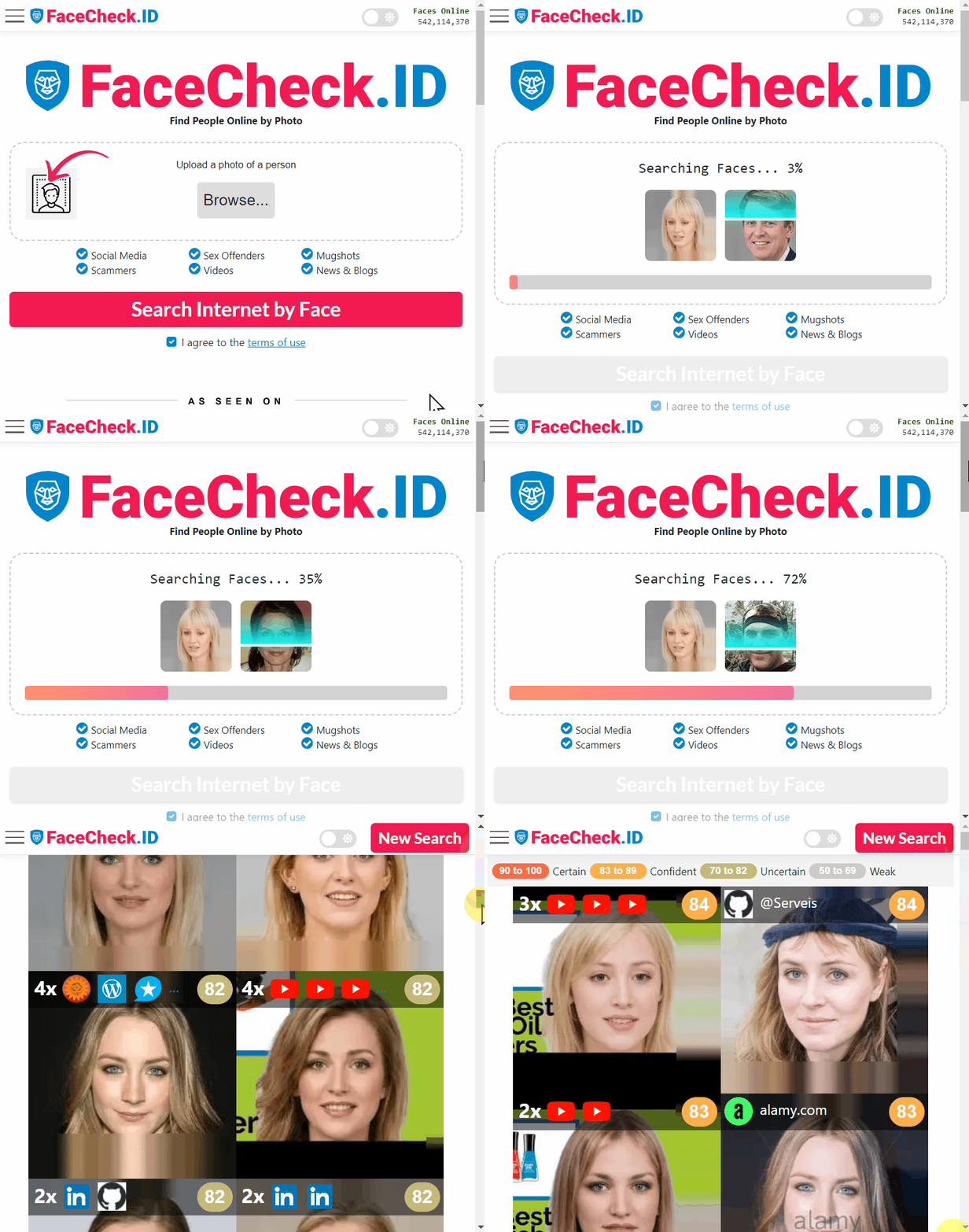
When running a suspected scammer's photo through FaceCheck.ID, the useful signals are:
- Hits on a real person's social media under a clearly different name
- Hits on news articles, obituaries, or interviews unrelated to the dating persona
- Multiple dating or social profiles using the same face but different ages, cities, or ethnicities
- Listings on scam-reporting sites, where victims have already flagged the photo
Behavioral signs that should trigger a face search
A face search is most useful when paired with the behavioral patterns scammers fall into. Run the photos through a face search before sending money, before sharing private images, and before sharing identity documents if any of these are present:
- Fast escalation from a dating app to WhatsApp, Telegram, or Google Chat
- Refusal or repeated cancellation of live video calls
- A profession that conveniently explains absence: deployment, offshore rig, surgeon abroad, UN contractor
- Requests for gift cards, crypto, wire transfers, or help with a "stuck" inheritance or shipment
- Inconsistent details about location, family, or work between conversations
- Polished, slightly off-tone messages that read like translated templates
What a face match does and does not prove
A face-search hit is evidence, not proof. If a profile photo matches a real LinkedIn account under a completely different name, the most likely explanation is impersonation, but the actual person behind the scam profile is still unknown. The match identifies the victim of photo theft, not the scammer.
A clean search with no hits is also not a guarantee. Scammers sometimes use photos from private accounts, photos from regions with limited public indexing, or photos of real accomplices. Newer fakes may use AI-generated faces that have no matches anywhere because the person does not exist.
Treat face search as one of several checks. Combine it with a live video call, consistency checks across the person's accounts, and a refusal to send money or share sensitive documents until identity is independently confirmed. The strongest signal in romance scams is not any single result, it is the pattern: a face that belongs to someone else, a story that resists verification, and a request that always ends in a transfer.
FAQ
What are “romance scammers” in the context of face recognition search engines?
Romance scammers are fraudsters who build a fake romantic relationship online to obtain money, gifts, or sensitive information. In face recognition search engines, they’re often associated with stolen or repurposed photos used across multiple dating profiles, social accounts, or scam reports—patterns that face search tools can sometimes reveal.
How can a face recognition search engine help verify whether a dating profile photo is linked to romance scams?
You can upload the profile photo to a face recognition search engine to look for the same face appearing under different names, in different countries, or on scam-report and impersonation pages. Multiple unrelated profiles using the same face (especially with conflicting biographical details) is a strong warning sign, but it’s still a lead—not proof.
What result patterns in face search commonly indicate a romance scammer is using stolen photos?
Common patterns include: (1) the same face tied to multiple different names or ages; (2) the face appearing in “stolen photos” galleries, scam forums, or victim reports; (3) the image showing up as a model/actor/influencer while the person claims an unrelated identity; (4) many reposts across unrelated sites with no consistent original source; and (5) a sudden jump from “private dating profile” to widely indexed images elsewhere.
What if the romance scammer is using AI-generated or heavily edited face images—will face search still work?
Sometimes it works, often it doesn’t. AI-generated faces may have no real online footprint, so face search can return no matches or only visually similar faces. Heavy filters, face swaps, and strong edits can also reduce match quality or increase look-alike (doppelgänger) results. A “no results” outcome should not be treated as clearance; it may simply mean the image isn’t indexed or isn’t a real person’s face.
How should I use FaceCheck.ID (or similar tools) safely when I suspect a romance scammer?
Use it as a risk-check and documentation tool, not as identity proof. Prefer a clear, front-facing photo (avoid extreme filters). Review multiple top matches and open the source pages to verify context. Save URLs and screenshots of relevant matches for reporting to the platform, payment provider, or authorities. Avoid sharing sensitive personal data during the investigation, and don’t harass people whose images may have been stolen.

Recommended Posts Related to romance-scammers
-
How to Uncover a Romance Scammer Using Just a Picture
The power of technology and the internet has made it possible to discover more about individuals, including potential romance scammers. This step-by-step guide will walk you through the process of identifying a romance scammer using just a picture. FaceCheck.ID is made to find romance scammers!
-
Unmasking Romance Scams: Expert Tips to Identify and Avoid Falling Victim
How Romance Scammers Operate. This ABC Chicago segment looks at how AI character generators and photo enhancement tools are making it easier for romance scammers to fabricate convincing faces on dating apps. How long does a romance scammer usually wait before asking for money?
-
The Rise of Romance Scams: Protect Your Heart and Wallet
The heartless tactics of romance scammers: How they manipulate and deceive their victims. Hey, have you heard about those romance scammers? Learn about Romance Scammers' Tactics.
-
140+ Common Romance Scammer Lines, Excuses & Red Flags to Watch For in 2026
But there's a big difference between "he has a photo holding a fish" and "he literally is a fish." Romance scammers keep reusing the same scripts. A romance scammer’s favorite plot device: The Mysterious Package™. What are the most common romance scammer excuses?
-
Top 4 Benefits of Facial Recognition in Online Dating with FaceCheck.ID
Click to Search Romance Scammers Using a Photo! By performing a reverse image search, users can check they are not talking to a romance scammer before they agree to meet in person.