Vk.Com in Face Search Results

VK.com is one of the largest public sources of user-uploaded face photos outside the major Western platforms, which makes it a recurring hit in reverse image and face-search results. For anyone investigating an online identity, a romance scam, or a suspicious profile, VK matches often surface details that Facebook and Instagram no longer expose to outside indexing.
Why VK matters in face-search results
VK's photo albums, community pages, and profile galleries have historically been more openly indexable than equivalent content on Western networks. Profiles often keep years of photos public by default, and group pages collect tagged member images, event photos, and reposted portraits. That combination produces a lot of crawlable, face-bearing pages.
When a face-search engine returns a VK link, the match is usually one of three things:
- A profile photo or album shot uploaded by the account owner
- A group or community page where the same person was tagged or featured
- A reposted image, sometimes years old, that traveled from another platform into VK
The third case is important. VK is a common destination for images scraped or copied from Instagram, OK.ru, Telegram channels, and dating sites. A VK match does not always mean the person has a VK account. It may mean their photo was reused there.
Reading a VK match carefully
A high-confidence face match on VK gives you a name, a network of friends, posts in a specific language, location hints, and sometimes a school or employer. That is more identifying context than most platforms expose to a stranger. It is also where investigators most often jump to wrong conclusions.
A few patterns worth watching:
- Stolen photo sets used for catfishing. Attractive VK profiles, especially of young women or military men, are heavily mined by scammers building fake accounts on dating apps and Western social networks. If face search shows the same face on a VK profile from 2014 and a Tinder profile from last month, the Tinder account is usually the fake one, not the other way around.
- Duplicate or impersonation profiles on VK itself. Popular faces get cloned. Two VK profiles with the same photos and different names usually means one is impersonating the other.
- Old photos reused in new contexts. VK profiles often retain teenage or military-era portraits. A match from a 2011 album does confirm the face existed then, but it does not confirm current identity, location, or activity.
- Group memberships as identity signals. A face that appears in a regional university's VK community, a hometown group, and a hobby page gives you converging evidence. A single match in one large public group gives you almost nothing.
Common investigation scenarios
VK shows up most often in these face-search workflows:
- Romance scam checks. A face supposedly belonging to an American doctor or oil-rig worker turns up on a Russian or Ukrainian VK profile under a different name. This is one of the strongest signals of a scripted scam.
- Source attribution for stolen images. When a photo circulates on Twitter or Reddit, VK is sometimes the original upload point, with a timestamp predating the viral repost.
- Locating people who left Western platforms. Some users maintain active VK presences long after deleting Facebook accounts, so VK can be the only current public face match.
What a VK match does not prove
A face match on VK is a starting point, not a verdict. Lookalikes are real, especially across siblings and within tight regional populations, and face-search engines occasionally return high-confidence matches that a careful human review would reject. A match also says nothing about whether the VK account is genuine, abandoned, hacked, or itself an impersonation.
Treat a VK result as one data point. Compare multiple photos from different angles, check upload dates against other appearances of the same image, look at posting language and friend network for consistency, and resist the urge to identify someone from a single thumbnail. The platform's openness is what makes it useful for face search, and also what makes its content easiest to misread.
FAQ
What is Vk.Com, and why does it appear in face recognition search engine results?
Vk.Com (VK) is a social networking platform where users and communities can post profile photos, albums, and reposted media. It may appear in face recognition search results when a matching or similar-looking face is found on a VK page that is publicly accessible (for example, a public profile photo, a public group post, or a reposted image).
Does a Vk.Com match mean the person in my photo has a VK account?
Not necessarily. A VK result often indicates that the face (or a very similar face) appears on a VK-hosted page, but the image could be reposted, scraped, or shared by someone else (e.g., fan pages, community groups, meme pages, or reuploads). Treat VK hits as leads and verify context (account history, captions, other photos, and cross-site consistency) before assuming ownership or identity.
Why might face search results point to Vk.Com reposts, archives, or mirrored pages instead of the original source?
VK pages can act as secondary distribution points where images are reposted from other platforms, reuploaded in different crops/sizes, or embedded in community posts. Face recognition search engines may surface whichever copy is easiest to crawl and index, which can be a VK mirror rather than the earliest or “official” source. Checking timestamps, reverse image search for duplicates, and comparing multiple matches can help identify the likely origin.
How can I safely verify a Vk.Com result from a face recognition tool (including FaceCheck.ID) before taking action?
Use a verification workflow: (1) open the VK page and confirm the face appears clearly and is not a collage or unrelated thumbnail; (2) compare multiple photos on the same VK account for consistent facial features across angles/lighting; (3) look for corroborating signals (same username, same linked accounts, consistent biographical details) rather than relying on the face alone; (4) cross-check with other sources returned by the tool (FaceCheck.ID or others) to see whether the same face clusters around a consistent identity; (5) avoid doxxing or harassment—use results only for legitimate, proportionate purposes.
If my face appears on Vk.Com in search results and I didn’t post it, what practical steps can I take?
First, document the URLs and screenshots of the VK pages that contain the image, then determine whether the image is on a public profile, a community/group post, or an external site embedded on VK. Next, use the platform’s reporting/takedown paths (where applicable) to request removal on VK, and also pursue removal at the original hosting site if VK is reposting it. If the face search engine provides a removal/opt-out process for its index, submit a request there too. Consider reducing further spread by tightening privacy settings on your own accounts and watermarking or limiting high-resolution public headshots.

Recommended Posts Related to vk.com
-
How to Find People on VK.com by Photo
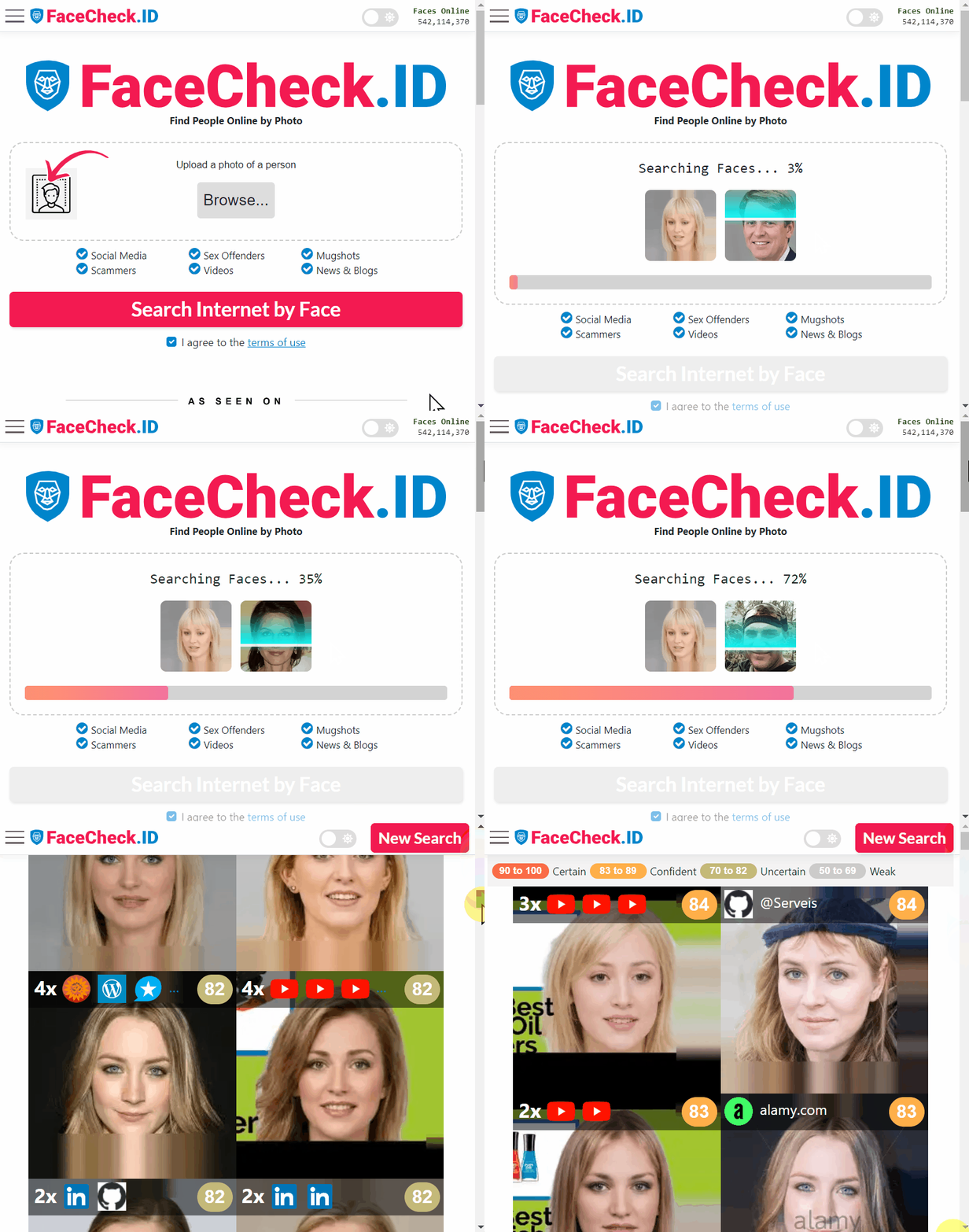
Reconnecting on VK.com Made Simple. This guide will walk you through the process of using FaceCheck.ID to find people on VK.com using just their picture. FaceCheck.ID is a search engine that uses facial recognition technology to match photos with public profiles on various social media platforms, including VK.com.