How to Spot a Catfish Online in Under 60 Seconds with FaceCheck.ID
Last Updated: December 2025
In 2025, romance scams and catfishing have reached record levels. According to the FTC's Consumer Sentinel Report, Americans lost over $1.3 billion to romance fraud in recent years, with losses continuing to climb as scammers adopt AI deepfakes and increasingly sophisticated tactics. Globally, online dating scams account for more than $1 billion annually in reported losses, and surveys indicate that 40% of dating app users have encountered fake profiles or been targeted by fraudsters, a 10% increase from 2024.
Scammers build fake dating profiles using stolen photos or entirely AI-generated faces that look hyper-realistic. These synthetic identities have no genuine online footprint, making them nearly impossible to trace with conventional reverse image search tools. The emotional and financial devastation is severe: victims typically lose between $2,000 and $15,000 per incident, suffer lasting trust issues, and experience profound heartbreak.
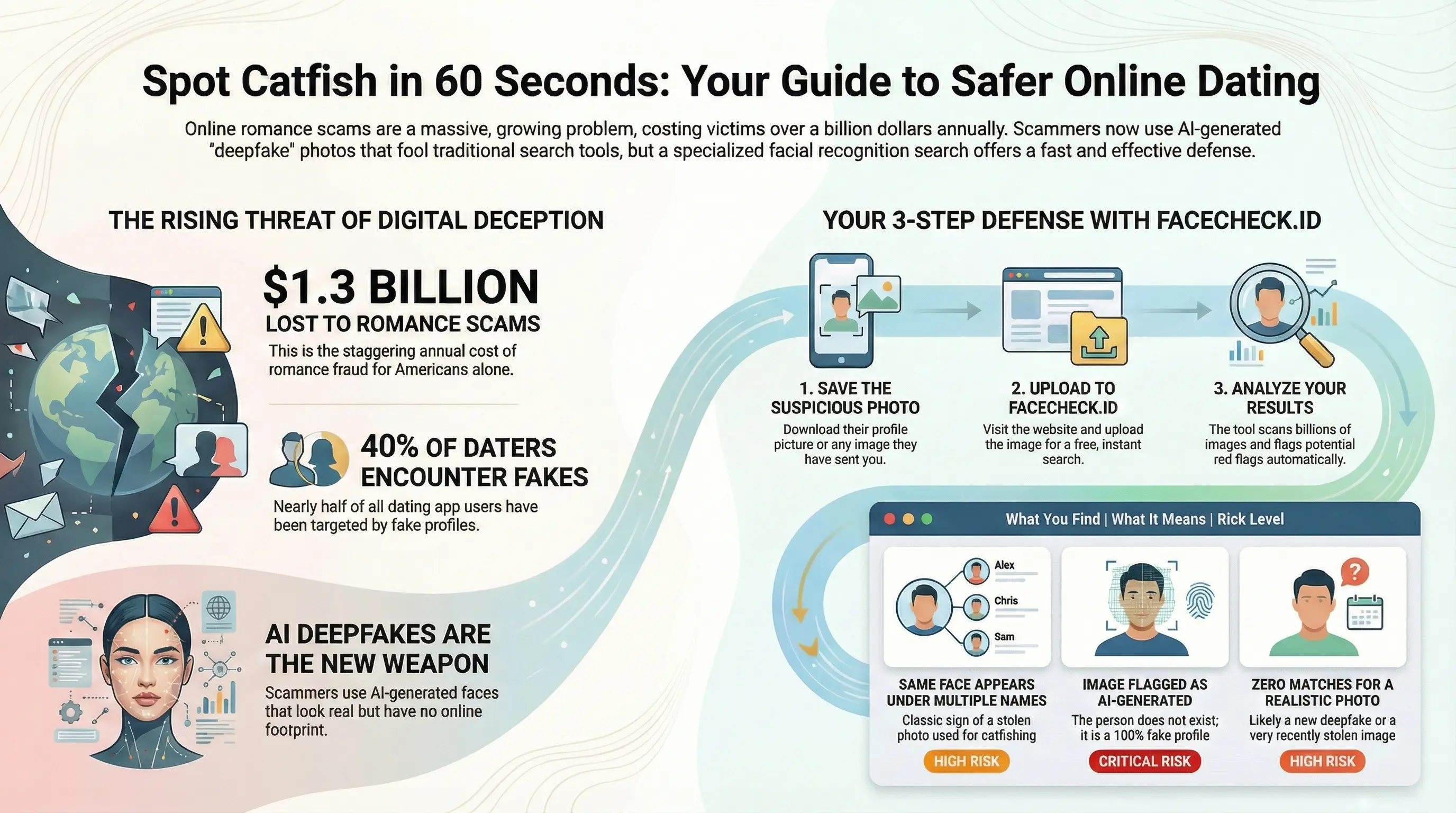
But there's a fast, effective defense against romance fraud: FaceCheck.ID, a specialized facial recognition search engine built specifically to combat catfishing and identity deception.
FaceCheck.ID lets you search for free by uploading a photo. It scans billions of public images in seconds, providing immediate basic results. You can unlock comprehensive details (additional matches, source links, and deeper analysis) with a small payment. This freemium approach makes powerful online dating safety tools accessible to everyone.
In this article, we're going to discuss
- Why Traditional Reverse Image Tools Fail in 2025
- Step-by-Step Guide: Verify Any Dating Profile in Seconds
- Key Red Flags in Your Search Results
- Pro Tips for More Accurate Identity Verification
- Real User Stories: How Quick Searches Prevented Scams
- Comparison: FaceCheck.ID vs. Popular Alternatives (2025)
- Top 15 Catfish Warning Signs in 2025 (Beyond Photo Verification)
- What to Do If You've Been Catfished
- Legal and Ethical Considerations: Is Facial Recognition Search Legal?
- Prevention Tips for Safer Online Dating
- Frequently Asked Questions
- Take Action: Protect Yourself Today
Why Traditional Reverse Image Tools Fail in 2025
Google, Bing, and general-purpose tools like TinEye restrict or limit facial searches due to privacy policies. They frequently miss photo variations (filters, angles, lighting, aging) and completely fail to detect AI-generated deepfakes, now the primary weapon in scammers' arsenals.
FaceCheck.ID is purpose-built for identity verification: advanced facial recognition that handles real-world image variations, combined with integrated AI-generated image detection to flag synthetic faces instantly.
Step-by-Step Guide: Verify Any Dating Profile in Seconds
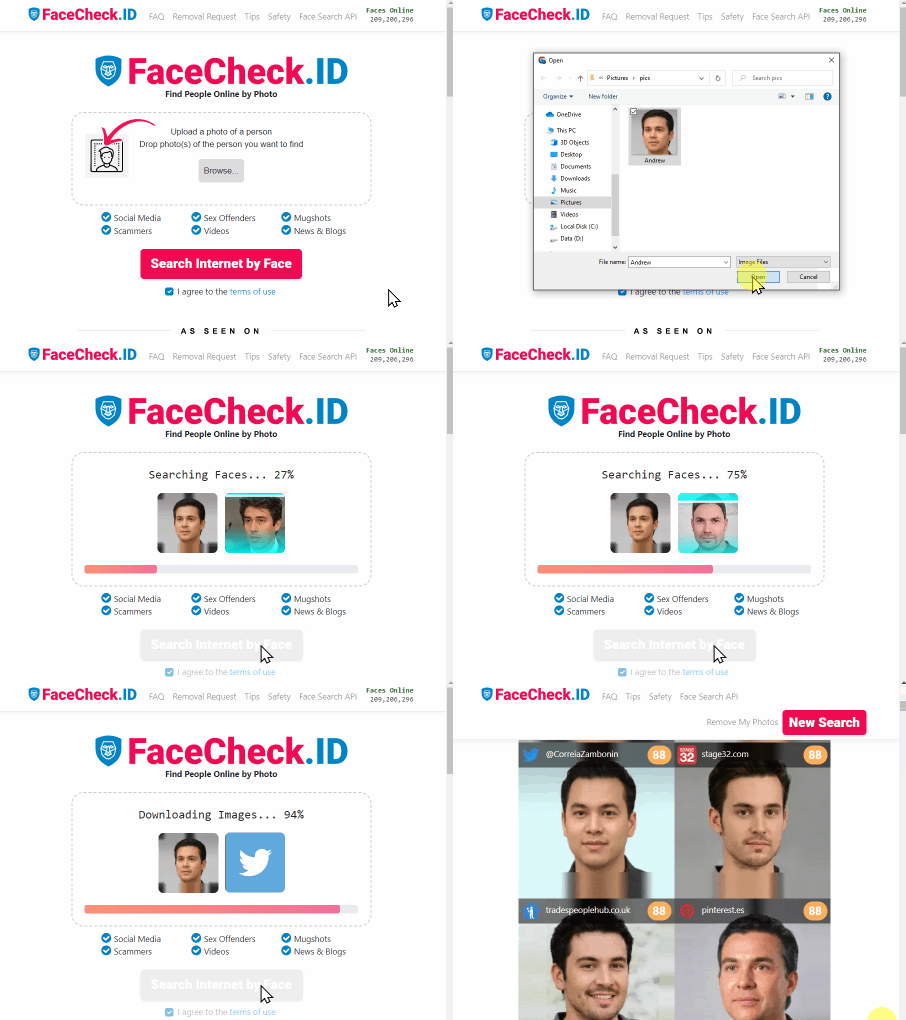
1. Save the Suspicious Photo
Download their profile picture, selfie, or any image they've shared. Clear, front-facing shots yield best results, but FaceCheck.ID's algorithms handle side profiles, partial views, and filtered images effectively.
2. Go to FaceCheck.ID
Visit facecheck.id and upload the photo for free using drag-and-drop or the file browser.
3. Run the Free Facial Recognition Search
The tool instantly scans billions of indexed public images using biometric facial analysis, cross-referencing social media platforms, news archives, blogs, and known scam databases.
4. Analyze Your Results
Review matches carefully. The platform flags potential concerns automatically and provides source links for verification.
5. Unlock Full Details (Optional)
For complete source information, higher-resolution matches, and advanced fraud indicators, a small one-time fee unlocks premium results.
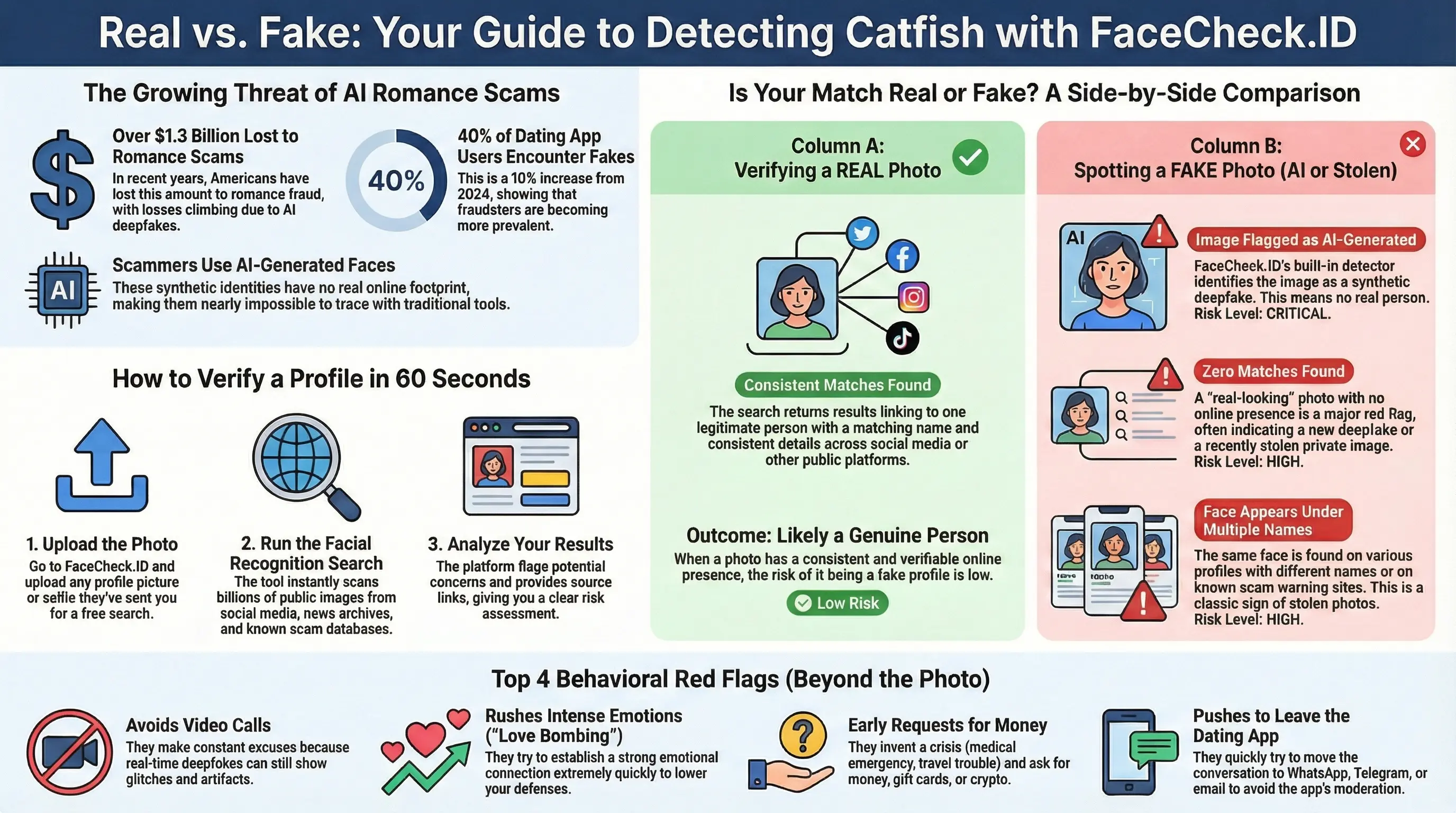
Key Red Flags in Your Search Results
| Finding | What It Means | Risk Level |
|---|---|---|
| Same face appears under multiple names/profiles | Classic sign of stolen photos used for catfishing | High |
| Face appears on known scam or mugshot databases | Person has documented history of fraud | Critical |
| Image flagged as AI-generated | No real person exists, 100% fake profile | Critical |
| Zero matches for a "real-looking" photo | Likely new deepfake or recently stolen image | High |
| Consistent matches on one legitimate profile with matching details | Probably a genuine person | Low |
Pro Tips for More Accurate Identity Verification
- Upload multiple photos of the same person for cross-verification and higher confidence
- Try cropped close-ups if the original image has distracting backgrounds or other people
- Mobile-friendly: Use your browser directly, no app download required
- Check image metadata: Before uploading, note when the photo was supposedly taken versus when they claim to have taken it
Real User Stories: How Quick Searches Prevented Scams
Thousands have avoided romance fraud and catfishing thanks to 60-second verification checks:
- "Sarah" (name changed) discovered the "military officer" photos her online match sent appeared across multiple scam warning sites. She avoided sending the $5,000 he requested for "emergency leave."
- "Mike" found that his "perfect match" was an AI-generated face with zero authentic online presence anywhere. He ended the conversation before emotional investment deepened.
- A concerned parent verified their teenager's new "online friend" and discovered the photos belonged to a European stock model, protecting their child from a potential predator.
These cases illustrate how a brief identity check prevents months of manipulation, financial loss, and emotional trauma.
Comparison: FaceCheck.ID vs. Popular Alternatives (2025)
| Tool | Free Search | Facial Focus | AI/Deepfake Detection | Handles Photo Variations | Scam Database Integration | Best Use Case |
|---|---|---|---|---|---|---|
| FaceCheck.ID | Yes (basic) | Excellent | Strong | Yes (filters, angles, aging) | Yes | Catfishing & quick profile verification |
| PimEyes | Limited | Excellent | Moderate | Yes | No | Broad web face tracking |
| Social Catfish | No (paid only) | Good | Limited | Moderate | Yes | Full background checks (name/email/phone) |
| Google/Bing Images | Yes | Poor (restricted) | None | Limited | No | General image search only |
| TinEye | Yes | No (exact match only) | None | Poor | No | Finding stock photo duplicates |
FaceCheck.ID leads for romance scam detection specifically due to its fraud-focused features, AI image flagging, and free entry point for basic searches.
Top 15 Catfish Warning Signs in 2025 (Beyond Photo Verification)
Combine facial recognition searches with these behavioral red flags for comprehensive fake profile detection:
- Avoids video calls real-time deepfakes still show glitches and artifacts
- Love bombing rushes intense emotions within days or weeks
- Inconsistent stories details about job, location, or family don't add up
- Early financial requests asks for money, cryptocurrency, or gift cards
- Classic cover stories claims deployment overseas, oil rig work, or international business travel
- Sparse social presence few friends, no tagged photos, minimal post history
- Too-perfect photos images look professionally shot or artificially flawless
- Endless excuses to avoid meeting always has a reason not to meet in person
- Unusual language patterns grammar or phrasing inconsistent with claimed background
- Generic, scripted messages responses feel templated rather than personal
- Rapid platform migration pushes to move to WhatsApp, Telegram, or email quickly
- Sob stories seeking sympathy medical emergencies, family tragedies, financial hardship
- New or inactive profile account created recently with minimal activity
- No mutual connections zero shared friends or contacts
- Gut instinct something simply feels "off" about the interaction
What to Do If You've Been Catfished
Discovering you've been deceived is devastating, but taking immediate action can limit damage and help prevent others from becoming victims. Here's a step-by-step recovery guide:
Immediate Steps (First 24–48 Hours)
1. Stop All Communication
End contact immediately. Don't confront the scammer, they may escalate manipulation tactics or attempt to extract more money through guilt or fake emergencies.
2. Document Everything
Before blocking or reporting, screenshot and save:
- All conversations (messages, emails, texts)
- Profile photos and any images they sent
- Phone numbers, email addresses, and usernames
- Payment receipts, wire transfer confirmations, or gift card codes
- Any links they shared
3. Secure Your Accounts
- Change passwords on all platforms where you communicated
- Enable two-factor authentication
- Review connected apps and revoke suspicious access
- Check for unauthorized logins on financial accounts
4. Report the Scammer
File reports with:
- The dating platform: Use built-in reporting tools; most apps have dedicated fraud teams
- FTC (U.S.): ReportFraud.ftc.gov
- FBI's IC3: ic3.gov for internet crimes
- Local law enforcement: File a police report, especially if significant money was lost
- Your country's fraud reporting agency (see comprehensive list below)
Global Fraud Reporting Agencies by Country
Use the table below to find the official fraud and cybercrime reporting agency for your country:
| Country | Agency | Report Link / Contact |
|---|---|---|
| North America | ||
| United States | Federal Trade Commission (FTC) | reportfraud.ftc.gov |
| United States | FBI Internet Crime Complaint Center (IC3) | ic3.gov |
| United States | Identity Theft Resource | identitytheft.gov |
| Canada | Canadian Anti-Fraud Centre (CAFC) | antifraudcentre-centreantifraude.ca |
| Canada | Canadian Centre for Cyber Security | cyber.gc.ca |
| Mexico | Policía Cibernética | gob.mx/policiafederal |
| Europe | ||
| United Kingdom | Action Fraud (National Fraud & Cyber Crime Reporting Centre) | actionfraud.police.uk |
| Ireland | An Garda Síochána (National Police) | garda.ie/en/crime/fraud |
| France | PHAROS (Ministère de l'Intérieur) | internet-signalement.gouv.fr |
| Germany | Polizei (State Police Online Reporting) | polizei.de |
| Netherlands | Politie | politie.nl |
| Belgium | CERT.be / Safe on Web | safeonweb.be |
| Spain | Policía Nacional | policia.es |
| Portugal | Polícia Judiciária | policiajudiciaria.pt |
| Italy | Polizia Postale | commissariatodips.it |
| Austria | Cyber Crime Competence Center (C4) | www.bundeskriminalamt.at |
| Switzerland | Suisse ePolice | suisse-epolice.ch |
| Sweden | Polisen | polisen.se |
| Denmark | Politi | politi.dk |
| Finland | Poliisi | poliisi.fi |
| Estonia | Politsei | cyber.politsei.ee |
| Latvia | Policija | www.vp.gov.lv |
| Cyprus | Cyprus Police Cybercrime Unit | cybercrime.police.gov.cy |
| Bulgaria | General Directorate Fighting Organized Crime | europol.europa.eu/report-a-crime |
| EU (Cross-Border) | Europol Report Cybercrime | Report Cybercrime Online |
| Asia-Pacific | ||
| Australia | Scamwatch (ACCC) | scamwatch.gov.au |
| Australia | Australian Cyber Security Centre (ACSC) | cyber.gov.au |
| New Zealand | Netsafe | report.netsafe.org.nz |
| Singapore | ScamShield / Singapore Police Force | scamshield.gov.sg | Helpline: 1799 |
| Japan | Japan Anti Fraud Organization | japanantifraud.org |
| South Korea | Ministry of Justice Cybercrime Unit | fgn.kics.go.kr |
| China | Ministry of Public Security / National Anti-Fraud Centre | Hotline: +96110 |
| Hong Kong | Hong Kong Police Force | erc.police.gov.hk |
| Taiwan | National Police Agency (165 Anti-Fraud Hotline) | 165.npa.gov.tw |
| India | National Cyber Crime Reporting Portal | cybercrime.gov.in | Helpline: 1930 |
| Philippines | NBI Anti-Fraud Division | afad@nbi.gov.ph |
| Vietnam | Ministry of Public Security | bocongan.gov.vn |
| Middle East & Africa | ||
| United Arab Emirates | UAE Government Cybercrime Portal | u.ae |
| Qatar | MOI Cyber Crime Investigation Centre | cccc@moi.gov.qa |
| South Africa | Cybersecurity Hub CSIRT | cshubcsirt@cybersecurityhub.gov.za |
| Nigeria | Police Special Fraud Unit | report@specialfraudunit.org.ng |
| Kenya | Directorate of Criminal Investigations | cid.go.ke |
| South America | ||
| Argentina | Jefatura de Gabinete de Ministros | argentina.gob.ar |
| Brazil | CERT.br | cert@cert.br |
| International / Cross-Border | ||
| International | eConsumer.gov (FTC partnership for cross-border scams) | econsumer.gov |
| International | Interpol | interpol.int |
Note: If your country isn't listed, report to your local police department's cybercrime or fraud unit, or use the international reporting portals (eConsumer.gov for cross-border scams, Europol for EU countries)
Financial Recovery
Contact Your Bank or Payment Provider Immediately
- Report unauthorized transactions
- Request chargebacks on credit card payments where possible
- For wire transfers, contact your bank's fraud department urgently (recovery is time-sensitive)
- Report to gift card issuers, some can freeze unredeemed balances
Document Financial Losses
Create a detailed record of all money sent, including dates, amounts, methods, and stated purposes. This documentation supports fraud claims and potential legal action.
Consider Identity Theft Protection
If you shared personal information (Social Security number, bank details, ID documents), monitor your credit and consider identity theft protection services.
Emotional Recovery
Recognize It's Not Your Fault
Romance scammers are professional manipulators who exploit human needs for connection. Victims span all ages, education levels, and backgrounds. Shame prevents reporting, which is exactly what scammers count on.
Seek Support
- Talk to trusted friends or family members
- Consider counseling or therapy, especially if you're experiencing depression, anxiety, or trust issues
- Join support communities like Romance Scams Now or AARP's fraud victim resources
- Allow yourself to grieve, the relationship felt real, and that loss is valid
Take Your Time Before Dating Again
There's no rush. When you're ready, use verification tools like FaceCheck.ID proactively on new matches.
Help Protect Others
- Share your story (anonymously if preferred) on scam awareness sites
- Warn others if you encountered the scammer on a specific platform
- Report the photos to FaceCheck.ID and similar databases to help flag the identity
Legal and Ethical Considerations: Is Facial Recognition Search Legal?
Using facial recognition tools for personal verification raises important questions. Here's what you should know:
Legality by Region
United States
Searching publicly available images is generally legal. No federal law prohibits individuals from using facial recognition on public photos. However, several states have specific regulations:
- Illinois (BIPA): Restricts commercial collection of biometric data without consent, but typically applies to businesses, not individual searches
- Texas and Washington: Have biometric privacy laws primarily targeting companies
- California (CCPA): Focuses on data protection but doesn't prohibit public image searches
European Union (GDPR)
The GDPR provides strong privacy protections. Using facial recognition on someone's photo may require a lawful basis. Personal, non-commercial use for safety purposes (like verifying a dating match) generally falls under household exemption, but commercial applications face stricter requirements. Some EU countries have proposed bans on public facial recognition for law enforcement.
United Kingdom
Similar to EU framework post-Brexit. Personal use for verification is generally permissible; commercial and government use faces scrutiny.
Australia
No comprehensive federal biometric law currently, though privacy principles apply. Personal use of publicly available images is generally acceptable.
Canada (PIPEDA)
Applies primarily to commercial activities. Personal safety verification typically falls outside its scope.
Ethical Use Guidelines
Even where legal, responsible use matters:
Do:
- Use facial recognition to protect yourself from fraud and deception
- Verify identities of people who've initiated contact with you
- Search photos shared directly with you or publicly visible on profiles
- Report confirmed scammers to appropriate platforms and authorities
Don't:
- Stalk, harass, or track individuals without legitimate safety concerns
- Use results to discriminate in housing, employment, or services
- Share search results publicly in ways that could harm innocent people
- Search images of minors or use for predatory purposes
Platform Policies
FaceCheck.ID and similar services:
- Only search publicly indexed images (social media, news, public records)
- Don't retain your uploaded photos long-term
- Provide results but don't guarantee identity, false positives can occur
- Encourage ethical, safety-focused use
When to Consult a Professional
For serious situations involving significant financial loss, stalking, or threats, consult:
- An attorney familiar with cybercrime and privacy law in your jurisdiction
- Law enforcement with cybercrime expertise
- Licensed private investigators who operate within legal frameworks
Prevention Tips for Safer Online Dating
Proactive measures reduce your risk of encountering romance scammers and fake profiles:
- Choose dating apps with verification features ID checks, video selfie verification, and real-time photo capture
- Never send money to anyone you haven't met in person regardless of the stated emergency
- Keep intimate photos private sextortion is rising; never share compromising images with unverified matches
- Do a quick web search Google their name plus "scam" as an additional safety check
- Tell someone about new connections friends and family can offer objective perspective
- Video chat before meeting insist on live video to confirm they match their photos
- Meet in public places first prioritize safety for initial in-person meetings
- Trust your instincts if something feels wrong, it probably is
- Report suspicious profiles immediately help platforms remove fraudsters faster
Frequently Asked Questions
Is FaceCheck.ID free?
FaceCheck.ID is a freemium facial recognition search tool: you can upload photos and run basic searches for free, seeing initial matches, but unlocking full detailed results (such as direct profile links, sources, and advanced features) requires purchasing credits (3 credits per search, at around $0.10 USD each). This credit-based system makes it accessible for occasional use while charging for complete access.
How accurate is the AI/deepfake detection?
FaceCheck.ID's detection is highly effective against 2025's commonly used image generators and face-swap tools. The system is regularly updated to recognize new synthetic image techniques as they emerge.
Is my privacy protected when I search?
Yes. FaceCheck.ID only searches publicly available data and doesn't store your uploaded images long-term. Full details are available in their privacy policy.
What if my search returns no results?
Zero results often indicates an AI-generated face or very recently stolen photos that haven't been indexed yet. Treat this as a significant warning sign, especially combined with other red flags.
Is FaceCheck.ID better than PimEyes or Social Catfish for detecting catfishing?
For specifically detecting fake dating profiles and romance scams, FaceCheck.ID offers advantages: it combines strong facial matching with scam database integration and AI detection, plus a free search option. PimEyes excels at broader face tracking; Social Catfish provides comprehensive background checks using names, emails, and phone numbers beyond just photos.
Is using facial recognition to verify dating matches legal?
In most jurisdictions, searching publicly available images for personal safety purposes is legal. See our detailed legal section above for region-specific guidance. When in doubt about your specific situation, consult a local attorney.
Can FaceCheck.ID identify people from side profiles or heavily filtered photos?
Yes. Advanced algorithms are designed to handle angles, lighting variations, filters, and aging. Results may be less comprehensive than with clear front-facing photos, but the system performs well with imperfect images.
How long does a search take?
Basic results typically appear within 30–60 seconds. More comprehensive searches may take slightly longer depending on image complexity.
Take Action: Protect Yourself Today
Romance scams and catfishing thrive on trust, and on victims' reluctance to verify. A 60-second facial recognition search can reveal deception before emotional and financial damage occurs.
Have you used FaceCheck.ID to spot a fake profile? Share your experience (anonymously if you prefer) in the comments below. Your story could help someone else avoid heartbreak.
Disclaimer: This article is for informational purposes only and does not constitute legal advice. Facial recognition technology and privacy laws vary by jurisdiction and evolve rapidly. Consult qualified professionals for guidance on specific situations.

Learn More...
How to Spot a Catfish in 2025: Red Flags in Fake Dating Profiles
Deepfakes, AI-generated photos, and stolen identities are fueling a catfishing epidemic, and victims are losing an average of $3,200 per scam. Here's how to spot the warning signs that expose fake dating profiles before you fall for a fabricated romance.
On the subject in other languages
 Como Identificar um Catfish Online em Menos de 60 Segundos com o FaceCheck.ID
 如何使用 FaceCheck.ID 在 60 秒内识破网络“钓鱼猫”(假身份)
 Jak odhalit „catfishe“ online za méně než 60 sekund s FaceCheck.ID
 Wie man einen Catfish online in unter 60 Sekunden mit FaceCheck.ID enttarnt
 Cómo detectar a un catfish online en menos de 60 segundos con FaceCheck.ID
 Comment repérer un catfish en ligne en moins de 60 secondes avec FaceCheck.ID
 Come Riconoscere un Catfish Online in Meno di 60 Secondi con FaceCheck.ID
 FaceCheck.ID を使って 60 秒以内にオンラインのなりすまし(キャットフィッシュ)を見抜く方法
 FaceCheck.ID로 60초 안에 온라인에서 캣피시를 찾아내는 방법
 Jak rozpoznać oszusta (catfisha) online w mniej niż 60 sekund dzięki FaceCheck.ID
 Как разоблачить фейковый профиль (катфиш) онлайн за 60 секунд с FaceCheck.ID
 كيفية اكتشاف الـ«كاتفيش» أونلاين في أقل من 60 ثانية باستخدام FaceCheck.ID
 FaceCheck.ID ile 60 Saniyeden Kısa Sürede İnternette Catfish Nasıl Tespit Edilir
Popular Topics
Deepfake Face Recognition Search Engine Face Recognition Search Identity Social Media Image Search Facial Recognition Free Facial Recognition Reverse Face Search Advanced Facial Recognition How To Facial Recognition Technology TinEye Image Search Tool Scammers Catfishing Fake Profiles Law Enforcement Romance Scammers Romance Scam PimEyes Facial Search Mugshots Online Dating Bing Images Public Records Biometric Online Dating Scam Online Dating Safety Identity Theft Privacy Laws Screenshot Synthetic Identity Image Lookup Face Search Face Match Exact Match Ai-Generated Image Deepfake Detection Deepfake Detector Face Swap Identity VerificationBest Face Search 2026: PimEyes vs FaceCheck