Catfishing
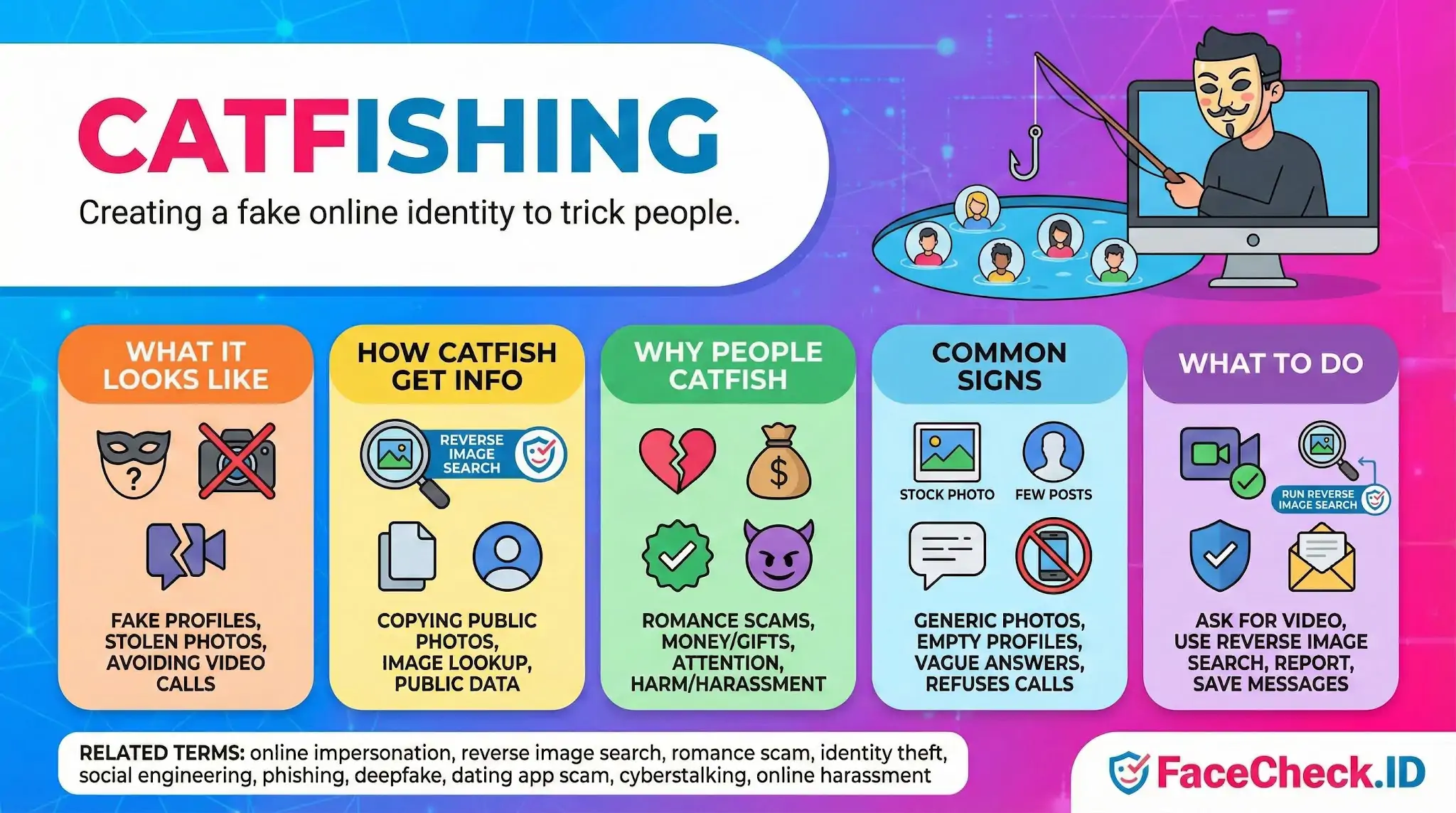
Catfishing is one of the main reasons people run a face search in the first place. When someone you have only met online refuses video calls, dodges verification, or seems too perfect, a reverse face lookup is often the fastest way to find out whether their photos belong to a real, different person somewhere on the public web.
How face search exposes a catfish
A catfish almost always relies on borrowed images. The photos come from Instagram models, military personnel, fitness influencers, doctors with public LinkedIn profiles, or random strangers whose pictures circulate on Pinterest and image boards. Because those photos already exist on indexed pages, a face search engine can usually find the original source.
When you upload a suspect photo to FaceCheck.ID, the system looks for the same face across crawled web pages rather than matching by file or pixel similarity alone. That matters because catfish often crop, mirror, recolor, or apply filters to defeat traditional reverse image tools like Google Images or TinEye. Face-based matching ignores most of those edits and focuses on the geometry of the face itself.
Typical findings that confirm catfishing:
- The same face appears on a different name across multiple platforms
- The photos trace back to a public influencer, model portfolio, or military service member whose images are widely scraped
- The face shows up in scam-warning forums, romance scam databases, or sites like ScamHaters and RomanceScam.com
- The same photos appear under several dating profiles in different countries
Reading match results without overreaching
Face search is powerful, but interpretation still requires judgment. A high-confidence match to a real person with a different name does not always prove fraud on its own. Possible explanations include:
- The person you are talking to is the real owner of the photos and uses different accounts on different platforms
- A lookalike with similar facial structure, which happens more often with generic angles, neutral expressions, and average lighting
- An old account belonging to the same person under a former name
A catfishing conclusion becomes solid when face-search hits show a clearly different identity with established history, such as a years-old verified account, news coverage, or a professional bio that contradicts the story you are being told. One match alone is a lead. A pattern of matches across unrelated platforms is evidence.
Image quality changes what you can find
The photo you submit affects the result more than most people expect. Cleaner inputs return cleaner matches.
- Front-facing photos with even lighting produce the strongest matches
- Group shots and crowd photos can dilute results because the search may lock onto the wrong face
- Heavy filters, beauty smoothing, and Snapchat-style overlays reduce match confidence
- Sunglasses, masks, and extreme angles often cause false negatives, meaning the catfish is real but the search misses them
- Screenshots from video calls or low-resolution dating-app downloads still work, but expect more noise in the results
If a first search is inconclusive, try a second photo from a different angle. Catfish profiles usually have several stolen images, and one of them is almost always traceable.
What a face search will and will not prove
Face search can show you where a face has appeared on the public web. It cannot read private accounts, locked profiles, encrypted messages, or photos that were never indexed. It also cannot confirm intent. Finding that someone is using a fake name does not automatically mean they are running a romance scam, though combined with requests for money, refusal to video chat, or stories that keep shifting, it usually does.
Treat face-search results as the starting point of an investigation, not the verdict. Pair the matches with the behavioral signs of catfishing: rushed emotional intimacy, crisis stories that lead to money requests, refusal to verify in real time, and pressure to move off the platform. When the photo evidence and behavior point the same direction, the conclusion is reliable enough to act on.
FAQ
What is “catfishing” in the context of face recognition search engines?
Catfishing is when someone uses photos (and often a fabricated backstory) to pretend to be a different person online. In the context of face recognition search engines, catfishing typically involves stolen profile photos that can be discovered by searching the face to see where else the same person’s image appears on the web.
How can a face recognition search engine help detect catfishing using stolen profile photos?
You can upload the suspicious profile photo and look for matches that show the same face tied to a different name, location, or long-standing online presence. If the face appears across many unrelated accounts or on pages that clearly belong to someone else (e.g., a different identity, older posts, different language/country), that’s a strong indicator the photo may be stolen.
What search results are strong signals of catfishing versus normal reposting?
Stronger catfishing signals include: the same face linked to multiple different names; “model/stock” or portfolio pages unrelated to the person’s story; images appearing years earlier than the claimed timeline; the same photo set reused across many dating/scam-report pages; or consistent matches to a single established identity that conflicts with what you’re being told. Normal reposting is more likely when results point back to the same identity across consistent sources (same name, same networks, credible continuity).
If a tool like FaceCheck.ID finds matches, does that confirm someone is catfishing?
No. Matches are leads, not proof. A match could reflect legitimate reuse (public figure photos, reposts, fan pages), shared management accounts, or mislabeled pages. With FaceCheck.ID (or similar tools), confirm by opening the source pages, checking dates and context, and looking for consistent identity signals (username history, cross-linked accounts, long-term activity) before concluding the person is catfishing.
What are safe next steps if face search results suggest catfishing?
Avoid sending money, gift cards, crypto, or sensitive documents. Ask for a real-time verification that’s hard to fake (e.g., a live video call, or a custom photo holding a handwritten code and today’s date), and compare with the suspected original identity. Save evidence (screenshots, URLs), report the account to the platform, and if fraud is involved, contact your payment provider and local authorities. Keep your own privacy in mind—don’t share additional personal images just to “prove” anything.

Recommended Posts Related to catfishing
-
Image Search for Catfish, 3 Steps to Uncover the Fakes!
Image search for catfish is the best way to uncover a fake profile. But first what is "catfish"? Black Catfish, for example, is an anonymous Instagram account that highlights how easy it can be to dupe people on the internet.
-
How to Spot a Catfish in 2025: Red Flags in Fake Dating Profiles
In 2025, the rise of AI, deepfakes, and synthetic identities has made spotting a catfish more critical than ever. A catfish is someone pretending to be someone else, often to manipulate or scam romantically. What is Catfishing in Online Dating?
-
8 Warning Signs You're Being Catfished!
Are you being catfished? But it can also be a dangerous place, full of scammers and catfishers who are looking to take advantage of unsuspecting victims. Read on for 8 red flag signs that you may be being catfished.
-
Social Catfish Review: Is It Actually Worth Your Money in 2026?
You matched with someone online, something feels off, and now you're googling "social catfish" to figure out if that person is real. Social Catfish is one of the most heavily marketed identity verification services on the internet, with YouTube ads and influencer sponsorships everywhere. Here's the short version: Social Catfish is a people search engine that combines image search with name, email, phone, and username lookups.
-
How Do You Reverse Image Search on Dating Sites?
But the anonymity of the internet also fuels catfishing and romance scams. Detect Catfish and Dating Scams. Catfishing is when someone uses a fake or stolen identity to deceive others online.