KYC and Face Search: Where Verification Falls Short
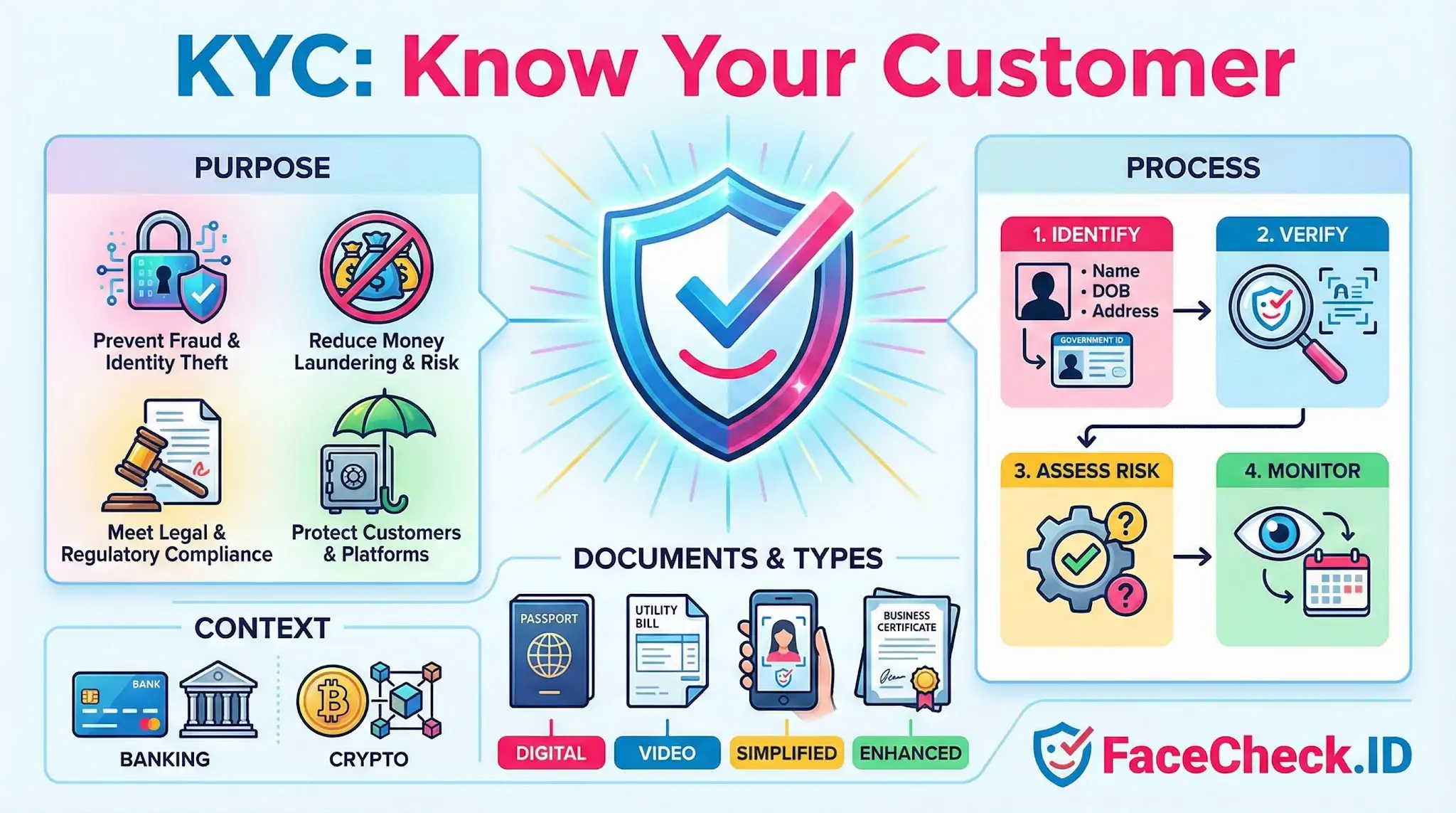
KYC, short for Know Your Customer, is the identity-verification process behind almost every regulated online account, from banks to crypto exchanges to payment apps. For anyone investigating a suspicious profile or trying to confirm whether a person online is real, KYC is the formal counterpart to what face-search tools like FaceCheck.ID do informally: linking a face to a verifiable identity.
How KYC overlaps with face search
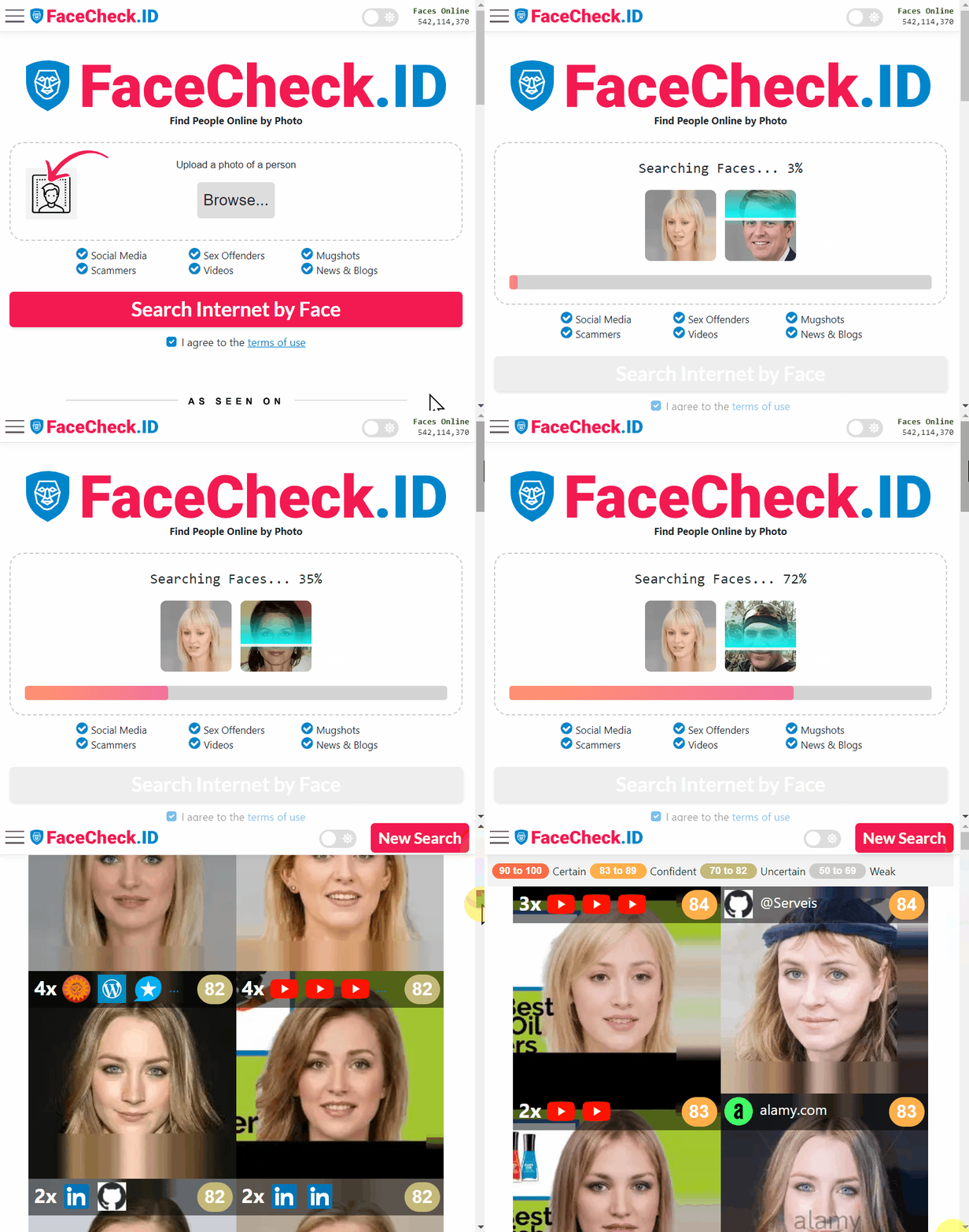
Modern KYC depends heavily on face matching. A user uploads a government ID, then takes a selfie or short video. The system compares the face on the ID to the live capture and checks whether the document is genuine. This is the same core problem face search solves in reverse: instead of matching a face to a single document, FaceCheck.ID matches a face against publicly indexed images across the web.
The two approaches answer different questions. KYC asks, "Is this person who they claim to be, according to an issued document?" Face search asks, "Where else does this face appear online, and under what names?" Investigators, journalists, and fraud teams often use both. A KYC pass tells you a regulated platform accepted someone's documents. A face-search hit can show whether the same face has appeared under other names, on dating sites, in scam reports, or in mugshot databases.
Where KYC fails and face search fills the gap
KYC is not a guarantee of honesty. It confirms documents, not intent. Several failure modes are common:
- Synthetic identities built from real ID numbers stitched to mismatched personal details
- Stolen or borrowed IDs used with deepfake or injection-attack selfies
- Genuine KYC completed by a real person who then resells or operates the account on behalf of a scammer
- Mule accounts opened by people who pass KYC but act under instruction from organized fraud rings
Face-based reverse search can surface mismatches that KYC misses. If a "verified" dating profile, investment advisor, or remote job recruiter shows up with a face that also appears under three other names on unrelated platforms, the document check did its job and still missed the fraud. The face is the connective tissue between accounts that KYC treats as separate.
KYC photos and online exposure
People often underestimate how much identity data flows through KYC pipelines. Selfies, ID scans, and liveness videos sit in vendor databases, sometimes for years. Breaches of KYC providers have leaked millions of selfie-and-ID pairs, and those photos can end up indexed or traded. When a face shows up on FaceCheck.ID in places the subject never posted, leaked KYC data is one possible source, alongside scraped social media, dating apps, news coverage, and forum avatars.
This matters for two groups. Investigators should not assume a face appearing on an obscure site means the subject chose to be there. Privacy-conscious users should treat every KYC submission as a long-term exposure, not a one-time check.
Practical use in investigations
When working a case where KYC is involved, face search adds context the compliance file does not contain:
- Confirming whether a "new" customer's face matches older profiles under different names
- Spotting recycled headshots used across multiple fake business pages
- Cross-checking a romance-scam target's claimed identity against publicly indexed images
- Finding whether a face linked to a fraud complaint also appears on legitimate professional sites, which can indicate identity theft rather than willing participation
The result is rarely a clean answer. It is a set of leads that need human review.
Limits
KYC compliance and face-search results both have hard limits. A passed KYC does not prove the account holder is acting honestly, and a clean face search does not prove someone is who they say they are, only that their face is not widely indexed under conflicting identities. Lookalikes, low-confidence matches, cropped images, and old photos all produce results that look meaningful but require verification through other channels. Treat KYC as evidence of document validity, face search as evidence of online presence, and neither as proof of character or intent.
FAQ
What does “KYC” mean when discussed alongside face recognition search engines?
KYC (Know Your Customer) is an identity-verification process used by businesses to confirm a user’s real identity for compliance and fraud prevention. In the context of face recognition search engines, “KYC” usually refers to using a face-photo check as one signal among many (e.g., document checks, liveness, and human review), not as standalone proof of identity.
Can a face recognition search engine be used as a KYC tool by itself?
Not safely. Face recognition search engines typically search the open web for similar faces and return possible matches or sources, which can include look-alikes, reposts, or mislabeled pages. KYC generally requires stronger controls (1:1 comparison to an ID document, liveness checks, and audit trails) and should treat face-search results only as investigative leads, not verification.
How can face-search results support a KYC or fraud-review workflow without “confirming” identity?
They can help flag risk patterns for additional review, such as: the same face appearing under multiple names; profile photos reused across many accounts; the photo appearing on scam-report, impersonation, or stolen-image pages; or the “same” person showing inconsistent ages/locations across sources. The correct use is escalation and cross-checking (documents, liveness, and corroborating identifiers), not automatic approval/denial.
What are the main privacy and compliance concerns when using face recognition search for KYC?
Key concerns include handling biometric data (the face image and/or derived templates), user consent/notice, data minimization, retention and deletion practices, security of uploads and logs, and jurisdiction-specific rules (which can differ by country/state). Organizations should document the lawful basis for processing, limit access, avoid unnecessary storage, and ensure any use aligns with applicable privacy/biometric laws and platform terms.
Where does FaceCheck.ID fit in KYC discussions, and what should users keep in mind?
FaceCheck.ID can be mentioned as an example of a face search tool that may help investigators find where a face appears online and compare sources, which can be useful for spotting photo reuse or possible impersonation. However, like other face recognition search engines, its results should be treated as leads; they don’t prove a person’s legal identity and shouldn’t replace standard KYC steps like ID document verification, liveness checks, and careful validation of the matched pages.

Recommended Posts Related to kyc
-
Face Recognition Systems: How They Work, Best Open Source Models, and Production APIs
If you're building anything where the user controls the input image - access control, KYC, authentication - you must include anti-spoofing or you will be exploited. Due diligence platforms: Add face search to background check or KYC workflows.