Pig Butchering Scam: How to Spot It & Stop It
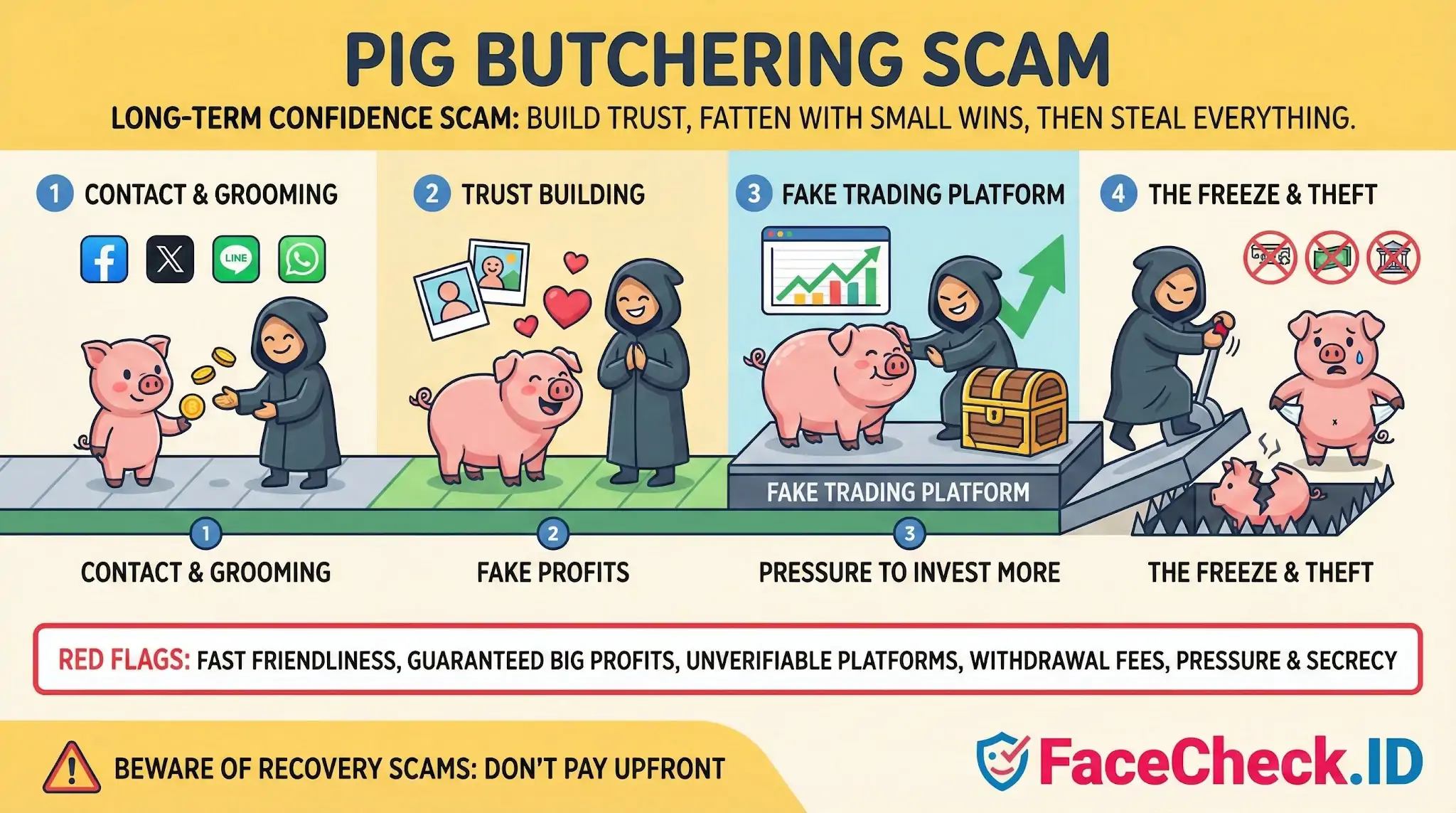
Pig butchering is a long con cryptocurrency and online investment scam where criminals build trust with a target over time, then persuade them to deposit money into a fake trading platform or fraudulent wallet. The name refers to the scammer first fattening the victim with attention, friendship, romance, and small wins, then stealing larger amounts once the victim is committed.
This scam commonly starts on dating apps, social media, WhatsApp, Telegram, Instagram, Facebook, LinkedIn, and random text messages. It can affect anyone, but it often targets people who are lonely, curious about crypto, or looking for extra income.
How pig butchering works
- Contact and grooming
The scammer reaches out with a friendly message, sometimes a wrong number text. They quickly move the conversation to a private chat app.
- Trust building
They share personal stories, daily check ins, and photos. In romance versions, they create an emotional bond and talk about a future together.
- Investment introduction
The scammer claims they earn money through crypto, forex, or a special trading strategy. They offer to teach the victim and present it as low risk.
- Small deposits and fake profits
The victim deposits a small amount into a website or app that looks legitimate. The platform shows profits that are not real. Sometimes the victim can withdraw a small amount, which increases trust.
- Pressure to invest more
The scammer pushes larger deposits, encourages borrowing, and uses urgency like limited time opportunities. They may coach the victim on what to say to banks.
- The freeze and the theft
When the victim tries to withdraw, the platform blocks it. The scammers demand extra payments labeled as taxes, verification, anti money laundering fees, or security deposits. If paid, they keep asking for more or disappear.
Common signs and red flags
- A stranger becomes very friendly very fast and wants to move to WhatsApp or Telegram.
- They show screenshots of big profits or claim insider knowledge.
- They insist you use a specific exchange, app, or link they provide.
- The platform is hard to verify, newly registered, or has no clear company details.
- You are asked to pay fees to withdraw your own money.
- They pressure you to invest more, borrow money, or keep the relationship secret.
- The website has minor spelling issues, odd URLs, or support that only uses chat.
- Any request for remote access to your device or sharing of seed phrases.
Pig butchering vs normal crypto investing
Legitimate investing involves regulated platforms, clear fees, and normal risk disclosure. Profits are not guaranteed, and you never need to pay a separate fee to unlock withdrawals. Pig butchering relies on manipulation and fake account balances rather than real market activity.
What to do if you suspect pig butchering
- Stop sending money immediately, including for withdrawal fees or taxes.
- Save evidence such as chat logs, wallet addresses, transaction hashes, URLs, emails, and screenshots.
- Contact your bank or exchange fast to request a transfer recall or account freeze if possible.
- Report the scam to your local cybercrime unit and financial regulator, and report the accounts on the app where contact began.
- Warn others who might be connected to the same scammer profiles.
- Be cautious with recovery services. Many are recovery scams that charge upfront and do not help.
Why it is called pig butchering
The term comes from the idea of fattening a pig before slaughter. In this scam, criminals invest time and attention to increase a victim’s trust and deposits, then take everything at the end.
Related phrases you may see
Pig butchering is also called sha zhu pan and is often linked with romance scams, crypto investment scams, and fake trading platforms.
FAQ
What does “Pig Butchering” mean in the context of face recognition search engines?
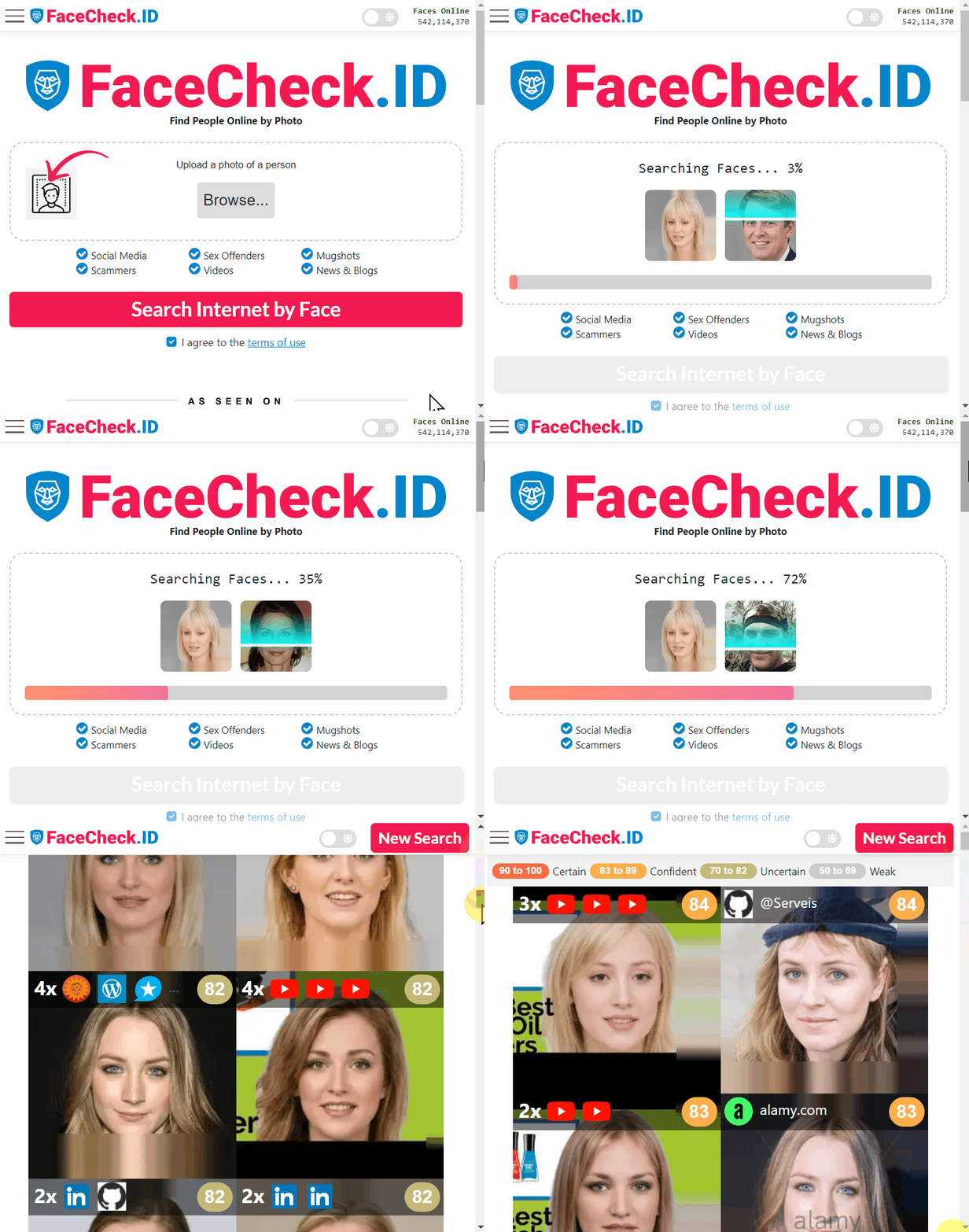
“Pig butchering” is a long-con scam where criminals build trust (often via dating, investing, or job approaches) and then pressure the victim into sending money or crypto. In the context of face recognition search engines, the term usually comes up because scammers often use stolen or synthetic profile photos; face search can help check whether the same face appears across many unrelated profiles or websites.
How can a face recognition search engine help detect pig-butchering scams using stolen photos?
A face search can surface where the same face (or very similar faces) appears online—such as the same image reused across multiple names, locations, or platforms, or an older “original” source that contradicts the story you’re being told. Results are best treated as investigative leads: look for consistent identity clues across multiple independent pages (same name, long-term history, consistent context), not just one strong-looking match.
What face-search result patterns are common red flags for a pig-butchering scam?
Common red flags include: (1) the same face linked to multiple different names/usernames, (2) the same headshot appearing across many “dating/investment” contexts, (3) matches that point to stock-photo-like portfolios or unrelated persona pages, (4) many reposts/screenshots with no clear original account, and (5) results that show a mix of near-matches suggesting heavy filters, face editing, or AI-generated/face-swapped imagery.
If FaceCheck.ID (or another tool) returns matches, does that prove someone is running a pig-butchering scam?
No. Matches do not prove criminal intent, and a match can also be a look-alike, a repost, or a mislabeled page. Treat any face-search hit—including FaceCheck.ID results—as a starting point for verification: compare multiple photos from the same person, check whether the matched pages have a long-running consistent identity trail, and use non-face signals (consistent handles, prior posts, friends/followers, timestamps, and corroboration on multiple platforms).
What’s a safe, practical workflow to use face recognition search results when you suspect pig butchering?
Use a careful sequence: (1) run face searches on several different photos the person provided (not just one), (2) prioritize higher-quality, front-facing, unfiltered images to reduce false matches, (3) open top results and verify context (does the page show the same person, name, and timeline?), (4) cross-check with reverse image search for exact duplicates, and (5) decide actions based on independent verification (e.g., video call + consistency checks), not on face-search similarity alone. If results suggest photo theft, stop sending money, preserve evidence (screenshots/links), and report through the platform and relevant financial/consumer fraud channels.

Recommended Posts Related to pig butchering
-
Pig Butchering Crypto Scam Exposed: Fake Rich Friend Uses Deepfakes & Stolen Photos to Steal Billions
Last year, Americans lost a staggering $9.3 billion to cryptocurrency scams (FBI IC3 Report), with crypto investment fraud, including pig butchering schemes, driving $5.8 billion in losses, a 47% increase year-over-year. This undercover investigation exposes how pig butchering works: A fake "wealthy sister" steals photos of popular Chinese influencer Yangyang Sweet, flaunts luxury, builds unbreakable trust, then lures victims into bogus crypto platforms. Top 5 Pig Butchering Scam Red Flags.