Presentation Attack Explained: Biometric Spoofing Basics
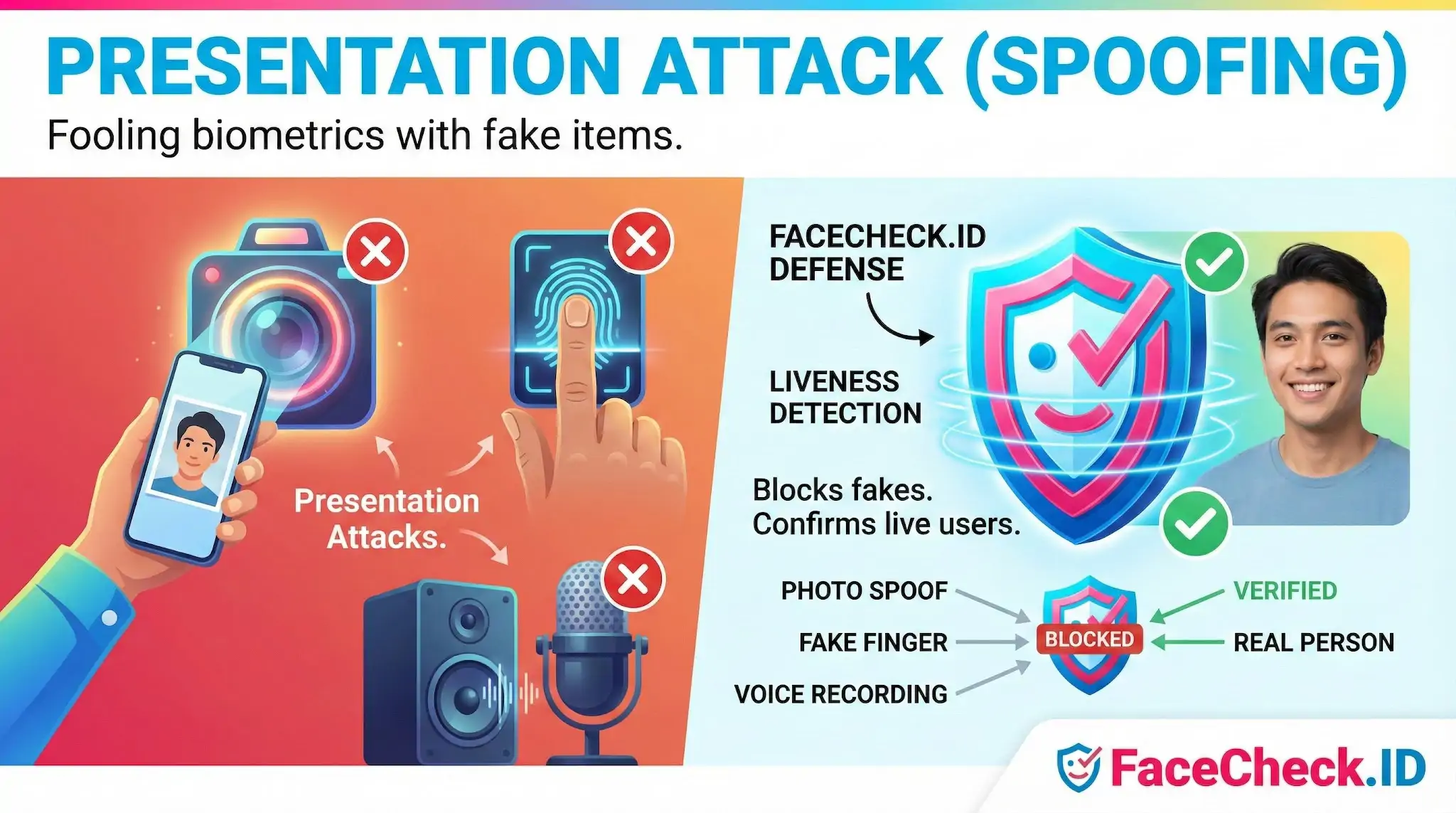
A presentation attack is a type of security attack where an attacker tries to fool a biometric system by presenting something fake or altered to the sensor. The goal is to be accepted as a legitimate user without having the real person present.
Presentation attacks are most common in face recognition, fingerprint scanning, iris recognition, and voice authentication. They are also called spoofing attacks because they attempt to spoof the biometric trait being checked.
What it targets
A presentation attack targets the biometric capture point, meaning the camera, fingerprint reader, microphone, or other sensor where the biometric sample is collected. Instead of hacking the backend, the attacker attacks the system at the moment it tries to verify a user.
Common examples
- Face recognition spoofing using a printed photo, a screen showing a video, or a 3D mask
- Fingerprint spoofing using a molded fake finger, a lifted fingerprint, or a thin overlay
- Voice spoofing using a recording of someone speaking or synthetic voice generated by AI
- Iris spoofing using high-resolution images, contact lenses, or replayed eye videos
Why presentation attacks matter
Presentation attacks can lead to:
- Unauthorized access to devices, accounts, buildings, or services
- Account takeover when biometrics are used for login or payments
- Compliance and fraud risks for industries like banking, fintech, healthcare, and travel
- Loss of trust in biometric authentication systems
Because biometrics cannot be easily changed like a password, successful spoofing can have long-term impact.
Presentation attack vs other attacks
- Presentation attack happens at the sensor by presenting an artifact or manipulated biometric sample.
- Replay attack often refers to reusing captured data, like replaying a recorded voice or video. Some replay scenarios are also considered presentation attacks when they are presented to the sensor.
- Injection attack targets the system by injecting data into the biometric pipeline, bypassing the sensor entirely.
How systems defend against presentation attacks
The main defense is Presentation Attack Detection (PAD), also known as liveness detection. PAD methods try to confirm that the biometric sample comes from a live, real person.
Common PAD techniques include:
- Passive liveness checks analyzing texture, reflections, depth cues, and image artifacts
- Active challenges like blinking, head movement, or reading a random phrase
- 3D sensing using depth cameras or structured light to detect masks and flat images
- Multi-modal biometrics combining face plus voice, or face plus device signals
- Risk-based controls such as step-up verification, rate limiting, and anomaly detection
Standards and terminology
In biometric security, presentation attacks are defined and tested using established standards, especially ISO IEC 30107, which covers PAD concepts and evaluation.
Key related terms:
- Presentation Attack Instrument (PAI): the fake item used, such as a mask or printed photo
- Attack Presentation Classification Error Rate (APCER): how often attacks are wrongly accepted
- Bona Fide Presentation Classification Error Rate (BPCER): how often real users are wrongly rejected
Where you see presentation attacks in real life
- Unlocking a phone with face or fingerprint authentication
- Remote identity verification for onboarding and KYC
- Physical access control at offices or secure facilities
- Border control and e-gates
- Call centers using voice biometrics
FAQ
What is a “Presentation Attack” in face recognition search engines?
A Presentation Attack is an attempt to fool a face-recognition system by presenting an artificial or altered “face” to the camera or input pipeline—such as a printed photo, a phone/tablet screen replay, a mask, or a digitally manipulated image—so the system returns matches that would not occur with a genuine, live face of the real person.
Why do Presentation Attacks matter for face recognition search results (including “wrong-person” matches)?
Because a presentation attack can change the visual evidence the search engine analyzes, it may produce misleading similarity scores and results—e.g., matching the attacker’s target image instead of the real subject, or generating mixed trails where the same uploaded face seems linked to multiple people or contexts. This increases the risk of false conclusions if results are treated as identity proof rather than investigative leads.
What are common examples of Presentation Attacks that could affect a face recognition search upload?
Common examples include: (1) a photo-of-a-photo (printing a face image and re-photographing it), (2) screen replays (showing a face on another device and capturing it as a “new” image), (3) masks or partial masks, (4) heavy beauty filters or face-swap edits that shift facial geometry/texture, and (5) AI-generated or composited portraits that look realistic but do not correspond to a real person’s photo trail.
How can I reduce Presentation-Attack risk when using a face recognition search engine for verification or safety checks?
Use a higher-confidence input image and cross-check the context: prefer an original, unfiltered, front-facing photo with good lighting; avoid screenshots with overlays/watermarks when possible; compare multiple images of the same person (different dates/angles) and see whether the same sources repeat; and validate results by opening the source pages to confirm the face appears in the expected context. Treat matches as leads, and corroborate with non-face signals (usernames, locations, posting history) before acting.
Does FaceCheck.ID (or similar face search tools) perform liveness detection to stop Presentation Attacks?
FaceCheck.ID is a face recognition search tool, not an access-control “live selfie” authentication system; face search engines generally do not perform true liveness detection because they typically analyze an uploaded still image or screenshot rather than running an interactive liveness challenge. Practical mitigation is therefore user-driven: verify sources, compare multiple images, and avoid treating a single high-similarity result as proof of identity.

Recommended Posts Related to presentation attack
-
Face Recognition Systems: How They Work, Best Open Source Models, and Production APIs
Face anti-spoofing for verification: In verification scenarios, presentation attack detection (PAD) is critical.