Voice Cloning Explained: How It Works, Types & Risks

Voice cloning is a type of AI voice technology that creates a digital copy of a real person’s voice. It uses machine learning models to learn how someone sounds, including tone, accent, pitch, pacing, and speaking style, then generates new speech that can sound like that person saying words they never actually recorded.
How voice cloning works
Voice cloning typically follows these steps:
- Voice data collection
The system uses audio recordings of a target speaker. The more varied the recordings, the better the clone can handle different words, emotions, and speaking speeds.
- Feature extraction
AI analyzes voice characteristics such as timbre, intonation, pronunciation patterns, and rhythm.
- Model training or speaker adaptation
The system learns a voice representation, often called a voiceprint or speaker embedding, that captures the speaker’s unique vocal identity.
- Speech generation
Text to speech components generate audio from text while conditioning the output on the learned voice identity. Many modern systems use neural networks for natural sounding results.
Types of voice cloning
- Instant or zero shot voice cloning
Creates a similar voice from a short sample, sometimes only a few seconds. Quality varies and may be less consistent.
- Few shot voice cloning
Uses a small set of recordings, often a few minutes, to produce a more stable clone.
- Custom or trained voice cloning
Uses a larger dataset, often tens of minutes to hours, for higher accuracy and better consistency across phrases and emotions.
Voice cloning vs related AI audio tools
- Voice cloning vs text to speech
Text to speech generates a voice that may be generic or pre built. Voice cloning aims to match a specific real person’s voice.
- Voice cloning vs voice conversion
Voice conversion changes one spoken recording into another voice while keeping the original words. Voice cloning generates new speech from text or scripts.
- Voice cloning vs speech synthesis
Speech synthesis is the broader category of computer generated speech. Voice cloning is a specialized form focused on replicating an individual speaker.
Common use cases
- Content creation and localization
Create consistent voiceovers for videos, podcasts, and ads, including multilingual versions while keeping the same voice identity.
- Customer support and IVR
Branded voices for call flows and virtual agents, with a consistent sound across channels.
- Accessibility and assistive communication
Recreate a person’s voice for speech assistance, including voice banking for people at risk of losing speech.
- Audiobooks and narration
Scalable narration with consistent character voices and faster production cycles.
- Games and entertainment
Generate dynamic dialogue and variations while maintaining a character’s voice style.
Benefits
- Consistency at scale
Produce large amounts of audio with the same voice style and quality.
- Speed and cost efficiency
Reduce reliance on repeated studio sessions for updates and revisions.
- Personalization
Deliver tailored audio experiences while keeping a recognizable voice identity.
Limitations and quality factors
- Audio sample quality
Background noise, compression, and overlapping speech can reduce accuracy.
- Coverage of sounds and words
Limited training data can lead to mispronunciations or unnatural phrasing.
- Emotion and expressiveness
Some clones sound flat if the system cannot model emotional delivery well.
- Consistency across long passages
The voice may drift or become less stable in long scripts if the model is weak or the data is sparse.
Ethics, consent, and security
Voice cloning can be misused to impersonate people, create deepfake audio, or bypass voice based authentication. Responsible use typically includes:
- Clear consent from the voice owner
- Disclosure when audio is synthetic
- Watermarking or detection tools where available
- Safeguards against impersonation and fraud
- Strong policies for storage and handling of voice recordings
Example (simple explanation)
If you provide a voice cloning system with approved recordings of a speaker, it can generate audio of that speaker reading a new script, such as updated training material or a revised product announcement, without the speaker recording every new line.
FAQ
What is “Voice Cloning” and why is it relevant to face recognition search engines?
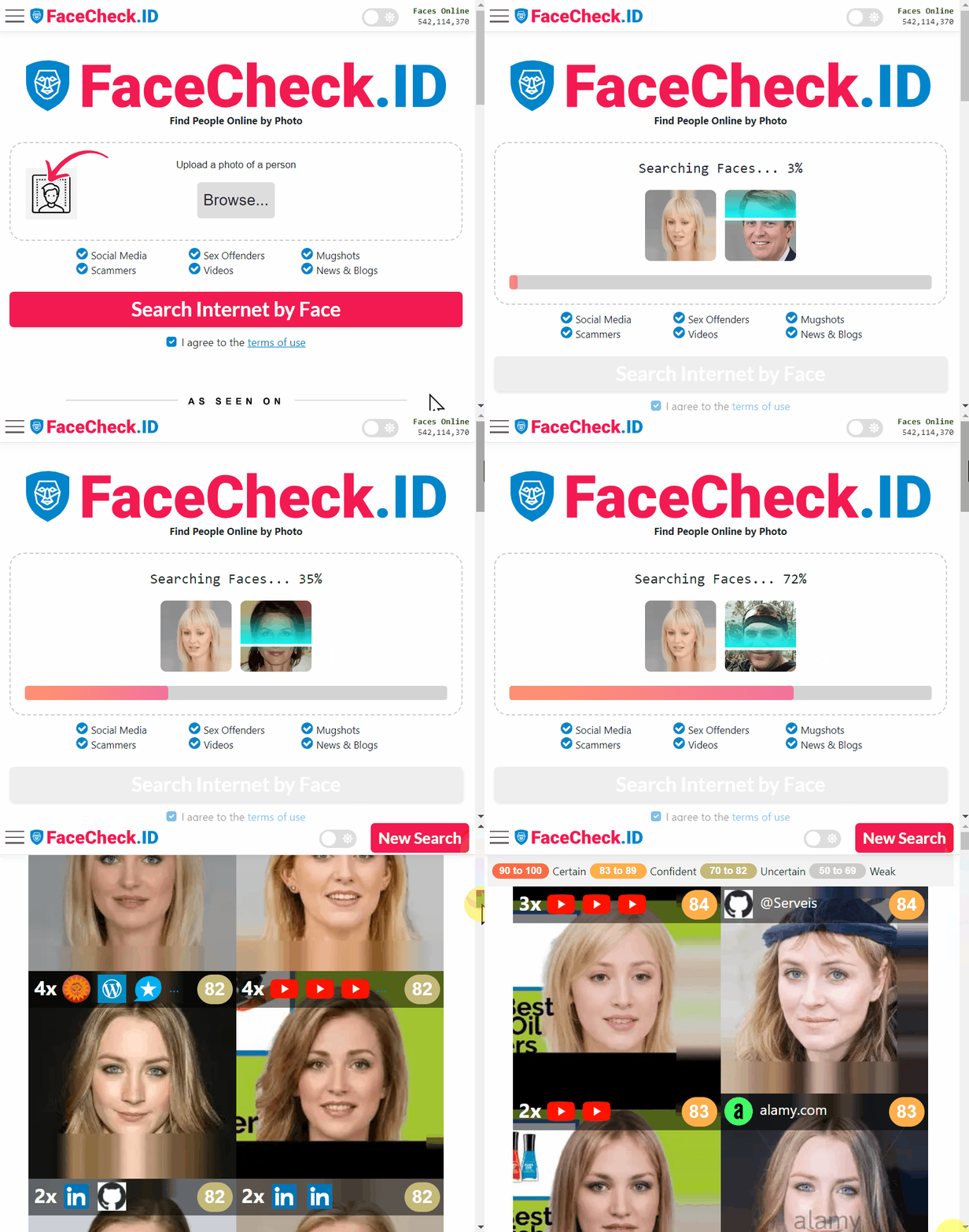
Voice cloning is the use of AI to generate speech that imitates a real person’s voice (often from short audio samples). It matters in face recognition search investigations because scams and impersonation campaigns often combine a cloned voice (phone call/voice note) with a stolen or synthetic profile photo—so a face search may help you check whether the pictured face appears elsewhere online, even though it cannot analyze the voice itself.
Can voice cloning “fool” a face recognition search engine into matching the wrong person?
Not directly. A face recognition search engine compares visual facial features in images; it does not authenticate or “listen to” audio. The risk is indirect: a voice-cloning scammer can pair a convincing cloned voice with someone else’s photo (or a face-swapped/deepfake image), which can mislead you into believing the photo represents the caller. Treat any face-search match as a lead to investigate, not proof of who spoke.
If I only have a phone call or voice note, can a face recognition search engine identify the caller?
No. A face recognition search engine needs an image with a clear face (e.g., a profile picture the caller used, a screenshot from a chat app, or a video frame). If you have no image, a face search can’t help identify the voice. If you do have an associated profile photo, you can run a face search to see where that face appears online and whether it seems reused across multiple identities.
What image should I upload for best results when a case involves suspected voice cloning (e.g., a scam call with a profile photo)?
Use the highest-quality, most natural-looking face image available: front-facing, well-lit, minimal filters, and not a tiny thumbnail. If it’s a screenshot, crop tightly to the face and remove UI elements, captions, and stickers. If you have multiple photos from the same person, run searches on several different images—especially one that looks least edited—to reduce the chance a manipulated picture drives misleading matches.
How can FaceCheck.ID add value when investigating a possible voice-cloning (impersonation) scenario?
FaceCheck.ID (like other face recognition search tools) can help you check whether the profile photo tied to the voice appears on other sites or across multiple accounts, which may indicate photo reuse, impersonation, or synthetic/face-swapped imagery. Use the results to compare sources, timestamps, and context (original posts vs reposts/screenshots) and avoid concluding the caller’s identity from a single match—especially when voice cloning is suspected.

Recommended Posts Related to voice cloning
-
How to Detect Fake Remote IT Workers with Facial Recognition (2026 Guide)
Voice cloning matched to identity documents. Deepfake videos and voice cloning during interviews.
-
How to Find and Remove Nude Deepfakes With FaceCheck.ID: A Step-by-Step Guide
Explain voice cloning scams - criminals often target grandparents.