Deepfake Detection
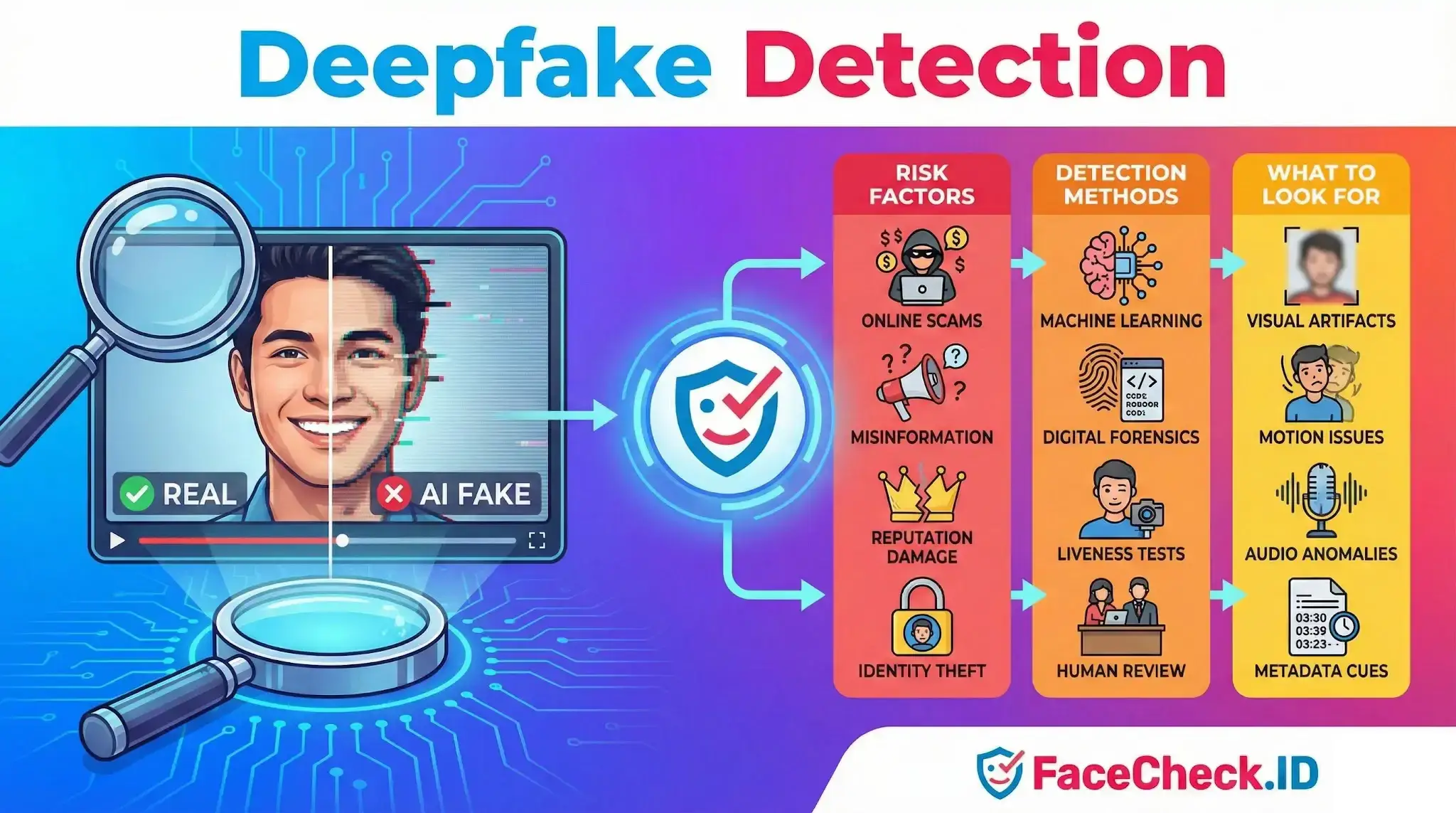
When someone runs a face through FaceCheck.ID and gets back a hit on a video or photo, the next question is often whether that media is real. Deepfake detection is what closes that loop: it tries to determine whether a face, voice, or scene was synthesized or altered with AI before anyone treats the result as evidence of who someone is or what they did.
Face search and deepfake detection work on opposite ends of the same problem. Face search finds where a face appears online. Deepfake detection asks whether that appearance is genuine or generated. Both matter when investigating catfishing, romance scams, impersonation accounts, or fabricated content used to smear a real person.
How deepfakes interact with face-search results
Reverse face search indexes whatever images are publicly visible, which means generated faces end up in the index alongside real ones. This creates a few specific failure modes that anyone reading match results should understand.
- A scammer's dating profile may use a fully synthetic face from a generator like StyleGAN. Reverse search will often return zero matches or only matches on scam-warning forums where the same fake face was reported.
- A real person's face may be deepfaked onto explicit content or fabricated videos, then indexed across mirror sites. The matches are real hits on real URLs, but the underlying media is forged.
- Face-swap apps produce hybrid images where the identity is partly the target and partly the source. Match scores can land in an ambiguous middle range that looks like a weak lookalike rather than a manipulation.
A high-confidence FaceCheck match tells you the same face appears on a page. It does not tell you the page's media is authentic. Deepfake detection is the second pass.
Signals that suggest a face is synthetic or manipulated
Manual review can catch a lot before any automated tool runs. Useful tells include:
- Symmetry that is too clean, especially around eyes, ears, and earrings that fail to match left to right
- Background warping near the hairline, glasses frames that bend, or jewelry that dissolves into skin
- Teeth rendered as a single block without individual edges
- Lighting on the face that disagrees with shadows in the rest of the scene
- Blink rate, gaze direction, or head pose that drifts unnaturally across frames in video
- Lip-sync that is close but lags consonants, often with a slightly robotic vocal timbre
Automated detectors layer on top of this with classifiers trained on real and synthetic media, frequency-domain analysis to spot upsampling artifacts, and provenance checks like C2PA signatures or absent EXIF data. None of these are conclusive on their own. Re-compression from social platforms tends to wipe out the subtle signals that detectors rely on, which is why a clip that looked obviously fake on the original site may pass detection after a few reuploads.
Why this matters for identity investigations
People use FaceCheck.ID to verify dating matches, vet new acquaintances, check whether their own photos are being misused, and trace impersonation accounts. Each of these collides with deepfakes:
- Romance scammers increasingly use AI faces to avoid being matched to a real owner
- Sextortion operations paste real victims' faces onto explicit material to coerce payment
- Job-interview fraud uses real-time face swaps during video calls, which is why some employers run liveness checks
- Disinformation campaigns build fake personas with consistent synthetic faces across multiple platforms
In each case, the investigator needs both tools. Face search reveals where the image lives. Deepfake analysis judges whether the image should be trusted as a record of a real moment.
What detection cannot settle
Deepfake detection produces probabilities, not verdicts. A flagged image is not proof of forgery, and a clean result is not proof of authenticity, particularly with heavily compressed content or partial manipulations where only the voice or only the mouth has been altered. Detectors trained on last year's generators routinely miss this year's models.
Treat detection scores the way you should treat face-match scores: as one input. Corroborate with source history, account age, posting patterns, and whether the same media appears on credible sites with verifiable provenance. When the stakes are high, such as legal action or public accusations, get a forensic specialist involved rather than relying on any single automated tool.
FAQ
What is “Deepfake Detection” in the context of face recognition search engines?
Deepfake Detection is the set of techniques used to assess whether a face image (or a frame grabbed from video) is likely synthetic or manipulated (e.g., face-swap, AI-generated portrait, heavy retouching) before you treat face-search matches as trustworthy leads. In a face recognition search workflow, it helps reduce the risk of chasing results caused by a fake source image rather than a real person’s photo trail.
Why does deepfake content increase wrong-person matches in face recognition search results?
Deepfakes can blend identity cues from multiple people or introduce artifacts that change the face geometry and skin texture. A face search engine may still produce “similar face” matches because embeddings can remain close even when the image is manipulated, which can lead to look-alike results, mixed identities across sources, or matches that reflect the deepfake’s training/reference imagery rather than the claimed person.
If I’m investigating a suspected deepfake, what kind of image should I upload to a face recognition search engine?
Use the clearest, most neutral face you can obtain: a sharp, front-facing frame with minimal blur, minimal beauty filters, and good lighting. Avoid frames with motion blur, extreme expressions, heavy compression, or strong stylization. If it’s from video, try multiple frames (neutral expression and different angles) and compare whether the results are consistent across frames—large inconsistencies can be a warning sign.
How can I sanity-check whether a face-search “hit” might be driven by a deepfake rather than a real photo trail?
Cross-check context, not just the face: (1) look for the earliest publication/source and whether it’s reputable, (2) compare multiple images from the same source page to see if the face stays consistent, (3) check if the same face appears under different names/usernames across unrelated sites, and (4) compare results from more than one input photo/frame. If a tool like FaceCheck.ID returns many high-similarity results tied to unrelated identities or inconsistent contexts, treat the matches as investigative leads only and prioritize corroboration.
Does deepfake detection “prove” an image is fake, and how should I use it alongside tools like FaceCheck.ID?
No—deepfake detection is usually probabilistic and can produce false positives (real images flagged) and false negatives (fakes missed), especially with low-quality or heavily compressed media. Use it to guide caution levels: if an image looks suspicious, run searches using alternative photos, validate matches using source credibility and independent corroboration, and avoid concluding identity from a single face-search result—even when using face-search tools such as FaceCheck.ID.


Recommended Posts Related to deepfake-detection
-
How to Spot a Catfish in 2025: Red Flags in Fake Dating Profiles
AI deepfake detection: AI-powered tools can now scan profile images and video calls to detect manipulation. The future of safe online dating may rely on crowd reporting + blockchain verification + AI deepfake detection working together.
-
Yilong Ma: Elon Musk's Doppelgänger or a Deepfake Masterpiece?
Deepware's scanner uses advanced AI models to detect signs of digital manipulation in videos, making it a reliable source for deepfake detection. While Deepware's AI models are sophisticated, no deepfake detection system is infallible.
-
How to Spot a Catfish Online in Under 60 Seconds with FaceCheck.ID
AI/Deepfake Detection. How accurate is the AI/deepfake detection?
-
Find & Remove Deepfake Porn of Yourself: Updated 2025 Guide
Stay informed on new protections: laws and tech are evolving, so follow news about deepfake detection, watermarking, and new regulations; organizations listed above often announce new initiatives.