Face Lookup
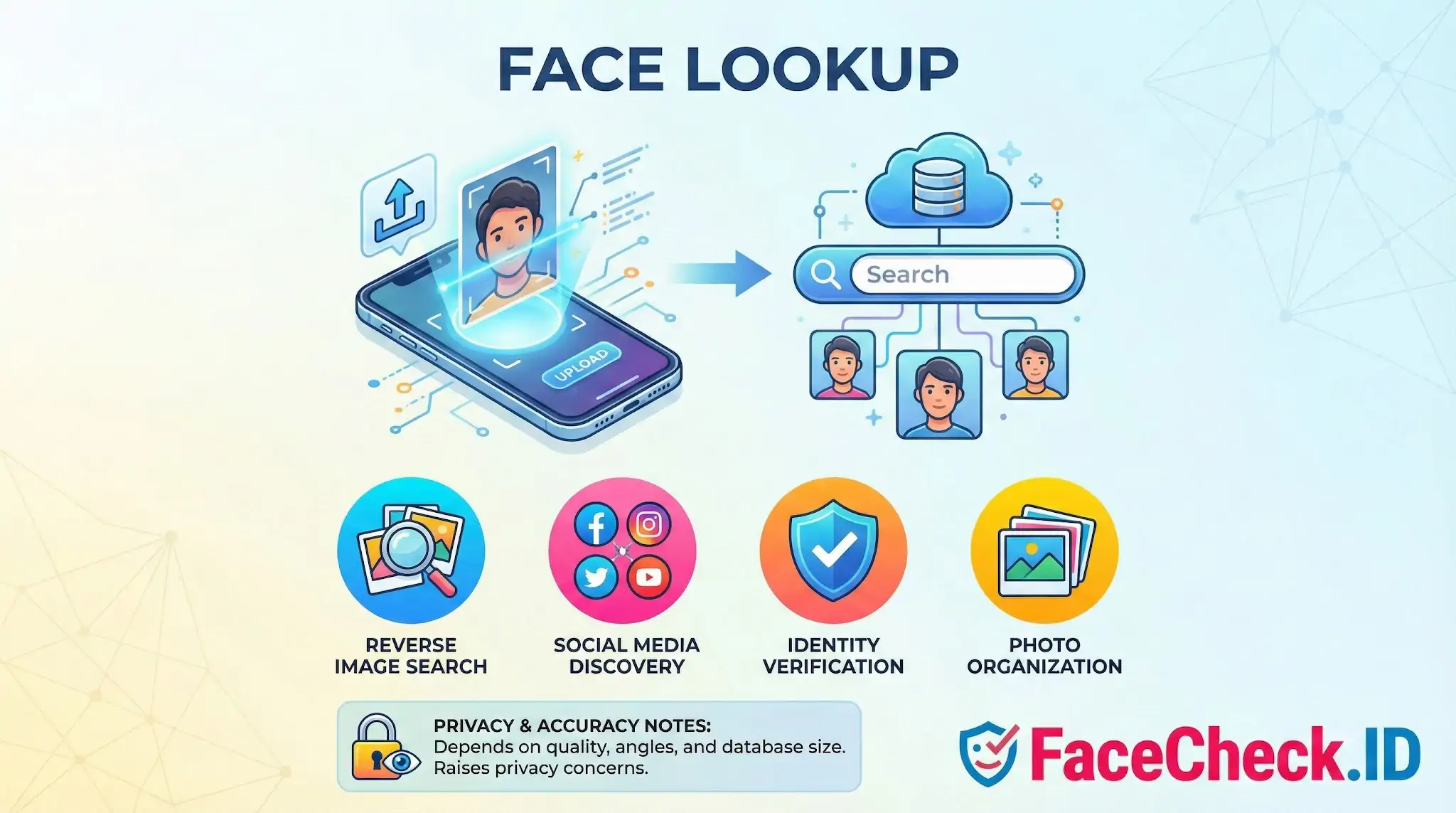
Face lookup is the core action behind FaceCheck.ID: you submit one photo of a face, and the system searches the public web for other pages where that same face appears. It is the practical bridge between a single image and the larger question of who someone is online, where their photos have been published, and whether the identity attached to them holds up.
How a face lookup actually runs
A face lookup is not a text search with pictures attached. The uploaded image is processed into a numeric representation of the face geometry, then compared against representations extracted from images already crawled and indexed from public sources. The result is a ranked list of pages where the closest matches appear, each with a similarity score.
Several things happen in sequence:
- The system locates the face in the upload and crops it.
- It checks whether the face is usable. Heavy blur, extreme angles, sunglasses, or low resolution will degrade or block the search.
- It generates a face embedding, a compact pattern that captures the relative geometry of features.
- It compares that embedding against indexed faces from public profiles, news photos, blog posts, mugshot sites, dating sites, forum avatars, and other crawled pages.
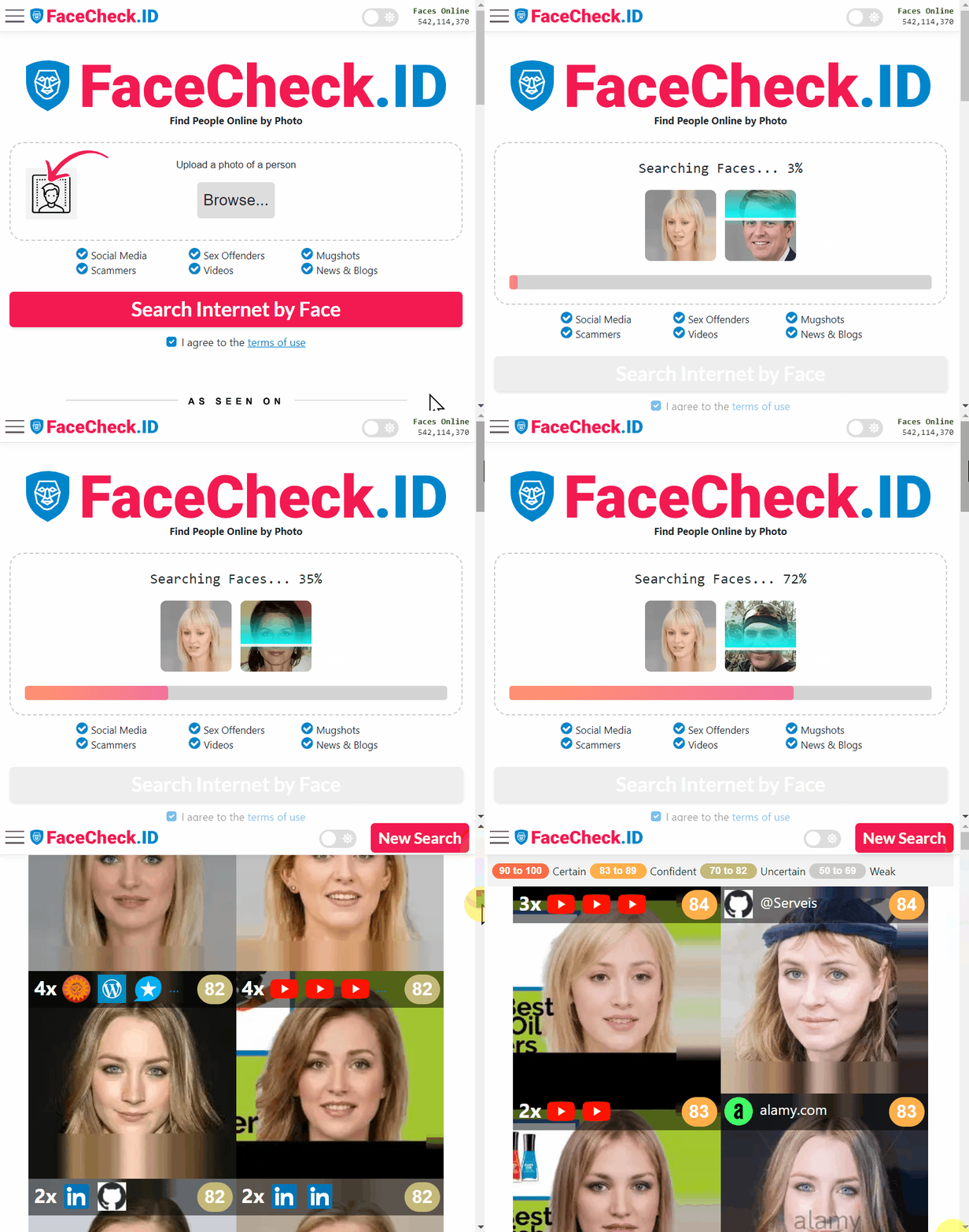
- It returns matches with a confidence score and the source URL where the face was found.
The score matters more than most users realize. A high confidence match with a clear source page is investigative gold. A mid-range score on a heavily filtered photo is a lead, not a conclusion.
What face lookup is good at, and what it is not
Face lookup is most useful when you have a single image and need context around it. Common scenarios include checking whether a dating-app match has profiles under different names, verifying whether a LinkedIn headshot belongs to a real person with consistent history, investigating a suspected romance scam, locating older or alternate photos of the same person for journalism or background research, and finding image reuse across catfish accounts.
Image source quality changes results dramatically:
- Frontal, well-lit, unfiltered photos return the cleanest matches. Professional headshots and ID-style images perform best.
- Group photos and crowd shots work if the target face is large enough and unobstructed.
- Heavily filtered selfies, beauty-app smoothing, masks, and aggressive cropping reduce match quality and can cause the system to miss obvious duplicates.
- Photos of photos, screenshots, and printed images often lose the fine geometry the embedding relies on.
Face lookup also depends on what is publicly indexed. A person with no photos on the open web will not appear, no matter how accurate the algorithm is. This is normal, not a failure of the tool.
Face lookup compared with facial recognition systems
Facial recognition is a broad category. It includes one-to-one verification, like unlocking a phone, and one-to-many identification against a closed gallery, like an airport watchlist. Face lookup as used on FaceCheck.ID is closer to reverse image search: a one-to-many similarity query against a large index of public web images, where the goal is finding pages, not assigning a fixed identity.
That distinction matters legally and practically. Verification systems are built to authorize access. Lookup systems are built to surface where a face has been seen online. The output of a lookup is evidence for human review, not an authoritative identification.
Limits and honest interpretation
A face lookup result tells you that a face on a given page resembles the face you uploaded with some confidence. It does not prove the two are the same person, and it does not prove the name on the matching page is genuine. Lookalikes, twins, family resemblance, and edge cases at lower confidence can produce convincing false positives.
Common interpretation mistakes include treating a single mid-confidence hit as proof of identity, ignoring the date and context of the source page, and assuming a stolen profile photo confirms who runs the account. A reused photo on a scam profile usually means the photo was stolen, not that the real owner is the scammer. Strong conclusions need multiple high-confidence matches, consistent context across sources, and judgment about who actually controls each page.
FAQ
What does “Face Lookup” mean in the context of face recognition search engines?
“Face Lookup” usually means searching the public web using a person’s face photo (or a cropped face) as the query. The engine converts the face into a mathematical representation and returns web pages or images that contain visually similar faces, which can help locate reused photos, possible impersonations, or other occurrences of the same (or similar-looking) person online.
Is Face Lookup the same as a name/identity lookup?
No. Face Lookup is primarily a visual similarity search. It can surface pages where a similar face appears, but it does not reliably provide a verified name or prove identity. Names on matched pages can be wrong, outdated, or belong to a different person, so results should be treated as leads that require independent verification.
What are common legitimate uses of Face Lookup (and what uses should be avoided)?
Common legitimate uses include finding where your own photos are reposted, spotting stolen profile pictures, checking for potential impersonation, or locating duplicate appearances of a headshot across sites. Uses to avoid include harassment, doxxing, stalking, discrimination, or making high-stakes accusations based solely on face matches.
How can I do a Face Lookup more safely and with less privacy risk?
Use the minimum necessary image (crop to the face, remove background if possible), avoid uploading photos of minors or sensitive situations, and prefer images you have rights to use. Review the service’s retention, logging, and opt-out/removal policies, and treat results as unverified until corroborated with other evidence (e.g., consistent usernames, cross-posted content, or original sources).
If Face Lookup results seem wrong or mix multiple people, what should I do (including on FaceCheck.ID)?
Assume the match may be a look-alike or an error and do not conclude identity from a single result. Re-run the search with a clearer, front-facing image; try multiple photos of the same person; compare distinctive, non-sensitive cues (tattoos, scars, consistent context); and check whether different pages reuse the same exact photo versus merely similar faces. On tools like FaceCheck.ID, use any available similarity indicators and always click through to inspect the source page before relying on a hit.

Recommended Posts Related to face-lookup
-
How-To Guide for Effective Face Lookup
Discover FaceCheck.ID, the ultimate face lookup search engine for finding faces online. Explore our in-depth, step-by-step guide and learn how to use FaceCheck.ID face lookup effectively, responsibly, and ethically. In this comprehensive guide, we introduce you to FaceCheck.ID, a state-of-the-art face lookup search engine designed to simplify the process of finding faces online.
-
Fake Profile Scam? Why 99% of the Time the Person in the Photo Is Innocent
That means you're not getting a true face lookup across the web.
-
TinEye Review: What It Does Well and Where It Falls Short
A face search engine finds the face in your photo, turns it into a numeric description of what the face looks like, and looks for similar faces across the pages it has indexed.
-
Reverse Image Search FAQ: The Ultimate Guide for 2025
Face Lookup on Android.