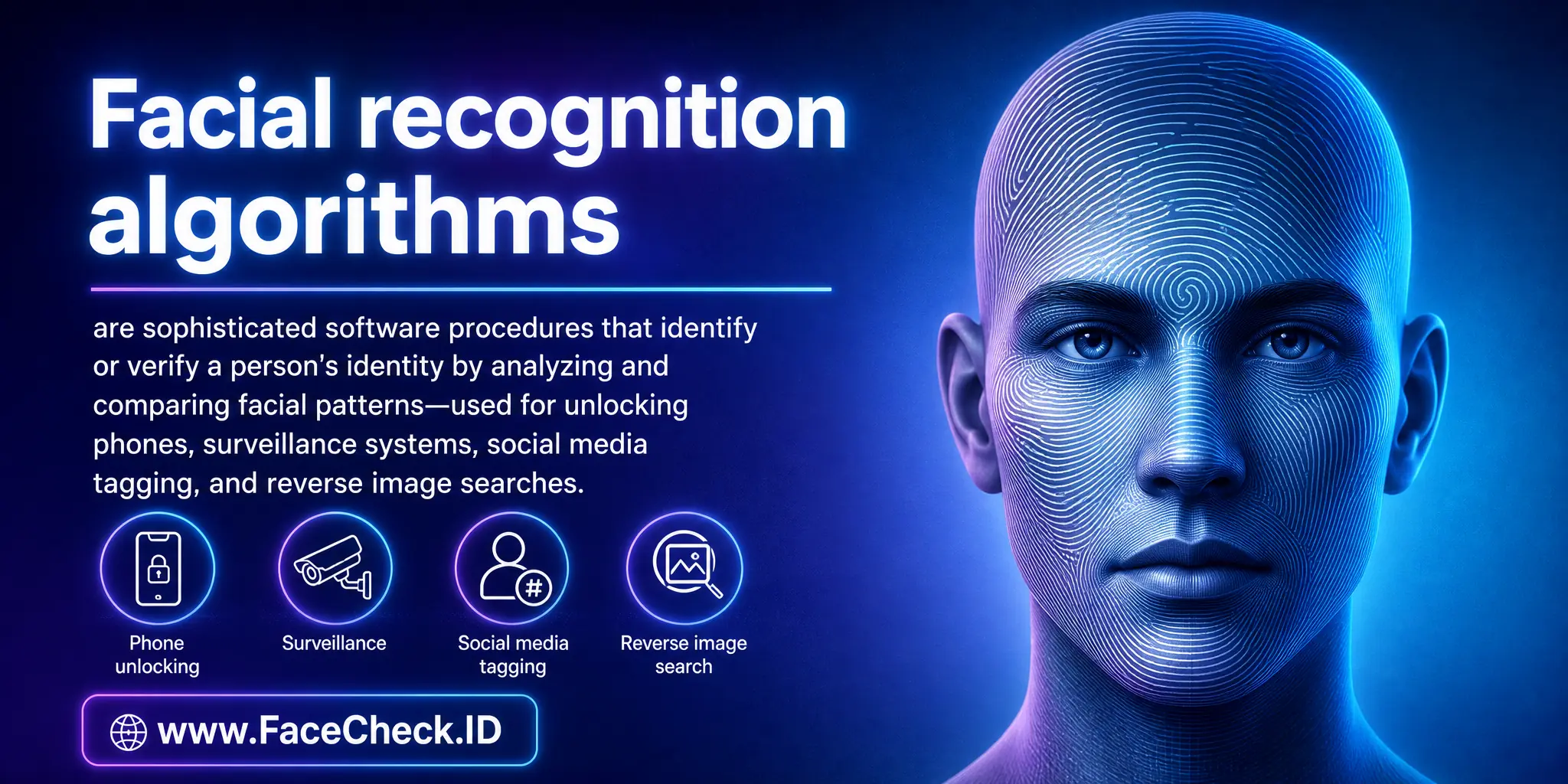
Facial Recognition Algorithms
Facial recognition algorithms are the engine behind any face search tool, including FaceCheck.ID. When you upload a photo to find where a face appears online, an algorithm decides which faces in the indexed web are similar enough to yours to be worth showing, and how confident that similarity is.
What the algorithm actually does during a face search
A reverse face search is not a pixel comparison. The algorithm reduces each face to a numerical embedding, a vector of several hundred values that captures the geometry and texture of that specific face. Two photos of the same person taken years apart, in different lighting, should produce vectors that sit close together in this space. Two different people, even lookalikes, should sit further apart.
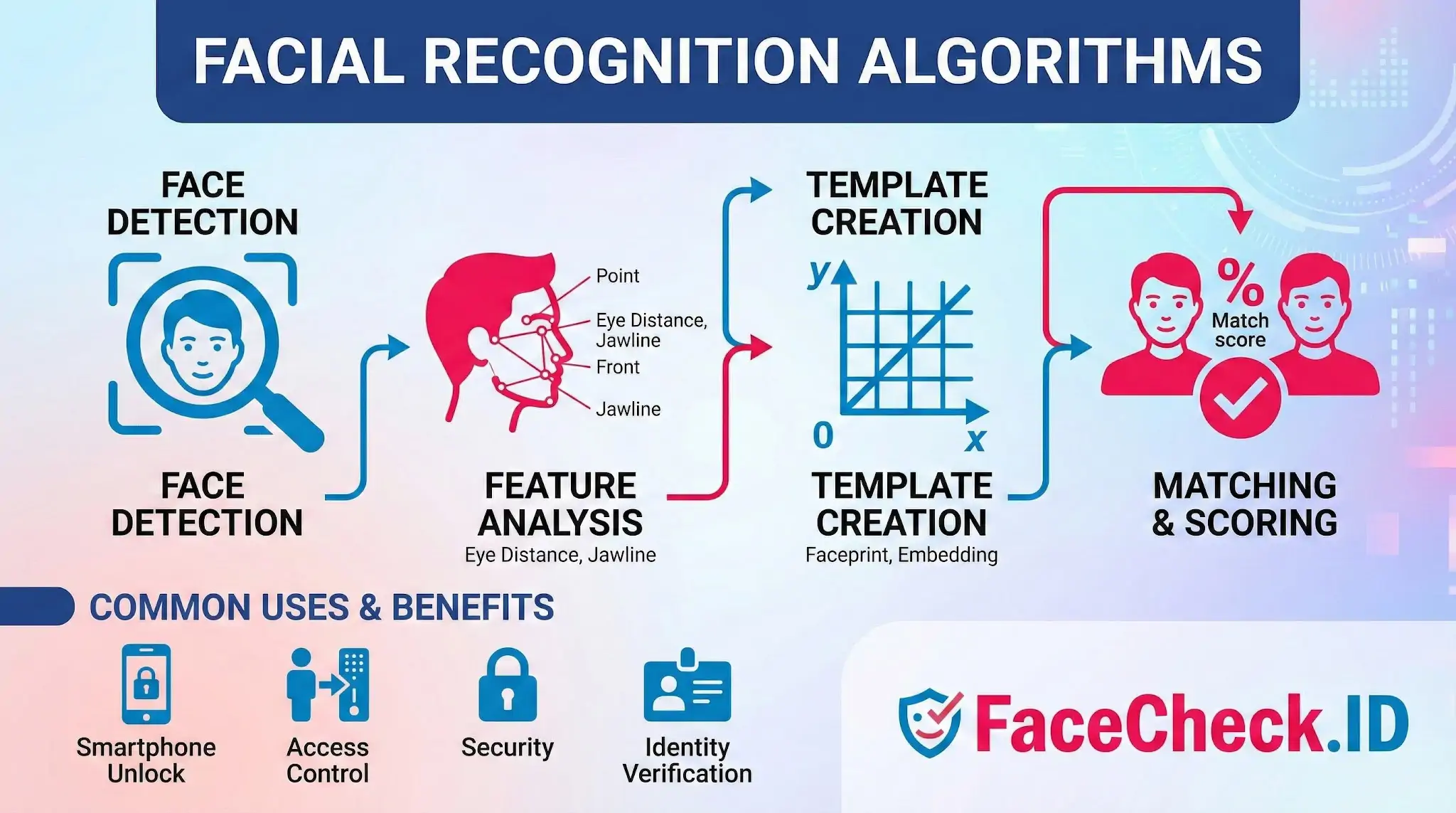
The pipeline runs in roughly this order:
- Detection. The system locates faces in the uploaded image and crops them. If multiple faces are present, each is processed separately.
- Alignment. Eyes, nose, and mouth are used as anchor points to rotate and scale the face into a standard pose. This is why a slightly tilted phone selfie can still match a straight-on profile photo.
- Embedding. A deep neural network converts the aligned face into a vector.
- Search. The vector is compared against millions of vectors extracted from publicly indexed images. The closest matches are returned with a similarity score.
The score is the part most users misread. A high score means the algorithm believes the two faces are the same person. It does not mean a person has confirmed it.
Why image quality changes results more than people expect
Two photos of the same person can produce very different match results depending on the source. A LinkedIn headshot, with even lighting, a neutral expression, and the face filling most of the frame, gives the algorithm clean features to work with. A nightclub photo with harsh side lighting, half the face in shadow, and the subject mid-laugh produces a noisier embedding and weaker matches.
Conditions that degrade face recognition accuracy:
- Heavy yaw or pitch, meaning the face is turned more than about 30 degrees away from the camera
- Sunglasses, masks, or hair covering the eyes or jawline
- Low resolution where the face is under roughly 100 pixels wide
- Strong backlighting that flattens facial structure
- Aggressive beauty filters, which can shift landmark positions enough to change the embedding
- Heavy compression artifacts from screenshots of screenshots
This matters when interpreting FaceCheck results. A weak match on a low-quality input is not proof of absence. A strong match on a clean input is not proof of presence either, because the same photo may have been reused across many profiles by different people.
How the algorithm handles lookalikes, twins, and reused photos
Modern face recognition is good at distinguishing most strangers but struggles in predictable places. Identical twins often produce embeddings close enough to confuse any system. Family members sometimes score in the gray zone between match and non-match. Heavily edited or AI-generated faces can score similarly to several real people because they were trained to resemble an average.
Reused photos create a different problem. Scammers, catfish accounts, and astroturf profiles often steal a single image and repost it across dating sites, Telegram channels, and fake LinkedIn pages. The algorithm correctly returns many strong matches, but those matches represent one stolen photo, not one person. Reading the surrounding context, names, post dates, and platform credibility, is how an investigator separates the real owner of the face from accounts pretending to be them.
What facial recognition algorithms cannot prove
A face match is a statistical claim, not an identification. Even at very high confidence, the algorithm is saying these two faces are very likely the same person, given everything it has learned. It cannot tell you:
- Which account is the real one and which is the impersonator
- Whether the person actually wrote the posts on a matched page
- Whether a mugshot or news article still reflects current legal status
- Whether two profiles with the same face belong to the same operator
Treat algorithmic matches as leads. Confirm identity through context, corroborating details, and, where the stakes are high, direct verification. The algorithm narrows the search space from billions of images to a handful worth a human look. Deciding what those matches mean is still a human job.
FAQ
What are “Facial Recognition Algorithms” in a face recognition search engine?
Facial recognition algorithms are the mathematical and machine-learning methods that detect a face in an image, normalize it (e.g., alignment), and convert it into a numeric representation (an embedding) that can be compared against an indexed database to retrieve likely matches on the web.
What are the main stages of a facial recognition algorithm used for face search?
Most face-search systems follow a pipeline: (1) face detection (find the face region), (2) landmarking and alignment (standardize pose/scale), (3) feature extraction (generate an embedding/faceprint), (4) similarity search (nearest-neighbor lookup in an index), and (5) ranking and filtering (remove low-quality or duplicate results and order candidates by score).
What types of models power modern facial recognition algorithms (e.g., CNNs vs. transformers)?
Modern facial recognition commonly uses deep neural networks trained to produce embeddings where the same person clusters together. Many systems are based on convolutional neural networks (CNNs), while newer approaches may use vision transformers or hybrid architectures. In practice, the model choice affects robustness to lighting, pose, blur, and cross-site image variation, which can change the quality of matches returned by face recognition search engines.
Why can different face recognition search engines return different results for the same photo?
Results can differ because engines may use different facial recognition algorithms, training data, face-alignment methods, similarity thresholds, and indexing strategies, and they may crawl different parts of the web. Even with the same algorithm, update cycles and ranking rules can change which matches appear first. For example, tools like FaceCheck.ID may prioritize certain source types or apply specific filtering that influences which candidates you see.
What are common failure modes of facial recognition algorithms in face search (and how can I reduce them)?
Common failure modes include poor image quality (blur, low resolution), extreme angles, heavy occlusion (masks, hair, hands), harsh lighting, strong edits/filters, and look-alike faces that produce similar embeddings. To reduce errors, use a sharp, front-facing image with good lighting, minimal filters, and a clearly visible face; try multiple photos from different angles; and treat results as leads that require verification via context (source page, dates, additional photos), including when reviewing matches on FaceCheck.ID or similar services.


Recommended Posts Related to facial-recognition-algorithms
-
Examining the State-of-the-Art in Facial Recognition Algorithms for Unconstrained Environments
Top Facial Recognition Algorithms 2023 Reviewed and Compared. In this context, there is a growing interest in understanding the technical details and performance of different facial recognition algorithms, as well as their ethical, legal, and social implications. DeepFace is a facial recognition algorithm developed by Facebook, which uses a deep neural network with 3 billion parameters to perform face verification and recognition.
-
How to Reverse Image Search Mugshots
It uses powerful facial recognition algorithms to match uploaded images with mugshots in the database, providing users with accurate and fast results. - **False positives:** Facial recognition algorithms may occasionally produce false positives, leading to misidentification. Biases in algorithms: Biases in the data used to train facial recognition algorithms may result in unfair treatment of certain groups, leading to potential ethical concerns.
-
How-To Guide for Effective Face Lookup
Robust facial recognition algorithms. Face Lookup Technical Foundations: Unveiling the Power of Facial Recognition Algorithms. Face lookup technology is fundamentally based on sophisticated facial recognition algorithms that utilize deep learning techniques to identify and analyze unique facial features in images.
-
Top 5 Reverse Image Search APIs for Your Projects
Cutting edge facial recognition algorithm and fast search.
-
Search for Actors by their Face
Explanation of the facial recognition technology used: FaceCheck.ID uses advanced facial recognition algorithms that analyze and compare facial features to a vast database of actors, ensuring accurate results.