Liveness Detection vs Reverse Face Search
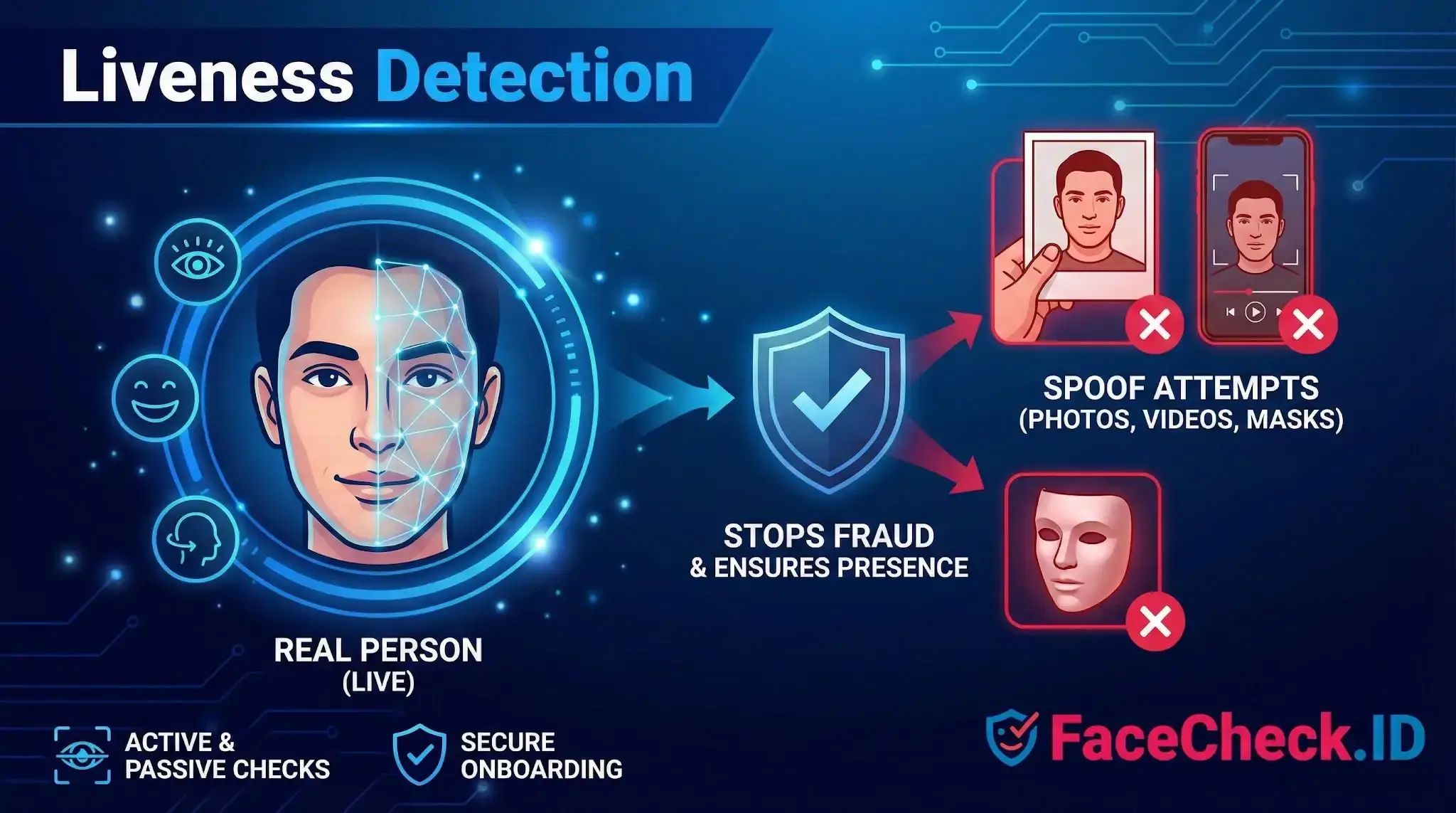
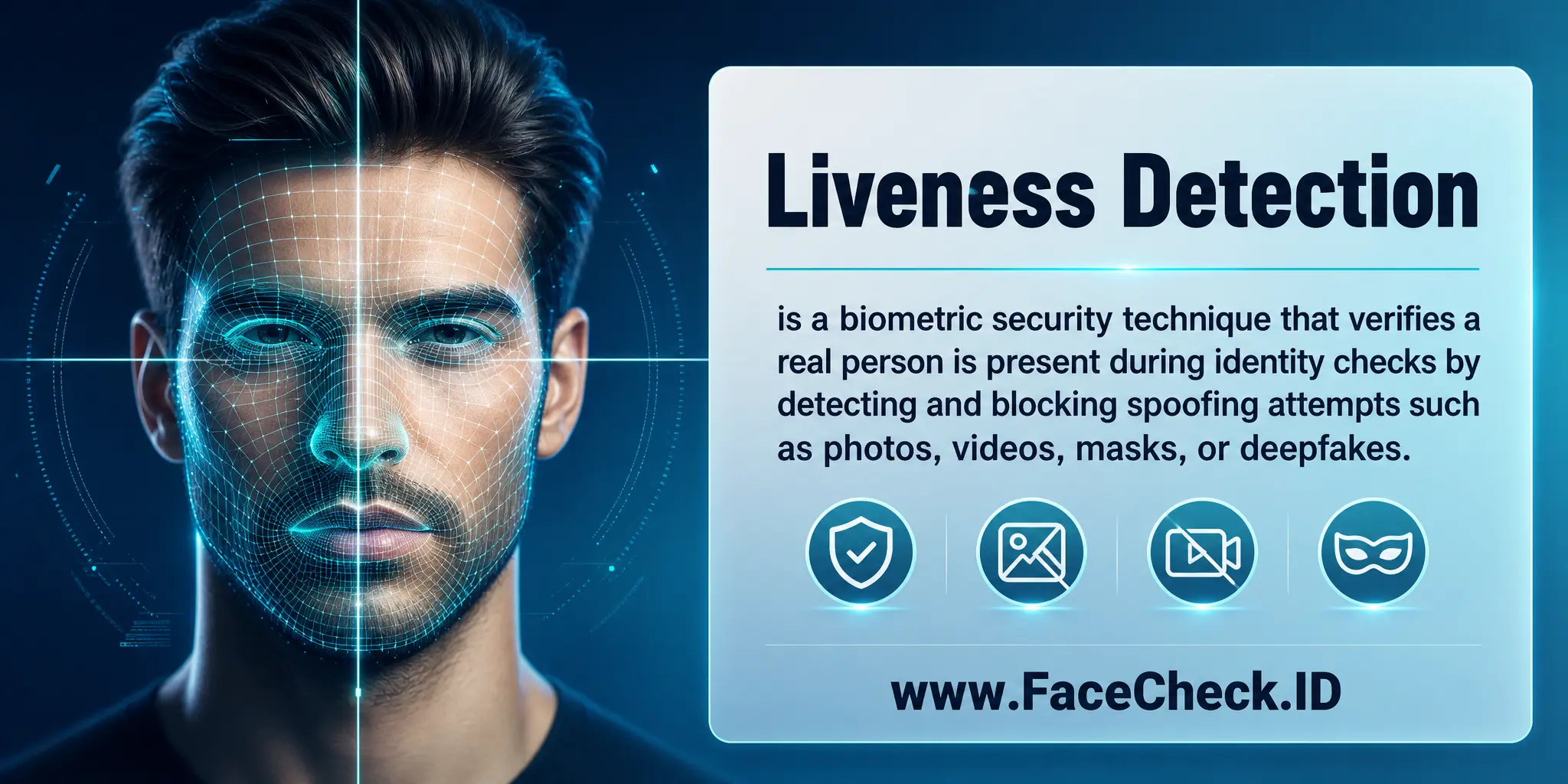
Liveness detection is the layer of biometric security that decides whether a face presented to a camera belongs to a real person sitting in front of it, or to a photo, screen, mask, or deepfake. It sits next to face recognition in identity workflows and answers a different question: not who is this, but is this actually a person right now.
Liveness detection is not part of how FaceCheck.ID works. FaceCheck.ID is a reverse image search engine for faces, meaning it takes an uploaded photo and finds other public web pages where that same face appears. There is no live capture, no selfie prompt, and no biometric authentication happening. Understanding liveness detection still matters for FaceCheck.ID users though, because it explains why a face that exists online is not the same as a person who can prove they are online, and why fraudsters lean on stolen images that face search can sometimes trace back to a real source.
How liveness detection differs from reverse face search
A liveness check happens in real time during a verification flow, usually onboarding for a bank, a crypto exchange, a dating app, or a workplace login. The user is asked to take a selfie or short video, and the system looks for biological signals that confirm a live capture.
Two main approaches are used:
- Active liveness: the user blinks, turns their head, smiles, or follows a moving dot. The system checks that the response matches the prompt in real time.
- Passive liveness: the system evaluates skin texture, reflectance, micro-movements, 3D depth cues, lighting consistency, and camera sensor noise without asking the user to do anything specific.
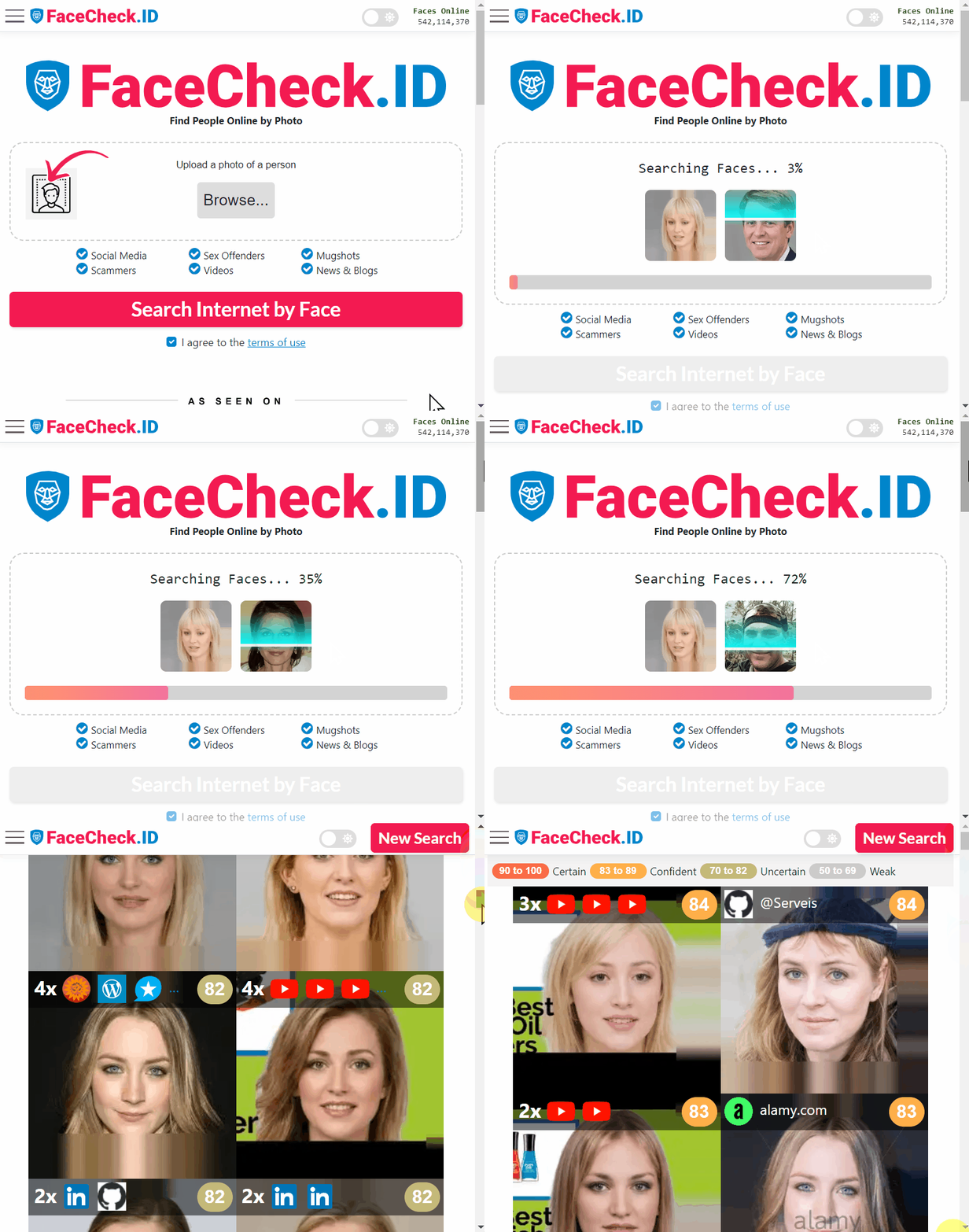
A reverse face search like FaceCheck.ID does none of this. It takes a static image and looks for visual matches across indexed pages. The image could be a selfie, a screenshot, a stolen profile picture, or a frame from a video. There is no biological signal to evaluate, only pixels.
Where the two intersect in scam investigations
People often run a face through FaceCheck.ID precisely because someone failed, or refused, a liveness-style check in everyday interaction. A romance interest who will not video call, a recruiter who only sends still images, a buyer whose verification photo looks pasted in: these are situations where reverse face search becomes useful after live confirmation breaks down.
Common patterns worth checking:
- A dating profile photo that traces back to a model's portfolio, an actor's headshot, or another person's Instagram
- A LinkedIn picture reused across multiple names or companies
- A so-called verification selfie that already appears on stock image sites or older social profiles
- A face that surfaces in scam-warning forums, image-abuse trackers, or unrelated countries from where the person claims to live
Liveness detection would catch a printed photo or screen replay during a real verification session. Reverse face search catches the same stolen image after the fact, by showing where else it lives online.
What liveness detection does not solve, and what face search cannot replace
Liveness detection is good at blocking presentation attacks: printed photos, replayed videos, masks, and many deepfakes. It is not good at proving who someone is over the long term. A passed liveness check confirms that a real person was in front of a camera at one moment. It does not confirm that the person is who they claim to be, that the documents shown match the face, or that the same face is not being used under a different identity elsewhere.
Reverse face search has the opposite limits. It can show that a face appears under multiple names, in scam reports, or on accounts that contradict the story someone is telling. It cannot confirm that the person you are talking to is the same person in those photos, because anyone can copy a public image. It also cannot guarantee that the absence of matches means the person is genuine. New faces, low-quality captures, AI-generated portraits, and unindexed pages all reduce coverage.
The two tools work on different problems. Liveness detection guards the moment of capture. Face search investigates the history of an image. Either one alone can be fooled. Used together with human judgment, they cover more of the gap than either does alone.
FAQ
What does “Liveness Detection” mean in face-recognition systems, and what problem does it solve?
Liveness Detection is a set of checks used to determine whether a face presented to a camera is from a real, live person (or a real-time capture) rather than a spoof such as a printed photo, a replayed video, a mask, or certain face-swap/deepfake presentations. Its main goal is to reduce “presentation attacks” where someone tries to trick a face system into accepting an impostor.
How is liveness detection different from face matching in a face recognition search engine?
Face matching for a search engine focuses on “who does this face look like?” by comparing facial features (embeddings) against an index of images. Liveness detection focuses on “is this capture from a real live subject right now?”—it does not primarily try to find the person elsewhere online. A face recognition search engine can return strong visual matches even when the query image came from a screen, a replay, or a manipulated source, because matching and liveness are different tasks.
What are common liveness detection methods (passive vs. active), and what trade-offs do they have?
Passive liveness analyzes signals without requiring user actions (e.g., texture and moiré detection, lighting/reflection cues, blur/compression artifacts, 3D face-shape hints, subtle motion patterns). Active liveness asks the user to do a challenge (e.g., turn head, blink on command) or uses specialized capture (depth/IR on supported devices). Passive methods are easier to use but can be less robust in edge cases; active/depth-based methods can be stronger but add friction and may require compatible hardware.
If I upload a selfie or screenshot to a face search tool, does liveness detection change the search results?
Usually, liveness detection (if present) is used to decide whether to trust the capture for authentication—not to improve “same person across the web” searching. In an open-web face search workflow, a screenshot, a re-shared image, or a video frame can still match many indexed photos because the matching model only needs enough facial information. If you want fewer misleading matches, improving image quality and using multiple photos (different angles/lighting) generally matters more than liveness checks.
Does FaceCheck.ID (or similar face recognition search engines) verify liveness or confirm identity?
FaceCheck.ID is used for face recognition search (finding web pages/images that appear to contain a similar face), which is different from identity verification and typically does not require proving the face was captured live. Even if a platform implemented some anti-spoofing checks, a face-search “match” still should be treated as a lead, not proof of identity, because look-alikes, reused photos, edits, and context errors can all produce convincing but wrong associations.

Recommended Posts Related to liveness-detection
-
Facial Recognition: Understanding the Basics
Technologies like anonymization and liveness detection enhance its security, reducing the risk of unauthorized access. What is liveness detection in facial recognition? Liveness detection, or anti-spoofing technology, prevents biometric fraud by distinguishing between real users and imposters.
-
How to Detect Fake Remote IT Workers with Facial Recognition (2026 Guide)
Liveness detection validates the live human.