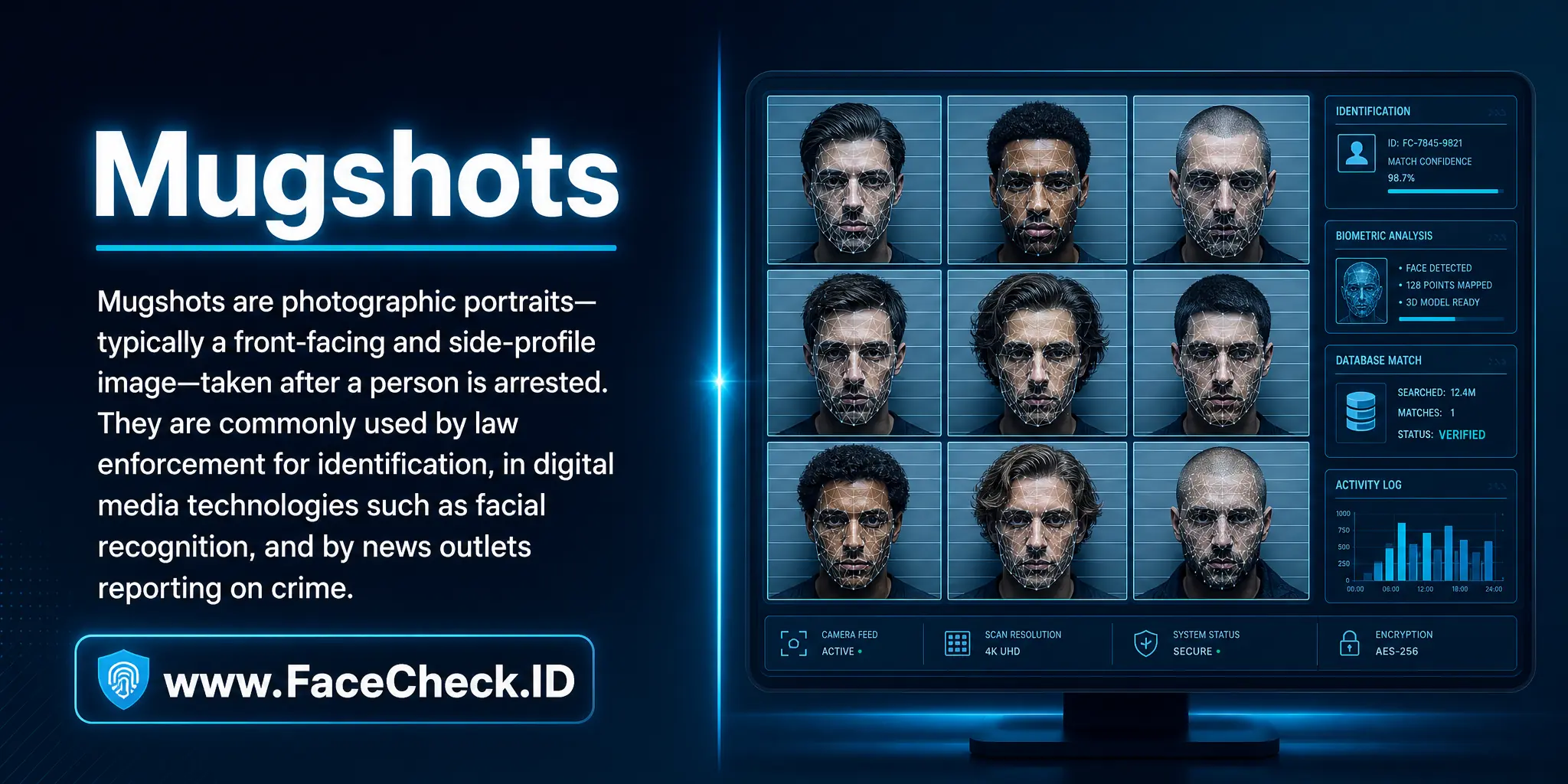
Mugshots in Reverse Face Search Results

Mugshots are one of the most consistently indexed face-image categories on the public web, which makes them a recurring hit type in reverse face searches. When FaceCheck.ID surfaces a mugshot match, it usually means a booking photo from a sheriff's office, county jail, or aggregator site has been crawled and tied to a face that resembles the uploaded image.
Why mugshots show up so often in face search results
Mugshots are produced under near-identical conditions across thousands of agencies: front-facing pose, neutral expression, even lighting, plain background, and a side profile companion shot. That standardization is exactly what face-recognition models are good at. Compared to a cropped party photo or a sunglasses selfie, a booking image gives a clean facial signature with high feature visibility.
They also propagate widely. A single arrest can generate copies on:
- The originating agency's inmate roster or jail lookup
- Statewide arrest record portals
- News coverage of the incident
- Mugshot aggregator sites that scrape rosters automatically
- Pay-to-remove republishers that copy from the aggregators
This duplication boosts the chance that at least one indexed copy will match a face search, even years after the underlying record has been sealed or expunged in court.
How to read a mugshot match responsibly
A mugshot hit is a strong visual lead, but it is not a verdict. A few interpretation rules apply:
- A booking photo records an arrest, not a conviction. Charges may have been dropped, reduced, dismissed, or never filed. The image itself carries no case outcome.
- Lookalike risk is real. Booking images often show people in similar age ranges, similar haircuts, and similar lighting, which can produce convincing false positives. Cross-check name, date, jurisdiction, and any visible identifiers before drawing conclusions.
- Dates matter. A mugshot from 2009 tells you what someone looked like then, not who they are now. Aging, weight change, facial hair, and tattoos can all shift identity signals.
- Aggregator copies are not independent confirmation. Ten republished copies of the same booking photo are still one source.
For investigators, journalists, and people running due diligence on a stranger they met online, a mugshot match is best treated as a pointer to the original agency record, not as the conclusion itself.
Mugshots in catfish and scam investigations
People running romance scams or fake dating profiles sometimes use stolen photos pulled from anywhere, including, occasionally, mugshots that have been laundered through aggregator sites. More commonly, a face search will reveal that the person on the other end of a dating app has an arrest record under a different name than the one they are presenting. That mismatch alone is informative even when the charges are minor or old.
The reverse situation also happens: a face search returns a mugshot for someone with a common appearance, and the match is simply a stranger who looks similar. Treat any single result with caution, especially if the match confidence is borderline or the image quality is poor.
Limits and what a mugshot match does not prove
A mugshot match in a face search does not establish:
- That the matched person is the same person you searched for
- That any conviction occurred
- That the record is still legally public in the relevant jurisdiction
- That the photo is current
Removal rules vary by state and country. Some jurisdictions restrict mugshot publication outright, others allow takedown after dismissal or expungement, and some aggregator sites continue to host images long after the underlying record is sealed. A face search reflects what is publicly indexed, which is not always what is legally accurate. Verification still requires going back to the source agency, court records, or a direct conversation with the person involved.
FAQ
What does “Mugshots” mean in the context of face recognition search engines?
In face recognition search engines, “mugshots” usually refers to booking or arrest photographs published by law enforcement agencies or by third-party “mugshot”/public-record sites. A face search engine may surface these pages when it finds facial similarity between your query photo and images indexed from those sources.
Why do mugshot pages often appear in face recognition search results?
Mugshot pages appear frequently because they are often public, highly crawlable, and contain clear, front-facing faces with consistent lighting. Those qualities make them easier for face-matching systems to index and compare, so they can show up prominently when a similar face is searched.
Does a mugshot result mean the person in my photo was arrested or committed a crime?
No. A mugshot-like match is not proof of arrest, guilt, or even identity. Face search results are similarity-based and can point to look-alikes, mislabeled pages, reposts, or incorrect associations. Treat a mugshot match only as a lead and verify identity using multiple independent details (date, location, full name, and corroborating sources).
What should I do if a face search engine (e.g., FaceCheck.ID) links me to a mugshot page that isn’t me?
Do not assume the page is about you. Open the source page and check non-face details (name spelling, age, city/state, dates, tattoos/scars, and other photos). Save the URL and screenshots for documentation, then use the site’s dispute/correction process and any takedown/opt-out mechanisms offered by the publisher and the face search tool. If the mismatch is causing harm, consider requesting legal help for defamation/privacy remedies in your jurisdiction.
How can I reduce the chance that my face search query returns mugshot-style false matches?
Use a high-quality, recent, front-facing photo with minimal filters, avoid heavy compression, and crop to the face (not the background). If the tool provides similarity thresholds or result filtering, increase the match strictness and prioritize matches that include multiple consistent photos of the same person across reputable sources rather than a single mugshot page.

Recommended Posts Related to mugshots
-
How to Search Arrest Records and Mugshots by a Photo of a Person
Reverse Image Search Mugshots. With FaceCheck.ID you can upload a photo of a person's face, and our reverse face search engine will scour the darkest corners of the Internet for matching mugshots, arrests, and criminals featured in the news. Search Mugshots by a Face Photo!
-
How to Reverse Image Search Mugshots
One of its innovative applications is searching through a large database of mugshots using the groundbreaking platform FaceCheck.ID. This article will explore how reverse image searching mugshots can significantly contribute to community safety and foster transparency while ensuring the privacy of individuals. FaceCheck.ID is an advanced reverse image search platform specifically designed to search through a vast database of mugshots and suspects featured in the news.
-
Find Criminals by Face Pic
Here's the exciting part: FaceCheck.ID lets you search-by-face the largest public databases of mugshots, fugitives, inmates, gang members, and registered sex offenders. FaceCheck.ID can help identify them and provide a match to any mugshot they might have. If you know someone you suspect is involved in this dirty business, FaceCheck.ID can help confirm their identity and link them to any existing criminal records via mugshots.Cyberbullying Offenders: Cyberbullies think they can hide behind a screen.
-
Leveraging Facial Recognition Technology to Combat Human Trafficking
Facial recognition tools like FaceCheck.ID is crucial in investigations, matching faces against social media profiles, escort ads, and mugshots. FaceCheck.ID: A specialized facial recognition search engine for finding social media accounts, escort ads, or mugshots of both perpetrators and victims of human trafficking.
-
Unlocking the Power of Facial Recognition Technology: 10 Eye-Opening Facts
The database can include anything from mugshots to passport photos to social media profile pictures.