How to Find People's Mugshots by Name or by Photo
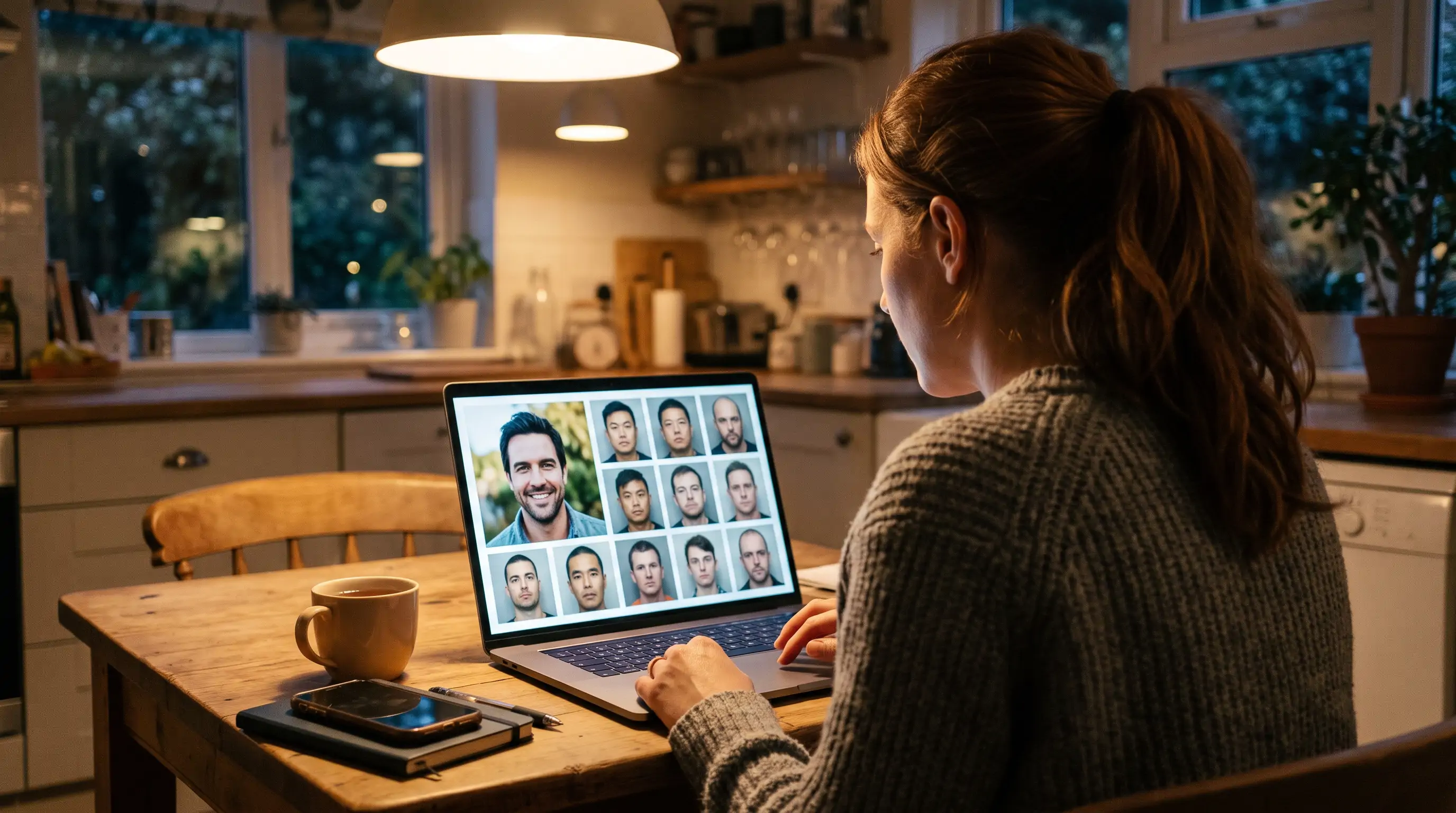
To find people's mugshots, go to the agency that took the picture. Search the county sheriff's or jail's online inmate roster by name for recent arrests, check the state Department of Corrections offender locator for people serving prison time, and use VINELink to see whether someone is in custody right now. If you only have a photo and no name, a face search engine such as FaceCheck.ID can find public booking pages that show a similar face.
No single national mugshot database is open to the public. Booking photos are scattered across thousands of sheriff's offices, police departments and court systems, each with its own website and its own idea of what a search box should look like. This guide walks through them in the order that finds the most photos for the least effort.
Updated November 2026. Written by the FaceCheck.ID team; we make the face search tool described in the photo section, and say plainly where it falls short.
In this article, we're going to discuss
Where mugshots are kept
A mugshot is taken at booking, the moment someone is processed into a jail. From there copies end up in several places, and each one answers a different question.
| Source | What you search with | Booking photo? | Best for |
|---|---|---|---|
| County sheriff or jail inmate roster | Name, sometimes booking date | Often, for current inmates | Arrests in the last days or weeks |
| City police arrest log | Date or name | Sometimes | Arrests by a city department |
| State Department of Corrections locator | Name or inmate number | Varies by state | People sentenced to state prison |
| VINELink | Name or offender ID | Not a photo tool | Is this person in custody right now? |
| County clerk or state court case search | Name or case number | Rarely | Charges, hearing dates, outcomes |
| Federal Bureau of Prisons inmate locator | Name or register number | Usually not | Federal prisoners |
| Commercial mugshot sites | Name, county | Yes, copied | Leads only, verify officially |
FindLaw's guide to finding a mugshot sums up the pattern: some county sheriffs run online jail rosters "often with mugshots", state corrections locators may include photos, and the federal Bureau of Prisons locator usually does not show them.
How to find people's mugshots by name
Work from the most local source outward. The closer you are to the arresting agency, the more likely the photo is still attached to the record.
1. Start with the county jail roster
Search for "[county name] sheriff inmate search" or "[county name] jail roster". Most county jails list who is currently booked, with charges, bond and, in many counties, the booking photo. Use the person's full legal name; nicknames and the spelling from their dating profile tend to return nothing.
A roster shows who is inside now. Once someone bonds out or is released, many counties drop them from the list, photo and all, which is why a mugshot you saw on Tuesday can be gone by Friday.
2. Check the city police department
If a city department made the arrest, its website may publish a daily arrest log or press releases. Photos here are less consistent than on jail rosters, but the log gives you the date and charge, which you need for everything that follows.
3. Search the state corrections locator
People sentenced to state prison move from the county jail to the state Department of Corrections, and the DOC runs its own offender search. Some states show a photo on the inmate's detail page; others show text only. California's CIRIS locator, for example, lists name, age, CDCR number, current location, admission date and parole eligibility for people currently in custody, according to CDCR, with no photo field in that list.
4. Use VINELink for custody status
VINELink tells you whether someone is in custody, released, on parole or probation, or has escaped. It is free to search and does not list charges or criminal history, per its Wikipedia entry, which also notes that Arizona, Georgia, Massachusetts, Montana, New Hampshire and West Virginia provide very limited information. Treat it as a status check, then go back to the county roster for the photo.
5. Pull the court docket
The county clerk's case search gives you case numbers, charges, hearing dates and outcomes. Court files rarely include booking photos, but the case number makes a public records request to the arresting agency much faster. Many clerk websites look like they were last redesigned when fax machines were exciting; the search usually works anyway.
Finding someone's mugshot in Texas, California and Washington
State law decides how much of this is visible, and the three most-searched states pull in different directions.
Texas
Start with the sheriff's office in the county where the arrest happened; each Texas county runs its own jail, and many post an online inmate search. For anyone sentenced to state prison, the Texas Department of Criminal Justice runs a statewide inmate search. Records that are not online can be requested under the Texas Public Information Act from the agency that holds them.
California
California agencies still keep booking photos, but Penal Code 13665 limits what police and sheriffs post on social media. For people arrested on suspicion of a nonviolent crime, departments generally may not share the booking photo there at all, and any booking photo they do post has to come down within 14 days unless an exception applies (a fugitive, an imminent threat, a court order). The rule covers social media, not the agency's own website, so the county inmate search is still the place to look.
Washington
Washington is the strict one. Grant County's sheriff explains on its jail roster page that "inmate booking photos are exempt from public disclosure except if they are used to assist with an investigation" or when a registered sex offender is released into the community. Expect names and charges on Washington rosters, and few faces.
Mugshot websites: useful leads, poor evidence
Type a name plus "mugshot" into Google and the first page is often commercial aggregators. They scrape county rosters, repost the photos with ads, and keep them long after the official record has moved on, been sealed or ended in a dismissal. Some then offer to remove the photo they copied, for a fee, a business model with all the warmth of a tow lot.
Several states have pushed back. California's Civil Code 1798.91.1 makes it unlawful to solicit or accept payment to remove or correct a booking photo, and lets the person sue for $1,000 per violation or actual damages, whichever is greater.
Use an aggregator page as a lead: note the name, booking date and county, then confirm on the official roster or court docket. If the official source has nothing, the aggregator's version proves very little.
How to find a mugshot with only a photo
Sometimes you have a face and no surname: a dating-app match, a new neighbour's profile picture, someone who gave you a first name and a story. The name-based route can't start without a name. A face search can.
FaceCheck.ID compares the face in your photo against faces on public web pages, including news sites, sex-offender registries and mugshot pages, and returns similar faces ranked by score. The free search shows every matching face thumbnail with its score; credits unlock the links to the source pages. When a match sits on a mugshot, sex-offender, scam or most-wanted source, the result carries a red flag so you notice it.
- Crop the photo to one face, front-facing, as large and sharp as you have it. Sunglasses, heavy filters and tiny faces in group shots make matching harder.
- Upload it at FaceCheck.ID and run the search.
- Read the scores before the pictures. 90 to 100 is a certain match, 83 to 89 a confident match, 70 to 82 uncertain (look-alike territory), and 50 to 69 a weak match.
- Open the source page for any flagged result and compare what the page says with what you know: name, age, city, tattoos, the booking date.
- Confirm on the official roster or court docket before you treat the hit as real.
A score measures how similar two faces look. It does not prove the person in your photo is the person on the booking page, and same-face mistakes are worse here than almost anywhere else, because the page attached to the face says "arrested".
A first-date example
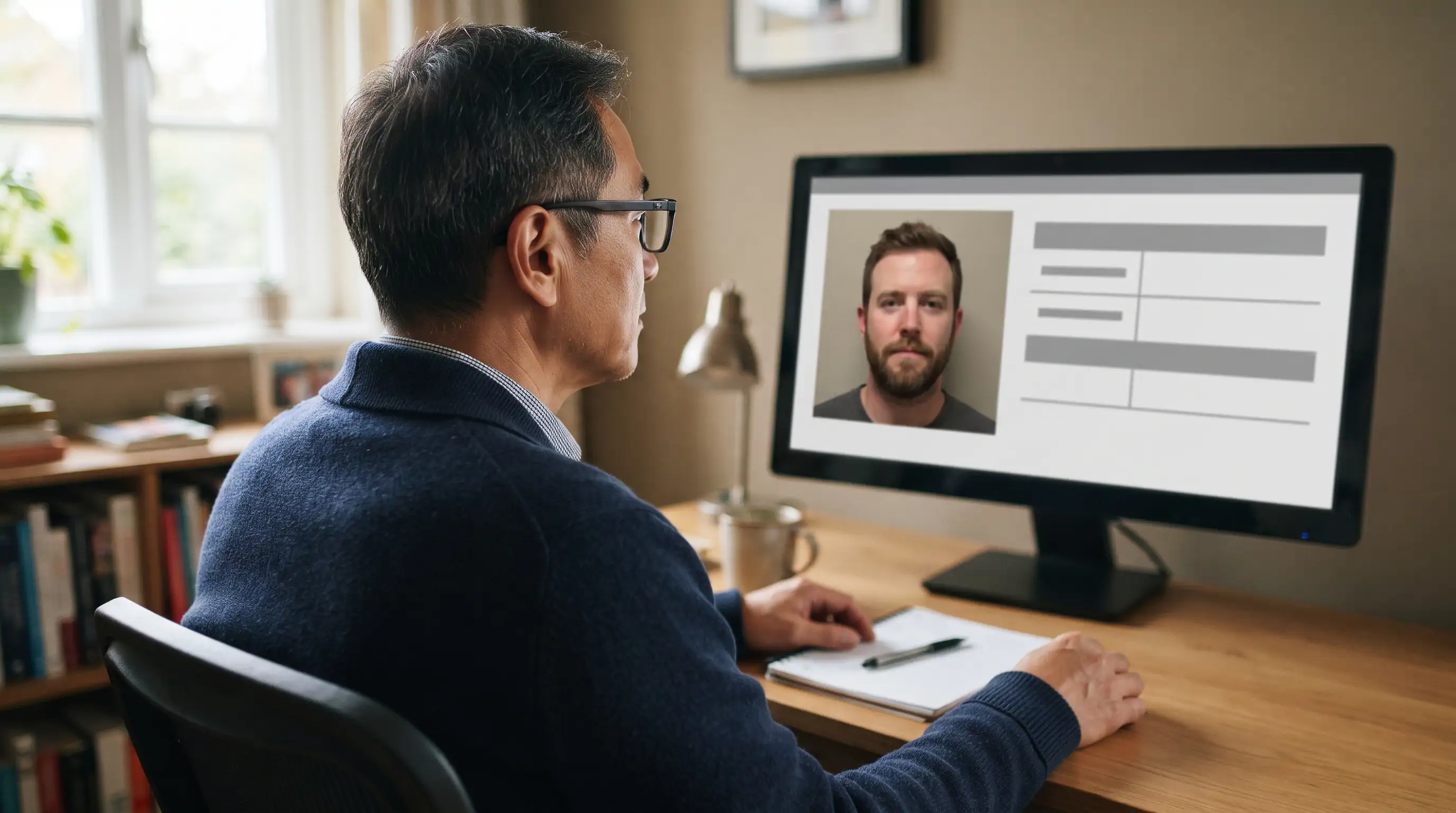
Say you matched with "Jake, 34" and his profile photos are all you have. You upload the clearest one. Among the results is a county booking page at 91, flagged as a mugshot source. You open it: the name on the page is Jacob, the age fits, and the forearm tattoo in the booking photo matches the one in his hiking picture. Then you search that county's inmate roster and court docket for the full name, and the case is there with a date and a charge.
Now you know something worth knowing before Saturday, and you know it from the court record, not from a similar-looking face. If the docket shows nothing, or the tattoo is on the wrong arm, the 91 was a look-alike. For more on checking dating profiles this way, see how to reverse image search on dating sites.
What a face search will not find
FaceCheck.ID indexes public web pages. A booking photo that was never published, sat behind a login, or was taken down before it was indexed won't appear, so no hit does not mean no record. Washington's rules and California's 14-day social-media limit mean whole categories of mugshots never stay public long. The reverse image search for mugshots guide goes deeper on the photo-upload side.
Two rules hold for every search. The face model is trained on adult faces, and searching for minors is prohibited and gets accounts banned. And FaceCheck.ID's terms prohibit using results for employment, tenant, credit or insurance decisions; this is for personal safety, not screening.
Your own privacy holds up too: FaceCheck.ID logs no IP addresses, deletes search history within 24 hours, and does not add uploaded photos to its index.
Why a mugshot search comes up empty
An empty result is common and usually means the record is somewhere you haven't looked, or is legally out of view.
The person may have been released and dropped off the roster. The case may have been sealed or expunged, which pulls it from official public records. The arrest may have been federal: after the Sixth Circuit's 9-7 en banc ruling in Detroit Free Press v. Department of Justice in 2016, FOIA no longer requires the U.S. Marshals Service to release booking photos, and release is weighed case by case (Harvard Journal of Law and Technology summary). Or the arrest happened in a different county than you assumed, which is the most boring explanation and frequently the right one.
Frequently asked questions
Are all mugshots posted online?
No. Many counties post booking photos for current inmates, but some states restrict them (Washington treats them as exempt from public disclosure), California limits what agencies post on social media, federal agencies rarely release them, and sealed or expunged records come down. Photos often disappear from rosters once a person is released.
Is there a free website to check someone's criminal record?
There is no single free national criminal record site. The free official sources are the county jail roster, the state DOC offender locator, VINELink for custody status, and your state or county court case search for charges and outcomes. For sex offenses, the National Sex Offender Public Website, run by the U.S. Department of Justice with the states, searches registries in all 50 states, DC, the territories and Indian Country. If you only have a photo, see how to search the sex offender registry by photo.
Is it legal to look up mugshots?
Yes, viewing booking photos that an agency or court has made public is legal. What varies is how much each state releases: Washington exempts most booking photos from disclosure, while many other states post them on jail rosters. What you do with the information is where the limits are; FaceCheck.ID results may not be used for employment, housing, credit or insurance decisions.
How do you know if someone just went to jail?
Check the jail roster or booking log of the county where you think the arrest happened, searching by full legal name. VINELink shows custody status and lets you register for an alert when that status changes. If nothing shows online, call the jail's records desk with the person's name and date of birth.
How do you find people's old mugshots?
Old booking photos usually leave the rosters. Ask the arresting agency through a public records request with the name, arrest date and case number; the court docket usually lists the last two. Local newspaper archives at a public library can hold arrest photos from years when papers printed them. If an old mugshot is still on a public web page, a face search can surface it.
What to do next
If you have a name, open the county sheriff's inmate search for the county where you think the arrest happened, then the state DOC locator, then the court docket. If you have a photo, run it through FaceCheck.ID, start with the flagged results scoring 83 or higher, and confirm every one against an official record before you act on it.

Read More on Facial Recognition Search
A Step-by-Step Guide on How to Search Sex Offender Registry by Photo
Can you really trust that new neighbor, coworker, or online date? Traditional background checks often miss important details buried in sex offender registries. Find out how face recognition technology can instantly match a photo to convicted offenders - before you let someone into your life.
Popular Topics
Face Search Engine Social Media Image Search Sex Offender Registry Registered Sex Offender How To Find Someone Sex Offenders Mugshots Public Records Face Lookup Face SearchBattle of the Face Search Engines: PimEyes and FaceCheck Compared