Online Dating Scam: Spot Stolen Photos
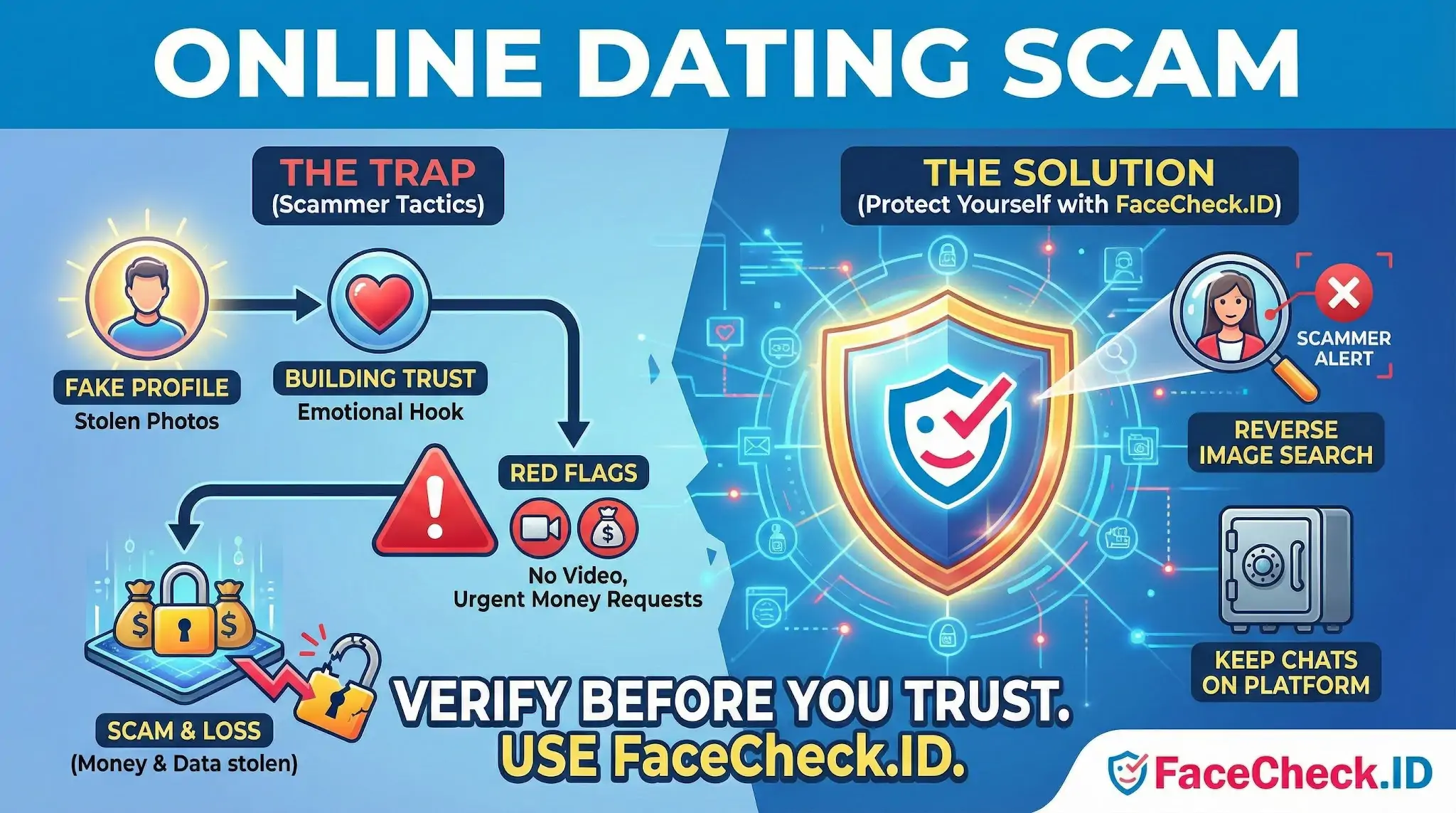
Online dating scams almost always start with a stolen photo. The person behind the profile is rarely who the picture shows, which is why reverse face search has become one of the few reliable ways to check whether the face you are talking to actually belongs to the name, age, and story attached to it.
Why face search exposes most romance scammers
Scammers reuse photos. They have to, because building a believable persona from scratch is harder than copying someone else's life. The same headshot of a deployed soldier, an oil rig engineer, or a model often appears across dozens of fake profiles on Tinder, Hinge, Bumble, Match, Facebook Dating, and Instagram, with different names and ages each time.
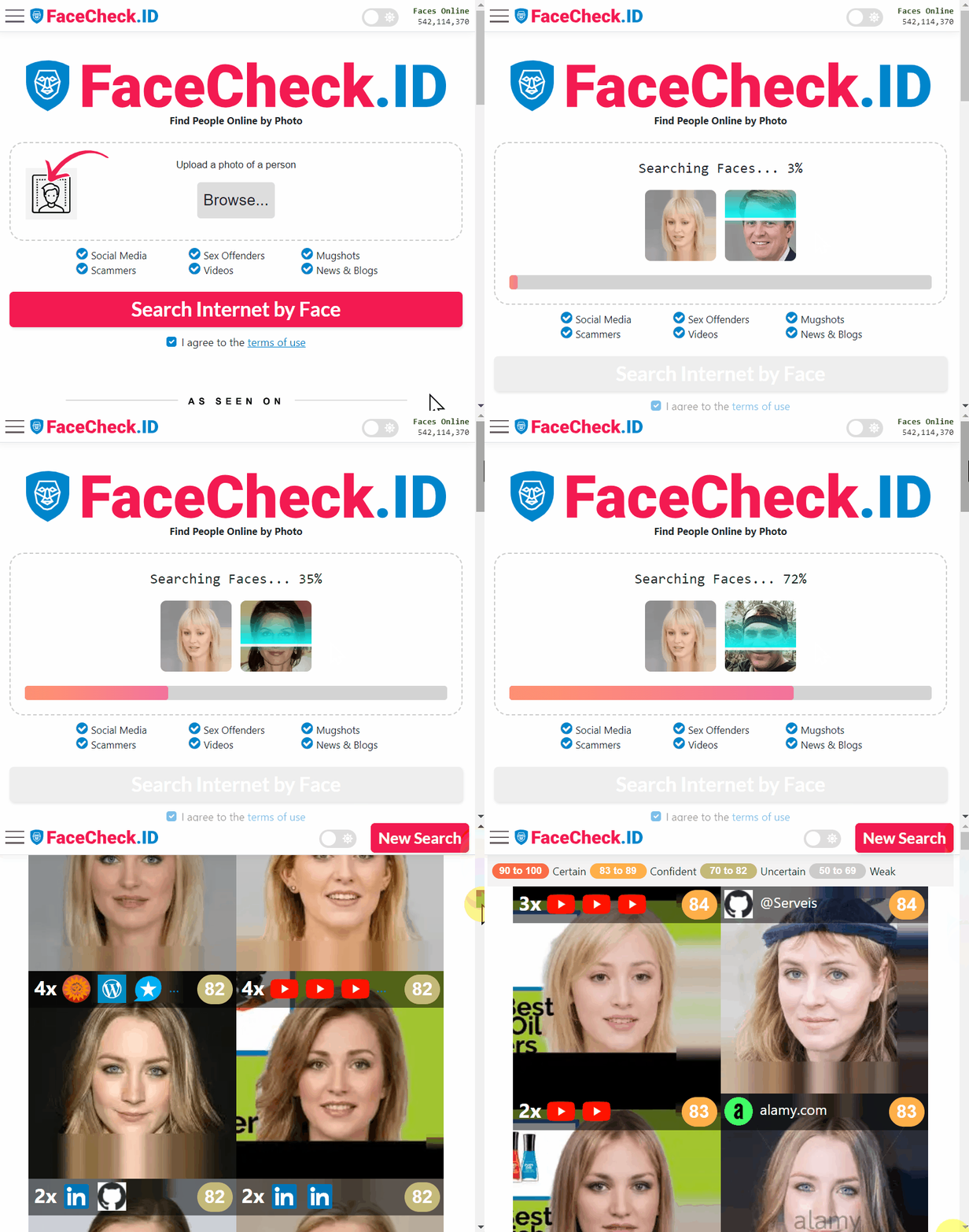
Running the profile photo through FaceCheck.ID can surface:
- The real owner of the face, often a public figure, model, or someone whose photos were scraped from social media
- Other dating or social profiles using the same face under different names
- News articles or scam-warning forums where the image has already been flagged
- Older posts that contradict the persona, such as a different country, marital status, or profession
A clean front-facing dating photo is close to ideal input for face-recognition systems. Good lighting, neutral expression, and a single subject produce strong match confidence, which is part of why dating-profile fraud is one of the easiest scam categories to investigate with a face search.
The standard romance-scam playbook
Most romance scams follow a recognizable arc, and each stage leaves traces a face search can verify or contradict.
- Contact starts on a dating app or social platform and quickly moves to WhatsApp, Telegram, or Google Chat, where there is no profile to report
- The persona is usually unavailable in person: deployed military, offshore worker, international doctor, traveling businessman
- Affection escalates fast, often with copy-pasted love letters that show up in scam-report databases
- Video calls are refused, cut short due to "bad connection," or faked with looped clips
- Eventually, money is requested through gift cards, wire transfers, cryptocurrency, or "investment" platforms the scammer controls
When a face search returns the same photo on a Russian VK profile, a YouTube fitness channel, or an Instagram account belonging to a different real person, the persona collapses. That contradiction is usually more persuasive than any single red flag in conversation.
Where face search fits into checking a match
Treat face search as one layer of verification, not proof on its own. A practical sequence:
- Save the clearest profile photo, ideally one with a visible face and minimal filtering
- Run it through FaceCheck.ID and review every match, not just the top result
- Compare the names, locations, and timestamps on those matches to what your contact has told you
- Look for the same face appearing under different identities, which is a strong fraud signal
- Check whether the original photo traces back to a real public account that does not match the person messaging you
Cropped, heavily filtered, or low-resolution profile pictures reduce match confidence. If the only photos available are sunglasses shots, side angles, or group images, that itself is suspicious, because scammers sometimes obscure faces to avoid being identified through reverse search.
What a face match can and cannot tell you
A face-search hit showing the same photo on someone else's verified social account is strong evidence that the dating profile is fake. It does not, by itself, identify who is actually running the scam. The operator could be in a different country from where the stolen photos originated, often working through scripted playbooks across dozens of victims at once.
Conversely, no matches do not prove a profile is genuine. A real person with a small online footprint, fresh photos that have not been indexed, or strict privacy settings may also produce few results. Lookalikes and identical twins can complicate interpretation, and lower-confidence matches need to be reviewed manually rather than trusted at face value.
The right use of face search in a dating context is to gather evidence, compare it against the story you are being told, and stop sending money or personal information the moment those two things stop lining up.
FAQ
How can face recognition search engines help detect an online dating scam (e.g., stolen profile photos)?
They can reveal whether the same face appears across many unrelated profiles, usernames, or websites. A common scam pattern is one face linked to multiple names, countries, or dating accounts, or appearing on “warning/scam report” pages. Treat results as investigative leads—confirm by checking the source pages, dates, and context of each match.
What face-search result patterns are strong warning signs of an online dating scam?
Warning signs include: (1) the same face tied to multiple different names or biographies; (2) the same face appearing in many languages/countries with conflicting details; (3) matches on scam-report, “catfish,” or impersonation-discussion pages; (4) the face appearing primarily in stock-model or influencer-style reposts with no consistent identity; and (5) heavy reuse of the same small set of photos across sites.
If FaceCheck.ID (or another face search tool) finds matches, does that prove someone is an online dating scammer?
No. A match only suggests the face is similar and may be reused online; it does not prove wrongdoing or confirm identity. Legitimate reasons exist (public figures, widely reposted content, memes, or reposted photos). To avoid false accusations, corroborate with independent signals such as inconsistent personal details, refusal to video chat, money/crypto requests, and verification through direct, real-time interaction.
How should I verify matches from a face recognition search engine before concluding a dating profile is a scam?
Open each matched page and check whether it shows the same person (not a look-alike), and whether the surrounding text identifies a different name/location than the dating profile. Compare multiple photos (not just one), look for consistent identifiers (handles, watermarks, long-running accounts), and check timestamps to see which identity existed first. If the dating profile’s images appear later on many unrelated pages, that can support a stolen-photo hypothesis.
What safe next steps should I take if a face search suggests an online dating scam?
Stop sharing sensitive data, do not send money or gift cards, and move communication back to the dating app while you document evidence (screenshots, URLs, timestamps). Ask for a real-time verification step (e.g., a brief video call or a specific gesture/photo request) and watch for excuses. Report the profile to the dating platform and, if money was lost, to relevant authorities/financial institutions. If your own photos are being misused, request takedowns from the hosting sites and use the face-search tool’s removal/opt-out process where available.

Recommended Posts Related to online-dating-scam
-
The Rise of Romance Scams: Protect Your Heart and Wallet
Married NJ duo caught in $6 million online dating scam, duping 33 innocent victims. One of the most common online dating scams is the "catfishing" scam.
-
How to Spot a Catfish Online in Under 60 Seconds with FaceCheck.ID
Globally, online dating scams account for more than $1 billion annually in reported losses, and surveys indicate that 40% of dating app users have encountered fake profiles or been targeted by fraudsters, a 10% increase from 2024.
-
How to Spot a Catfish in 2025: Red Flags in Fake Dating Profiles
Norton 2025 Report on AI & Online Dating Scams.
-
Uncover the Truth Before Your First Date
"Avoiding Online Dating Scams".