Reverse Search Facebook
Reverse searching Facebook means starting with an image instead of a name or keyword and trying to find where that face or photo lives on the platform. It is one of the most common starting points for catfish checks, impersonation reports, and verifying whether a profile photo is real or stolen from someone else.
Why people reverse search photos against Facebook
Facebook hosts billions of profile pictures, tagged photos, event uploads, and Marketplace listings, which makes it a high-value target when investigating an unknown face. The typical scenarios:
- A dating app match sends pictures and you want to confirm the person matches an actual Facebook profile, not a stolen one.
- A new follower or message contact looks suspicious and you want to find their real account.
- A friend's profile seems duplicated, and you suspect a cloned account is using their photos to scam contacts.
- An image from a news story, listing, or viral post needs to be traced to its original poster.
- You received a photo from a romance scammer and want to find the real person whose pictures were stolen.
How face search interacts with Facebook content
Facebook itself does not offer a public reverse image search. You cannot upload a photo into Facebook and ask the platform to return matching profiles. Internal facial recognition features that once linked photos to accounts have been scaled back, and most profile content is not openly indexed by general search engines.
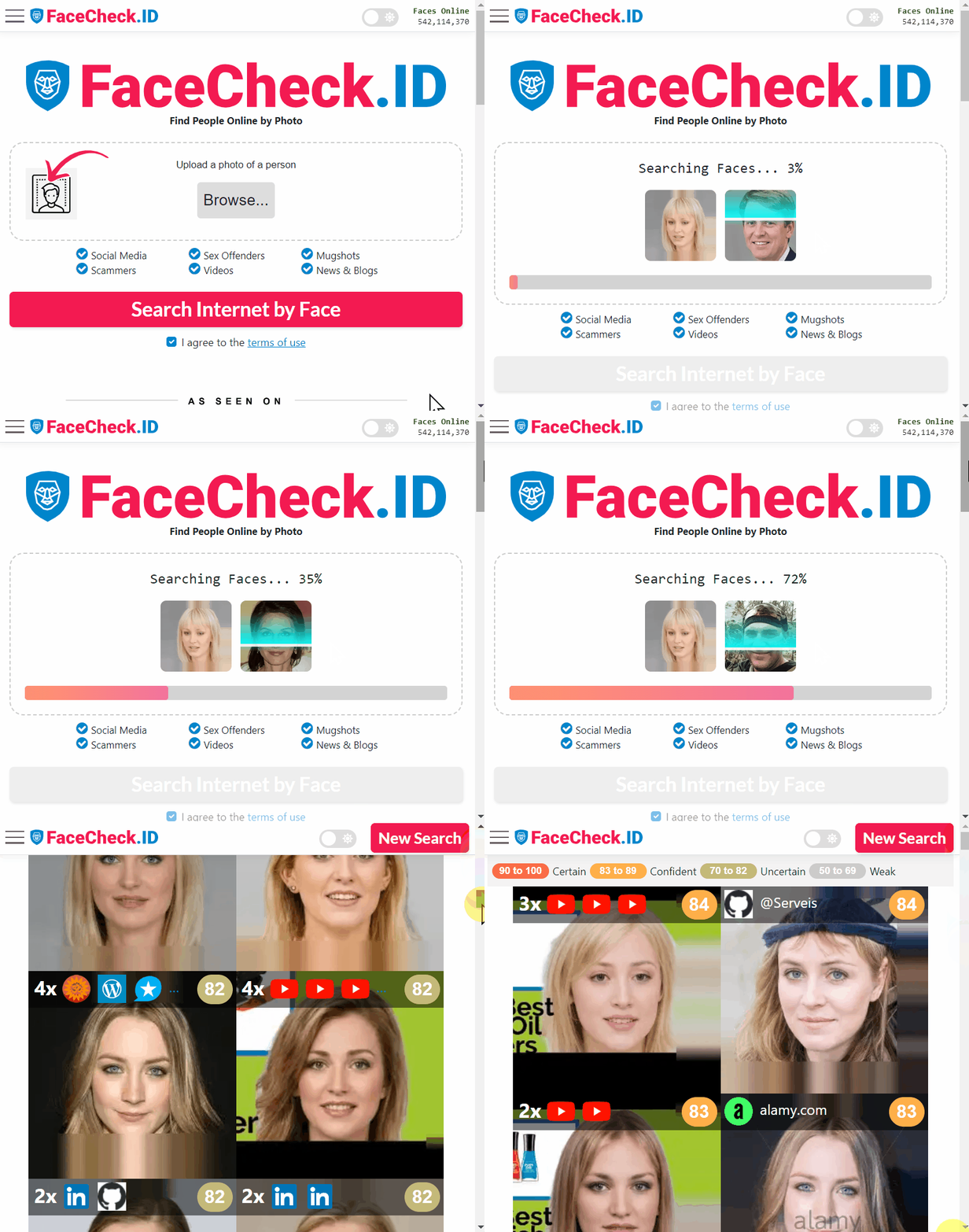
This is where a dedicated face-search engine like FaceCheck.ID fits in. Instead of crawling Facebook directly, it indexes faces from publicly visible pages across the web, which can include public profile photos, public posts, news mentions, blogs, and other sites that have republished or scraped Facebook images. When a Facebook profile picture has been shared elsewhere on the open web, a face search can surface it even if the original Facebook page is not directly searchable.
A few practical points to keep in mind:
- Strictly private Facebook profiles with no public photos generally cannot be found through any reverse search.
- Public profile photos are the most likely to appear in face-search results because they are reused, cached, and reposted.
- Profile photos uploaded from a phone are often cropped tightly to the face, which actually helps face matching.
- The same person may have multiple Facebook accounts, including old, abandoned, or fake ones that still surface in results.
Getting cleaner matches from a Facebook-style photo
Profile pictures vary widely in quality, and that has a direct impact on match confidence. To improve odds:
- Use a clear, front-facing image with the face taking up a meaningful portion of the frame.
- Avoid heavy filters, sunglasses, hats, and group shots where the target face is small.
- If the only photo you have is a screenshot, try to grab the original full-resolution version rather than a compressed thumbnail.
- Run multiple searches with different photos of the same person if you have them, since pose and lighting changes can pull up different match sets.
- Pay attention to background details, watermarks, and visible usernames in result thumbnails. Those often confirm whether a hit is the same person or a lookalike.
What a Facebook reverse search cannot prove
A face match to a Facebook profile is a lead, not a verdict. Common interpretation mistakes:
- Treating a high-confidence match as proof of identity. Lookalikes and siblings produce convincing false positives.
- Assuming the Facebook profile that hosts a matching photo belongs to the person in the photo. Scammers, fan accounts, and cloned profiles routinely reuse other people's images.
- Concluding that the absence of results means a person has no Facebook presence. They may have strict privacy settings, no public photos, or use images that have not been indexed.
- Mistaking a recycled stock photo or model headshot for a real account.
Face search works best as one input among several. Cross-check matches against other platforms, look at posting history, mutual connections, and the consistency of biographical details before drawing conclusions about who someone really is.
FAQ
What does “Reverse Search Facebook” usually mean in the context of face recognition search engines?
“Reverse Search Facebook” is usually shorthand for trying to start with a face photo and end up finding Facebook profiles or Facebook-hosted copies of that face online. In practice, most face recognition search engines don’t “search inside Facebook” like Facebook’s own internal systems; they typically find public web pages and images that their crawlers can access, which may include public Facebook pages, public profile pictures, or reposts/scraped copies hosted elsewhere.
Can a face recognition search engine reverse-search Facebook profile photos if the Facebook account is private or locked?
Generally, no. Face recognition search engines can only match against images they can legally and technically access (for example: public pages, public posts, or images that have been reposted on other public sites). If a Facebook profile is private/locked and its photos are not publicly visible, a face search tool typically cannot retrieve or index those images—though the same photo might still appear elsewhere on the open web.
What’s a safe, practical workflow for doing a “Reverse Search Facebook” using a face photo without misidentifying someone?
Use results as leads, not proof: (1) crop to one clear face, (2) run a face-search tool and collect multiple candidate links, (3) open each source page and check context (same name, same location, consistent timeline, multiple photos that match—not just one avatar), (4) cross-check with non-face clues like usernames, mutual friends, or linked websites, and (5) if it’s high-stakes (fraud, safety, accusations), treat the match as unconfirmed unless you can corroborate through independent evidence.
Why does “Reverse Search Facebook” sometimes return multiple similar Facebook profiles (or the wrong one)?
Common causes include look-alike faces, low-quality or filtered photos, partial/side-profile images, mismatched lighting/age differences, and the fact that profile pictures are often reused, reposted, or screenshot and shared across many pages. Another frequent issue is that a result may point to a repost, fan page, or impersonation account rather than the original Facebook profile.
How can FaceCheck.ID add value when someone says they want a “Reverse Search Facebook”?
FaceCheck.ID can be useful as a face-first search step to find public web occurrences of the same (or very similar) face, which may include public Facebook links or copies of Facebook images reposted elsewhere. The key safeguard is interpretation: a Facebook link (or any social link) is not identity proof by itself—use it to locate candidate pages, then verify with multiple matching photos and consistent non-face details before concluding it’s the same person.

Recommended Posts Related to reverse-search-facebook
-
Facial Recognition and Reverse Search on Facebook: A Deep Dive into FaceCheck
In this in-depth guide, we'll show you how to use FaceCheck.ID, a fantastic tool that harnesses facial recognition technology to reverse search Facebook profiles. How to Reverse Search Facebook using FaceCheck.ID.