Search by Screenshot

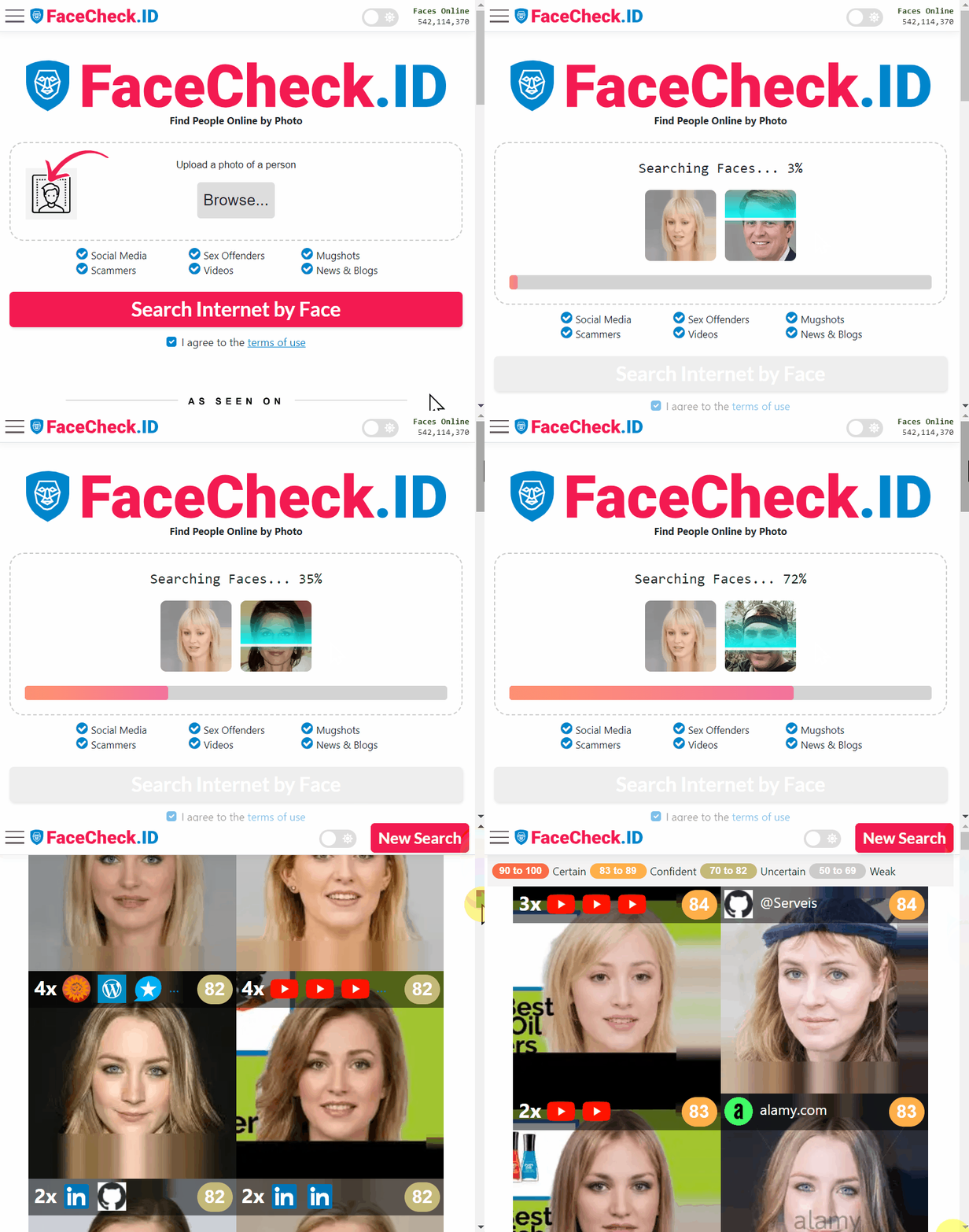
Searching by screenshot is one of the fastest ways to investigate a face you have spotted on screen, whether it appeared in a dating app profile, a video call, a Twitch stream, or a suspicious Instagram DM. On FaceCheck.ID, a screenshot of a face becomes the input for a reverse face search across publicly indexed pages, helping you check whether the same person shows up elsewhere under a different name or context.
Why screenshots are the most common input for face search
Most people do not have a clean portrait of the person they want to look up. They have what they can capture in the moment: a screen grab from a Tinder match, a Zoom thumbnail, a TikTok still, a Telegram avatar, or a frame paused on a YouTube video. Screenshots fill the gap because they let the user freeze a face that would otherwise disappear behind a swipe, a timer, or a deleted message.
Common scenarios where a screenshot becomes the search image:
- A romance scam target wants to know if a profile photo from Hinge or Bumble appears on stolen-photo lists or unrelated social accounts
- A recruiter wants to verify whether a video interview candidate matches the LinkedIn headshot they submitted
- A journalist captures a face from a livestream and wants to confirm an identity through other public posts
- A parent screenshots a stranger from their child's follower list to check for prior reports
- A buyer on Marketplace or Depop screenshots a seller's profile picture before sending money
How screenshot quality affects face-match results
Face recognition is sensitive to the same things that make any image hard to read. Screenshots add their own quirks: compression from the source platform, low resolution from mobile screens, and clutter from UI elements like usernames, like buttons, and chat bubbles overlapping the face.
Results tend to improve when the screenshot has:
- A face that takes up a meaningful portion of the frame, not a 60 pixel avatar
- Even lighting without heavy shadows across one side of the face
- A roughly front-facing angle, since extreme profile shots reduce the number of usable facial landmarks
- Minimal motion blur, which is common in video-call captures and TikTok frames
- The face cropped away from surrounding UI, watermarks, or other faces that confuse the detector
A screenshot of a Snapchat filter, a heavily edited selfie, or a face partially covered by a sticker or emoji will often produce weaker matches or none at all, even when the person has a strong public presence elsewhere.
What a screenshot search can and cannot tell you
A screenshot search can surface pages where the same face appears: other social profiles, news mentions, forum posts, archived dating profiles, scam-warning sites, or modeling portfolios. That is enough to confirm an inconsistency, such as a "Daniel from Houston" whose photo also lives on a Russian VK account under a different name, or a "verified" profile whose pictures have been recycled across dozens of throwaway accounts.
What it does not do is prove identity on its own. Lookalikes exist. Twins exist. Stock photos exist. A high-confidence match still needs a human to read the surrounding context: the username, the post date, the language, the bio, the friends list. A face that appears on a stolen-photo aggregator strongly suggests catfishing, but a face that appears on a stranger's Facebook from 2014 might just mean someone borrowed the picture, or the match is wrong.
Screenshots also age. A face captured from a five year old YouTube video may look different enough today that a current profile photo of the same person scores lower than expected. Treat screenshot results as leads, not verdicts, and confirm anything important with a second source before acting on it.
FAQ
What does “Search by Screenshot” mean in a face recognition search engine?
“Search by Screenshot” means using a screenshot (for example, from a dating app, social post, or video call) as the input image for a face-search tool. The engine detects the face inside the screenshot, creates a facial representation (embedding), and searches its index for visually matching faces across other images online.
When is “Search by Screenshot” the best option compared to using the original photo?
It’s most useful when you can’t download the original image file—such as images inside apps, ephemeral stories, livestreams, or video calls—so a screenshot is the only practical capture method. It can also help preserve on-screen context for your own review, but you should avoid relying on that context (captions/usernames) as proof of identity.
How do face recognition search engines handle screenshots with UI elements, captions, or watermarks?
Most face-search engines first run face detection, then crop/align the face region and ignore much of the surrounding interface. However, heavy overlays (stickers, emojis, text covering facial features, strong watermarks) can block key landmarks and reduce match quality, so cropping tightly to the unobstructed face usually improves results.
Can a “Search by Screenshot” workflow increase false matches, and what’s a safer way to interpret results?
Yes. Screenshots are often lower quality (resized, compressed, or sharpened by the app), and may capture expressions or angles that resemble other people. Treat matches as investigative leads, validate using multiple independent images of the same person (different angles/lighting), and corroborate with non-face cues (consistent handles, timestamps, linked accounts) before concluding it’s the same individual.
How can FaceCheck.ID add value in a “Search by Screenshot” workflow without over-identifying someone?
If you use a tool like FaceCheck.ID, it can be helpful to (1) upload a tightly cropped face from the screenshot, (2) run searches with 2–3 different screenshots/frames of the same person, and (3) compare whether results converge on the same sources rather than one-off near-matches. Use any similarity indicators to prioritize review, not as identity proof, and avoid public accusations or doxxing based on search results alone.

Recommended Posts Related to search-by-screenshot
-
How to Find Someone Using a Screenshot
Search by Screenshot and Find Anyone.