Search for Actors
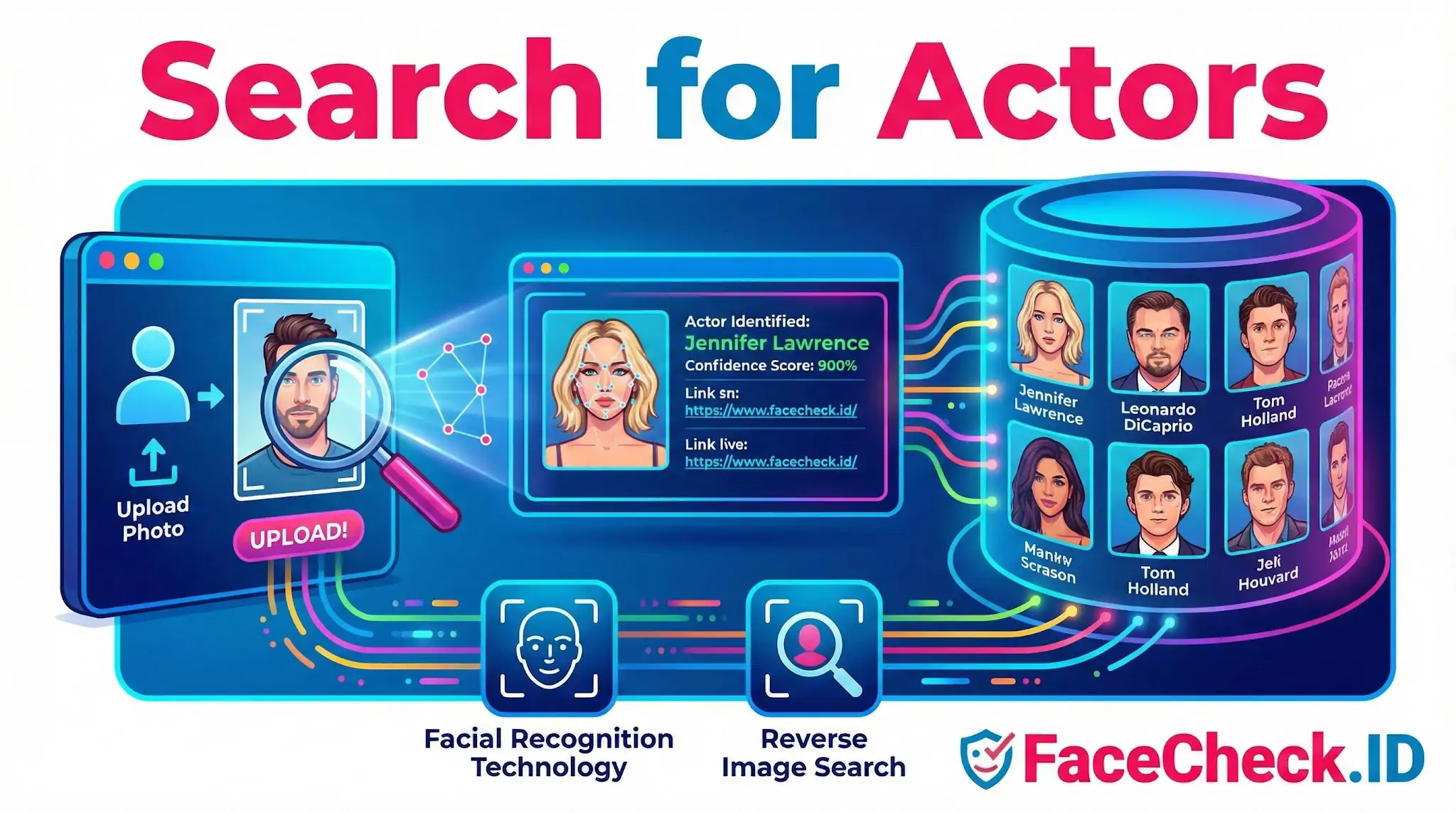
Searching for actors is one of the most common reasons people turn to face-search tools. Someone watches a film, sees a meme, or scrolls past a press still and wants to know who the person on screen is. Face recognition makes that possible by matching a captured frame or photo against publicly indexed images of working actors, character headshots, and red-carpet coverage.
How face search handles actors differently from regular people
Actors are an unusually easy case for face recognition. Their photos are heavily duplicated across IMDb pages, studio press kits, fan wikis, news articles, festival coverage, and entertainment blogs. That redundancy gives a search engine many reference angles, lighting conditions, and ages of the same face, which raises confidence scores and reduces false positives.
The tradeoff is that actors are also the most common source of mistaken identity in reverse image search. A few patterns to expect:
- Lookalike clusters. Some working actors share strong feature similarity, and short-haired men in suits or women with similar bone structure often appear in each other's results.
- Age drift. A face from a 1990s role may not match the same person's current red-carpet photos with high confidence. The reverse is also true.
- Character versus person. Heavy prosthetics, fantasy makeup, or de-aging effects can pull a face away from any indexed reference of the actor's real appearance.
- Stunt doubles and body doubles. A close-up may be the credited actor, but a wider shot of the same scene may not.
Working from screenshots and video frames
Most actor searches start from a still grabbed off a streaming service, a YouTube clip, or a phone photo of a TV. Frame quality usually decides whether the search works. Motion blur, interlacing artifacts, compression noise, and oblique camera angles all reduce the quality of the face embedding the system generates.
Practical steps that improve results:
- Pause on a frame where the actor is looking close to the camera. Three-quarter and profile shots match poorly compared to front-facing frames.
- Crop tight enough that the face fills most of the image, but include the full head shape.
- Avoid frames where the actor is mid-expression, mid-blink, or partially turned.
- Skip frames with heavy color grading, filters, or stylized lighting when a cleaner alternative exists in the same scene.
For older or independent films, expect weaker results. Indie cast members, theatre actors, and regional television performers are indexed less thoroughly than mainstream Hollywood names, so a confident match may not exist even when the search is technically working.
Reading the results without overtrusting them
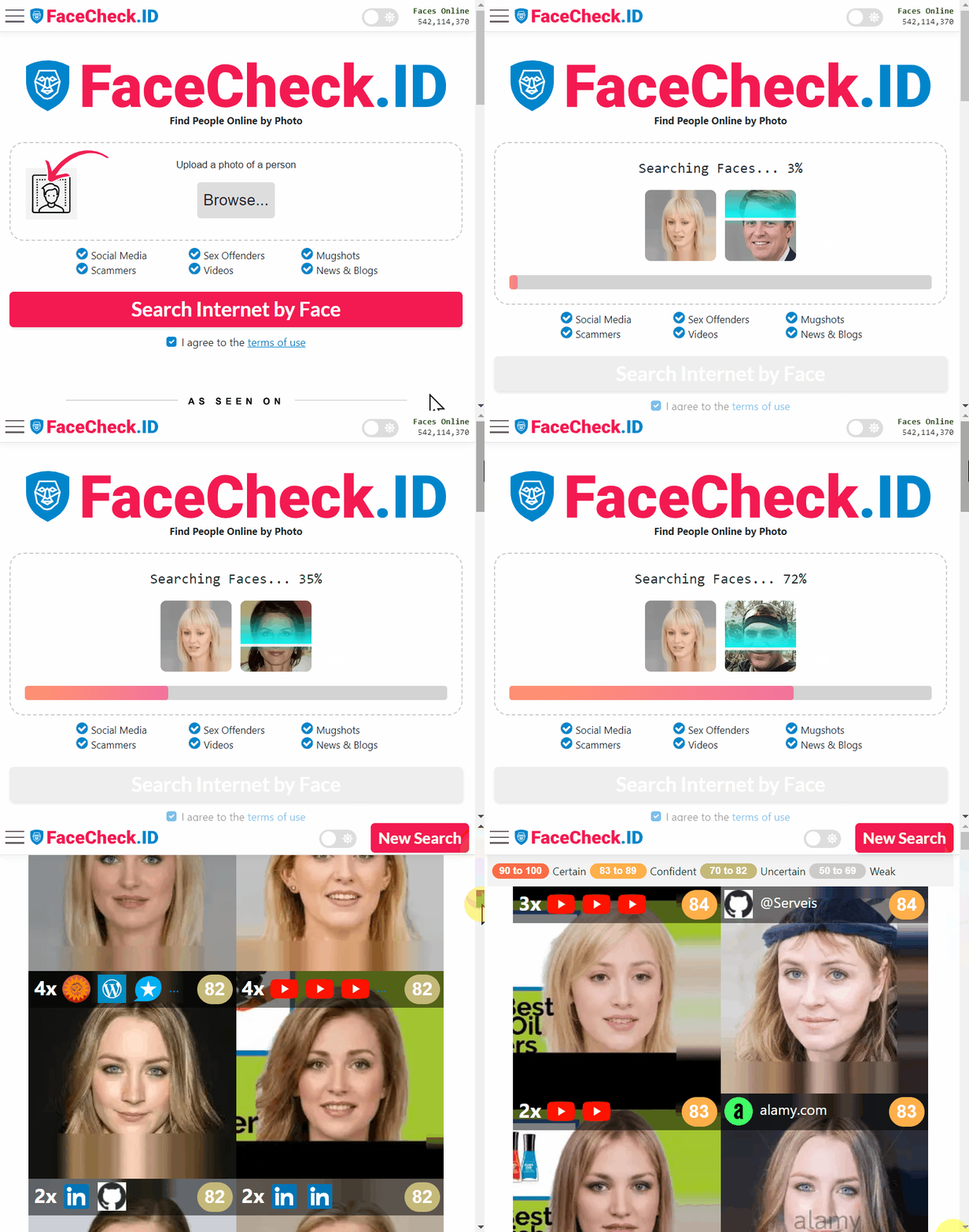
A face-search result for an actor query usually returns a ranked list of candidates with similarity scores and source links. Treat the top result as a strong lead, not a confirmed identity. Verification should come from cross-checking the source pages: an IMDb credit for the title the screenshot came from, a matching role description, or a press still from the same production.
Common ways an actor search goes wrong:
- The top match is a lookalike, and the real actor is third or fourth in the list with a slightly lower score.
- The search returns a fan-made deepfake or AI-generated image because those now appear in public indexes.
- The match links to a stock photo site, where the labeled name is the model's, not the actor's.
- A character name is confused with the performer because most indexed captions reference the role.
What an actor search cannot tell you
Face search identifies who appears in an image. It does not confirm the title, scene, or context. A confident match to a specific actor does not mean the screenshot is from the project you assume it is, and it does not authenticate the image as genuine. With synthetic media now common in fan edits and promotional content, a strong face match is the start of an identification, not the end of one. Treat the actor's name as a hypothesis to verify against the original source, the production credits, and at least one independent reference image.
FAQ
What does “Search for Actors” mean in the context of face recognition search engines?
“Search for Actors” usually refers to using a face recognition search engine to find web pages and images where a person’s face appears, commonly to identify an actor/performer or to find other photos of the same person. It does not guarantee the person is an actor—it's a face-based lead-finding workflow, not proof of identity or occupation.
Can “Search for Actors” identify the actor’s real name with certainty?
No. Face recognition search can surface look-alike matches, reposts, fan pages, or mislabeled content, and it typically does not provide verified identity. Treat any name you see as a hypothesis: confirm by cross-checking multiple independent sources (official filmography pages, verified social profiles, reputable databases) before concluding it’s the same person.
What are the safest steps to run a “Search for Actors” query without exposing sensitive personal data?
Use the minimum-necessary image (crop to the face, remove bystanders), avoid uploading images containing minors or private/intimate context, and consider using a neutral headshot rather than an image tied to a home address, workplace badge, or other identifying details. Prefer tools with clear privacy/retention controls, and avoid sharing your query image publicly after uploading.
Why might a “Search for Actors” query return adult-content sites, mugshot pages, or other high-risk results?
Face search engines index what is publicly accessible or discoverable online, and faces get reposted across many contexts (memes, aggregators, scraped galleries, impersonation pages). A match to an adult, crime, or “scam report” page can be a repost, a mislabel, or a look-alike rather than the same person. Verify by checking the source page context, dates, and whether multiple unrelated sources consistently connect to the same identity.
How can FaceCheck.ID add value to a “Search for Actors” workflow, and what should I watch out for?
FaceCheck.ID can be used as a face-search tool to discover where a face appears online, which may help locate the earliest/most original source of an image or find additional appearances that hint at the person’s identity. Watch out for false matches, repost networks, and misleading page titles; use results as starting points, not conclusions, and validate any identity claim with corroborating evidence from reliable sources.

Recommended Posts Related to search-for-actors
-
Search for Actors by their Face
Steps to Search for Actors Using FaceCheck.ID. Advantages of using FaceCheck.ID over competitors: FaceCheck.ID's intuitive design and commitment to providing accurate results make it the ideal choice for users looking for a fun and engaging way to search for actors by their face. FaceCheck.ID offers a unique, engaging, and fun way to search for actors by their face, making it the go-to platform for movie and TV lovers.