Social Engineering
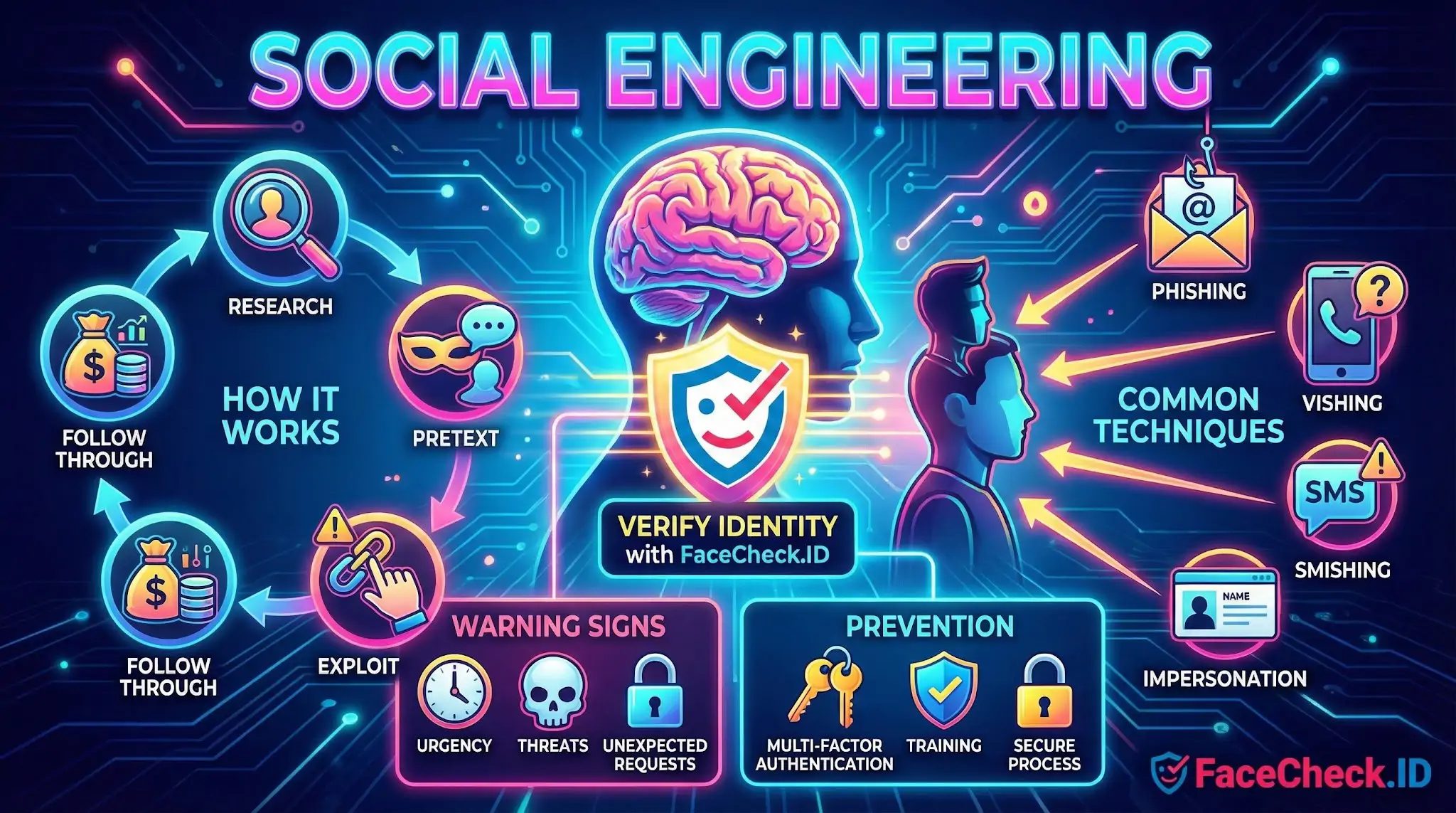
Social engineering is the manipulation of people into handing over information, money, or access through deception rather than technical hacking. On the identity side, attackers often build their pretexts using public photos, names, and social profiles, which is exactly the territory a face-search tool like FaceCheck.ID covers when someone needs to verify whether a person reaching out is who they claim to be.
How social engineering uses faces and stolen photos
Most modern social engineering relies on a believable identity. Attackers rarely invent a person from scratch. They borrow one. A scammer running a romance fraud will pull headshots from a real model, soldier, doctor, or oil rig worker and rebuild that person on Tinder, Hinge, Instagram, or WhatsApp. A recruiter scam will use a stolen LinkedIn headshot to pose as a hiring manager. A fake support agent might use a friendly stock-style photo with a fabricated name badge.
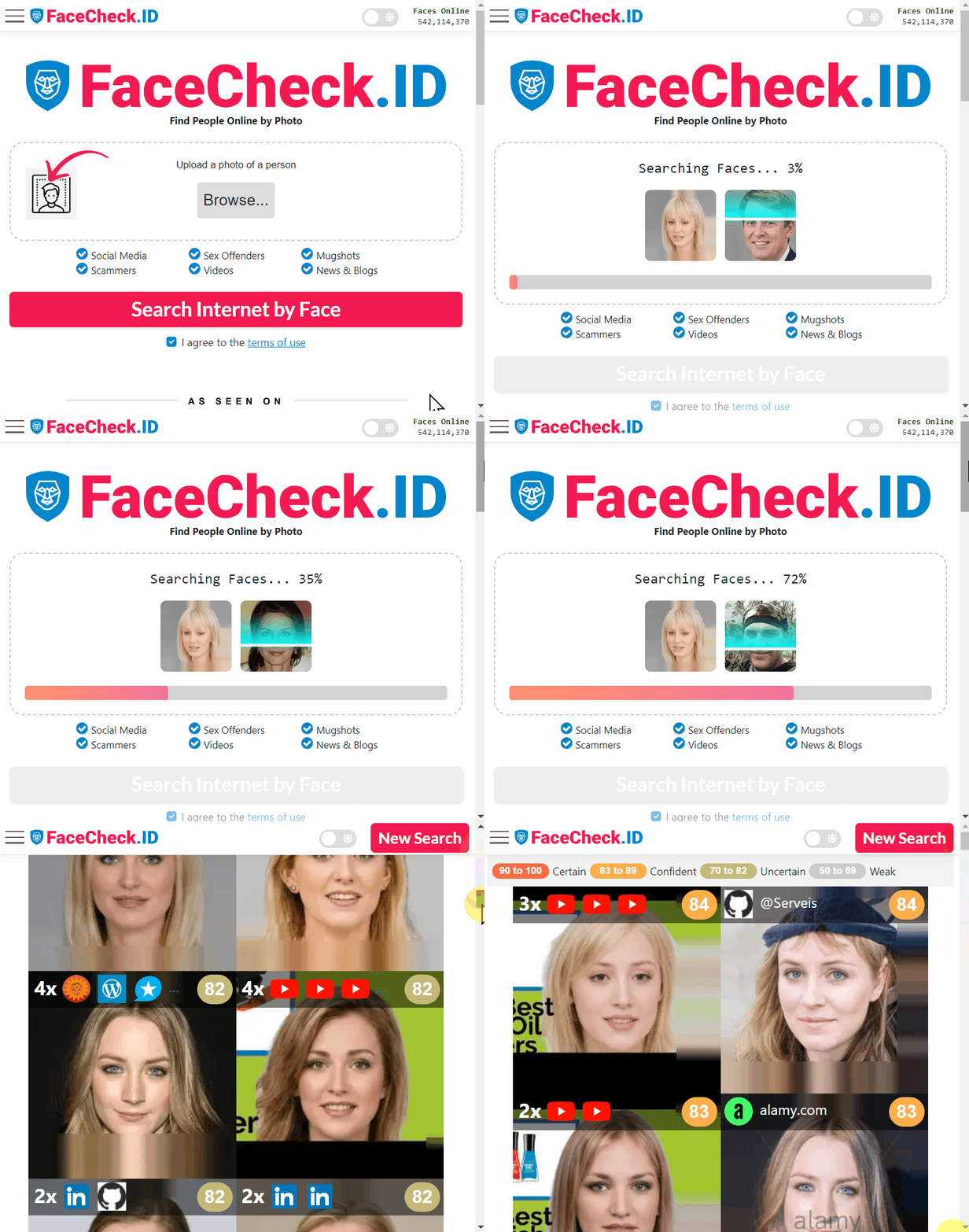
Face-search tools matter here because the same stolen photo usually appears in many places online. Running the image through reverse face search often surfaces:
- The original owner's real social profiles under a different name
- News articles, modeling portfolios, or company bio pages where the photo first appeared
- Scam-report forums and romance-fraud databases that already flagged the image
- Other dating or messaging accounts using the same face with inconsistent biographies
When the same face shows up across mismatched identities, the pretext collapses.
Common attacks where face search helps
Romance scams, sextortion, fake recruiter outreach, investment fraud (often called pig butchering), and impersonation of executives or celebrities all share one weakness: the attacker is using someone else's face. A few practical scenarios where running the photo through face search changes the outcome:
- A match on Hinge sends professional-looking photos and quickly moves the chat to Telegram. A reverse face search reveals the photos belong to a Spanish actor with no connection to the name being used.
- A LinkedIn message offers a remote job with unusual onboarding steps. The recruiter's profile photo traces back to a real engineer at a different company who has no recruiting role.
- A "verified" crypto advisor on Twitter uses a face that appears in unrelated YouTube tutorials under a different name.
- A military officer on Facebook asks for help with a wire transfer. The photo is reused across dozens of widow-targeted scam profiles.
Face search does not catch every attack, but it catches the lazy and mid-tier ones, which is most of them.
What face search can and cannot prove
A face-search hit is a strong signal, not a verdict. Several caveats matter:
- Lookalikes exist. A high-confidence match should still be cross-checked against names, locations, and timeline details.
- Public figures and models have legitimately wide image footprints. Many hits do not always mean impersonation if the person is the actual model or actor.
- Cropped, filtered, or AI-edited photos may produce weaker matches or false negatives. Attackers sometimes mirror images or apply light edits specifically to dodge reverse search.
- A clean result, meaning no matches found, does not prove someone is real. It can mean the photo is private, freshly taken, AI-generated, or scraped from an unindexed source.
- Generative-AI faces produce no reverse-search matches because the face does not exist anywhere else. Absence of results combined with other red flags is itself a warning.
The traditional warning signs still apply: pressure, urgency, secrecy, payment requests, requests for authentication codes, and stories that drift when questioned. Face search supplements those checks. It does not replace them.
Where verification ends and judgment begins
Identifying a stolen photo confirms the persona is fake. It does not identify the actual attacker, who is usually operating from a different country under a throwaway account. Reporting the impersonation to the platform, warning the real person whose photo was stolen, and preserving message history matter as much as the technical lookup. Face search is one layer in vetting an online identity, useful for catching reused images quickly, but final trust decisions still depend on context, behavior, and the kind of access or money being requested.
FAQ
What is “Social Engineering” in the context of face recognition search engines?
In face recognition search engines, “Social Engineering” refers to manipulating people (not the technology) using information found via face-search results—such as names, usernames, workplaces, locations, or social media links—to gain trust, obtain more data, or trigger actions (e.g., sending money, sharing codes, granting access). The risk is that face-search results can accelerate “research” used to craft believable pretexts.
How can face-search results enable more convincing social engineering attacks?
Face-search results can help an attacker quickly assemble a profile (photos across sites, repeated usernames, friend/family mentions, employer pages, repost networks). That context can be used to impersonate a coworker, match a target’s interests, reference real events, or contact someone’s social circle—making phishing, romance scams, and “urgent request” messages feel more credible even when the attacker never truly knows the person.
What are common social engineering scenarios involving face recognition search engines?
Common scenarios include: (1) impersonation or “helpdesk” fraud using a discovered name/role; (2) romance or dating scams using matched photos to refine a fake persona; (3) doxxing/harassment by linking a face to multiple accounts; (4) credential-reset attempts using personal details found on linked pages; and (5) “friend-in-need” scams where an attacker uses matching images to appear legitimate to a victim’s contacts.
What practical steps reduce social engineering risk when using a face recognition search engine (including FaceCheck.ID)?
Treat matches as leads, not proof; avoid contacting people based only on a face match; verify identity through independent channels (official company directory, known phone number, verified platform messaging); do not share screenshots of results publicly; minimize what you upload (crop to the face, remove extra identifiers); and document uncertainty (e.g., multiple similar matches). If you use a tool like FaceCheck.ID, apply these same controls and assume any result could be a wrong-person match or a repost page.
How can I tell if someone is using face-search findings to socially engineer me?
Warning signs include messages that reference personal details you didn’t share with them, unusual “verification” requests (codes, one-time passwords, gift cards), pressure/urgency, requests to move to a different channel, and claims that rely on photos as “proof.” If a person seems to know your online footprint too well, assume they may have used face-search or open-web research; pause and verify via a trusted, pre-existing contact method before taking any action.

Recommended Posts Related to social-engineering
-
The New Face of Digital Deception: FraudGPT, Romance Scams, and Protecting Yourself in 2026
While FraudGPT is widely used to generate flawless phishing emails, malicious code, and fake websites, its application in social engineering—particularly romance scams—is one of its most devastating uses. Decoding the Threat Landscape: ChatGPT, FraudGPT, and WormGPT in Social Engineering Attacks — International Journal of Scientific Research in Computer Science, Engineering and Information Technology (IJSRCSEIT).