Twitter Image Search for Face Verification

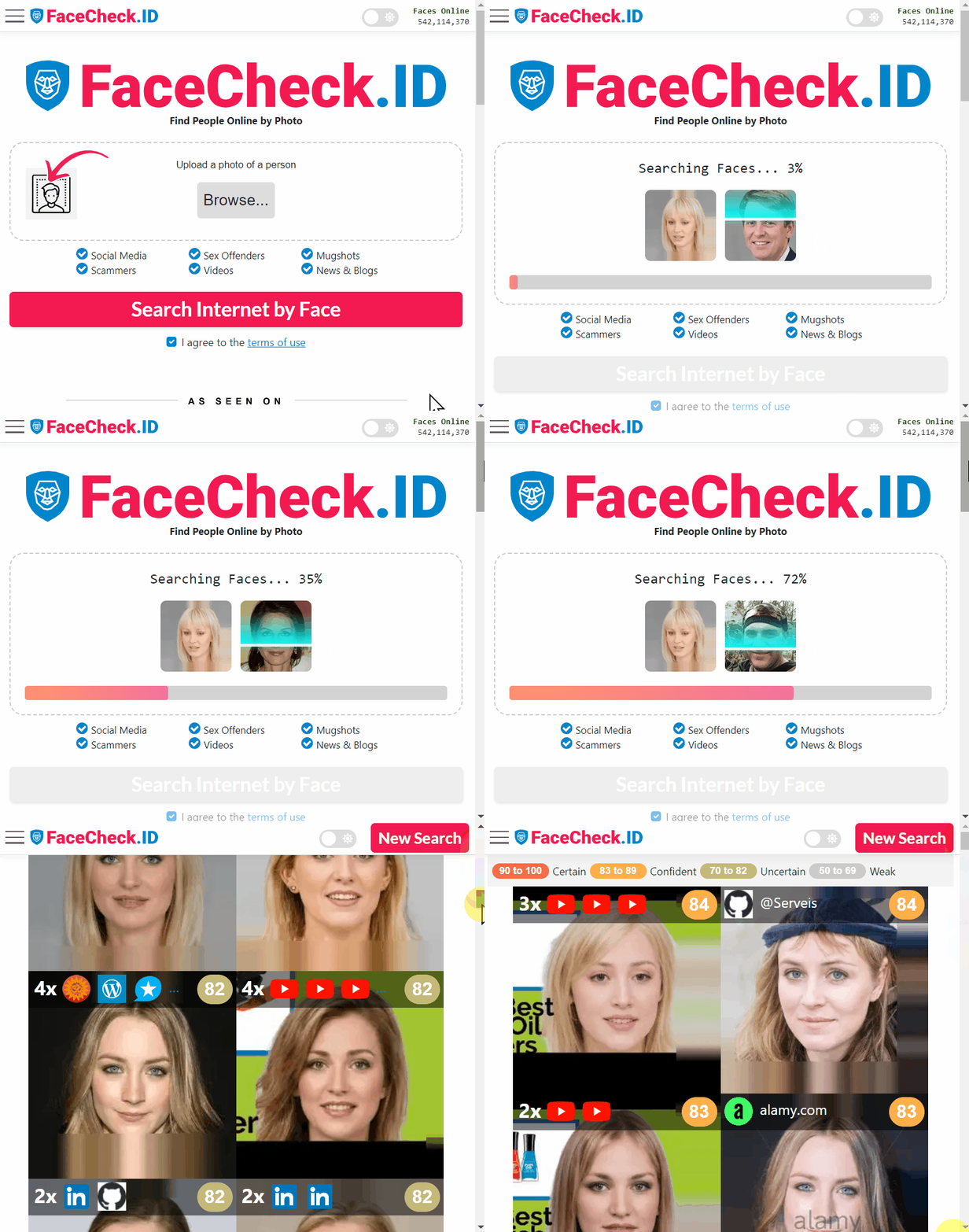
When a face shows up in a FaceCheck.ID result linked to a Twitter or X profile, the next step is usually to verify it. Twitter Image Search is one of the practical tools investigators, journalists, and ordinary users rely on to confirm whether a face, photo, or alleged identity actually belongs to the account behind it.
How Twitter Image Search fits into face investigation
Face-recognition results often surface profile photos, banner images, and embedded post images from X. A single match is rarely enough to confirm identity. The same headshot can be reused across catfish accounts, fan pages, parody profiles, and impersonation networks. Twitter Image Search lets you pull up additional images attached to a handle so you can compare them against the original photo you searched.
For example, if FaceCheck.ID returns a match on @somehandle, opening that account's Media tab shows every image they have posted publicly. Selfies taken at different angles, in different lighting, with consistent surroundings, suggest a real person operating the account. A media tab containing only one stolen headshot and unrelated stock photos is a common pattern for scam, romance fraud, and crypto bait accounts.
Practical search techniques for identity work
The basic method is the search bar with the Media filter, but operator-based queries are more useful for verification.
from:usernameshows only posts authored by that handle, useful when checking whether a face appears in their own contentfrom:username filter:imagesnarrows to image posts only"first last" filter:imagessearches mentions of a name attached to imagesfrom:username since:2020-01-01 until:2021-01-01pins down when a photo was first posted, which matters when you are trying to figure out who originally uploaded a face image
If a FaceCheck.ID result points to a stolen photo, locating the earliest post containing that image often reveals the real owner. Scammers usually copy photos from accounts that have been online for years, so the original post predates the scam account by a wide margin.
Reading what the images actually tell you
Treat Twitter Image Search results the way you treat any face-match evidence: as a lead, not a conclusion.
Look for consistency across the account's images. Real users tend to show:
- The same person in varied poses, locations, and outfits over months or years
- Backgrounds that match a stated city, job, or lifestyle
- Other people, pets, or recurring environments that imply a real life
- Replies and tagged photos that connect them to others who confirm the identity
Suspicious accounts tend to show:
- A handful of perfect, professional-looking headshots reused everywhere
- Images that reverse-search to influencer or model accounts on other platforms
- Inconsistent lighting, ages, or facial structure across photos suggesting multiple people
- Only avatar and banner images, with no candid or contextual photos
Where Twitter Image Search falls short
Image search on X cannot prove identity. It can show what a handle has posted, but not who controls the handle. Hacked, sold, or recycled accounts are common, and a long history of authentic photos does not guarantee the current operator is the same person.
The platform also does not index every image well. Posts behind protected accounts are invisible. Deleted images vanish from search even when archived elsewhere. Images embedded in quote posts or replies often do not surface through Media filters, so a face can appear on X without showing up in a Media-tab review.
Finally, Twitter Image Search has no built-in face matching. You are visually comparing photos by eye, which is unreliable for lookalikes, twins, or low-resolution images. This is where reverse face-search tools and Twitter Image Search work better together than alone: face recognition narrows the candidate accounts, and image search on X helps you judge whether the account behaves like a real person attached to that face. The conclusion still depends on human judgment, cross-referencing other platforms, and accepting that some matches will remain ambiguous.
FAQ
What does “Twitter Image Search” mean when people are talking about face recognition search engines?
In this context, “Twitter Image Search” usually means trying to discover where a person’s face photo appears on Twitter (now X) by using a face recognition search engine. It’s not an official Twitter/X feature; it’s a workflow where you take a face image (often a profile photo or screenshot) and search the open web for visually similar faces, then check whether any results include Twitter/X pages or reposts of Twitter/X images.
Why do “Twitter Image Search” results often point to reposts, screenshots, or third‑party sites instead of the original tweet?
Face search engines generally index what they can crawl from public web pages and image hosts. Twitter/X content is frequently re-shared as screenshots, embedded previews, news/blog reposts, forum mirrors, or cached copies, which may be easier to index than the original tweet. As a result, your “Twitter Image Search” may surface an external page that contains the same face image (or a crop of it) rather than the original Twitter/X URL.
What’s the best way to prepare a Twitter/X screenshot for a face recognition “Twitter Image Search”?
Use the highest-resolution version you can and crop tightly to a single, clear face. Avoid heavy compression, stickers, emojis over the face, extreme filters, or oblique angles. If the screenshot includes multiple faces, crop to one face per search. If available, prefer the original profile photo (downloaded image) over an in-app screenshot, because UI elements and scaling can reduce match quality.
Can “Twitter Image Search” find faces from private or locked Twitter/X accounts?
Usually no. Face recognition search engines can only return images that are publicly accessible and have been indexed from the open web. If an account is private/locked and its images are not publicly viewable (and not reposted elsewhere), there may be nothing for a face search engine to find. However, if the same photo was reposted publicly (by someone else, on another platform, or on a public page), it could still appear in results.
How can FaceCheck.ID add value to a “Twitter Image Search” workflow without over-identifying someone?
FaceCheck.ID (and similar tools) can help by finding visually similar faces across many public web sources, which may include Twitter/X-related pages or reposts. To use it responsibly: treat results as leads, not proof; open and verify the source context (is it the same person, the same photo, or a look-alike?); cross-check with non-face signals (username continuity, timestamps, linked bios, consistent locations); and avoid making high-stakes decisions based only on a face match.

Recommended Posts Related to twitter-image-search