Verify Profiles

Verifying profiles is the work of deciding whether the person on the other end of a chat, dating match, job pitch, or business inquiry is actually who they claim to be. Face search sits at the center of that work because a profile photo is often the only piece of evidence that can be checked against the rest of the public web.
Where face search fits in profile verification
Most fake profiles fail at the same point: the photo. Scammers, catfish accounts, and impersonators rarely produce original images. They reuse stolen headshots from real people, recycle modeling photos, or generate synthetic faces. Running the profile picture through a face-search engine like FaceCheck.ID returns the other places that face appears online, which usually exposes one of three patterns:
- The face belongs to a real person whose identity matches the profile (consistent name, employer, city, and history across results).
- The face belongs to a real person whose identity does not match the profile, which is impersonation or romance-scam territory.
- The face has no meaningful footprint at all, which is common with AI-generated images and brand-new sock-puppet accounts.
Reverse image search by pixel hash catches exact reuse. Face search catches the harder cases, where a scammer crops, mirrors, color-shifts, or filters a stolen photo to defeat hash-based matching but leaves the face itself recognizable.
Reading match results without overreaching
A face match is a lead, not a verdict. A confident match to a LinkedIn profile under a different name does not automatically mean the account you are checking is fake. Identical twins, lookalikes, shared stock photos, and old photos reused with permission all produce real matches that mean something other than fraud.
Treat results as evidence to weigh against the rest of the profile:
- Strong fake signal: the same face appears on multiple unrelated accounts, in different countries, under different names, especially when the older accounts predate the one you are checking.
- Strong real signal: the face appears across years of timestamped content under one consistent identity, including incidental photos like conference shots, news articles, or tagged group photos that are hard to fabricate.
- Ambiguous signal: a single match on a low-traffic site, or matches that are visually close but not the same person. Confidence scores, face angle, lighting, and image resolution all affect how much weight a match deserves.
Front-facing, well-lit photos produce cleaner matches. Heavily filtered selfies, group shots where the face is small, side profiles, and images with sunglasses or masks return weaker results and more false positives.
Combining face evidence with profile behavior
Face search works best alongside the rest of the profile. An account with a clean face history can still be compromised or operated by someone other than the real owner. An account with a thin face footprint can still be a private person who simply does not post much.
Useful cross-checks include account age relative to activity volume, whether the username and bio details appear on other platforms under the same face, whether linked websites resolve to legitimate domains, and whether the network of followers or connections looks organic rather than freshly assembled. Romance scams in particular tend to combine a stolen face with a polished but shallow profile, a recent creation date, and a refusal to do live video.
What verification through face search cannot prove
Face search cannot confirm that the person currently typing is the person in the photo. It cannot detect a hacked or sold account where the original owner's photo is still in place. It cannot establish intent, only identity reuse. AI-generated faces with no web footprint will return empty results that look similar to the results for a private real person, so absence of matches is not proof of fraud.
Legitimate verification treats face-search output as one input among several, documents the reasoning behind a decision, and leaves room for the result to be wrong. Treating a single match as conclusive, especially against someone who has not been given a chance to respond, is how lookalikes and innocent people get accused of running scams they have nothing to do with.
FAQ
What does “Verify Profiles” mean in the context of face recognition search engines?
“Verify Profiles” generally refers to a workflow where you use face-search results as leads to help check whether an online profile (dating, social media, marketplace, etc.) is likely connected to the same real person across multiple sources. It is not a guarantee of identity; it is a way to compare consistency across images, accounts, and contextual clues.
How do I use a face recognition search engine to verify whether two profiles are likely the same person?
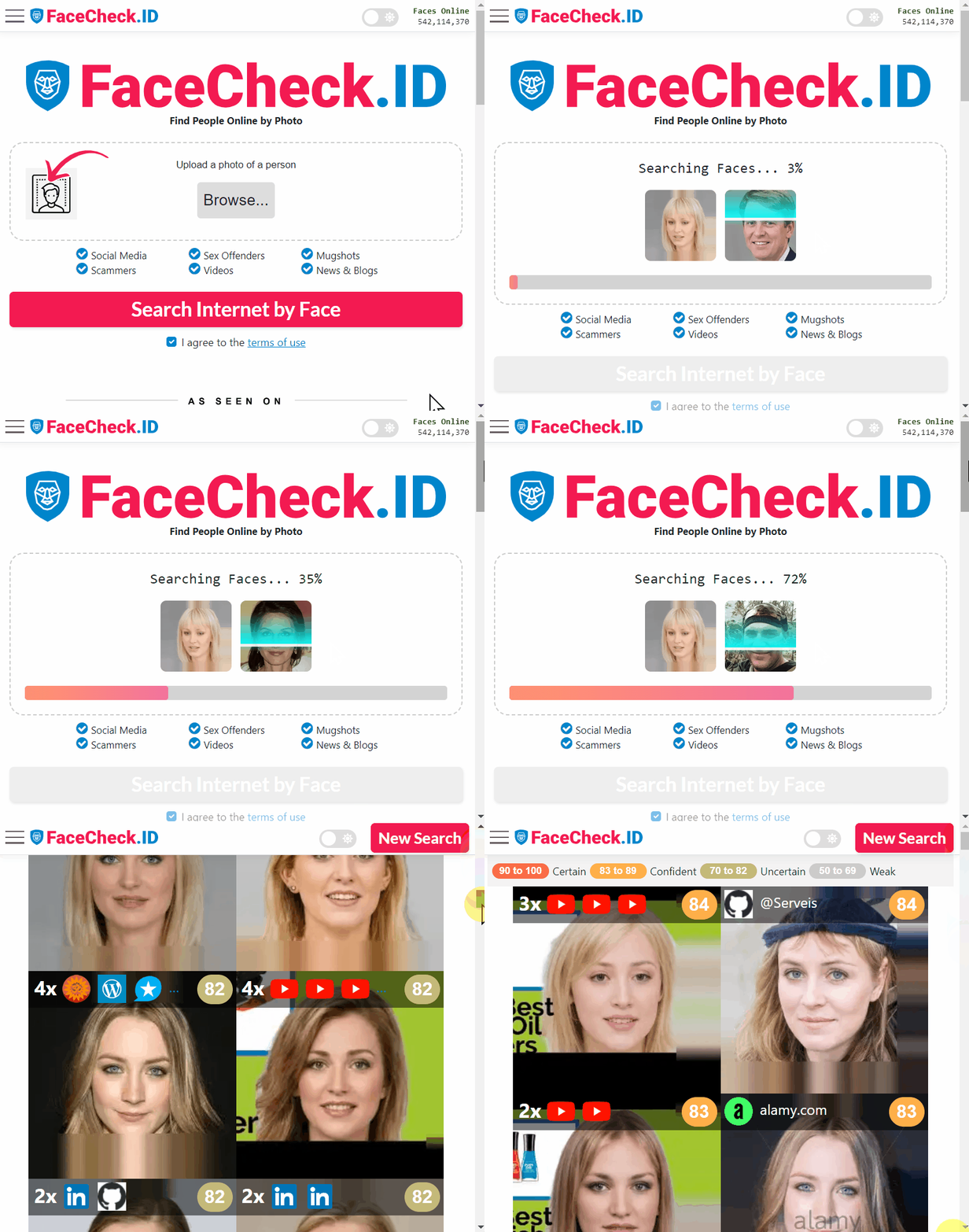
A practical “Verify Profiles” workflow is: (1) search with a clear face photo from Profile A, (2) check whether Profile B (or its photos) appears among results with strong similarity, (3) open the source pages and compare multiple photos (not just one), and (4) cross-check non-face signals like username history, location, posting timeline, and linked platforms. Treat matches as investigative pointers, not proof.
What are the most reliable signals that help confirm a profile is genuine after a face-match result?
Stronger confirmation usually comes from consistency across multiple independent sources: several different photos of the same person (different angles/lighting/ages), long-term posting history, consistent biographical details, and links between accounts (e.g., the same person appearing on a personal site plus established social profiles). A single matching headshot, repost, or screenshot is a weak signal because stolen images and fan/repost pages are common.
What are common reasons “Verify Profiles” can go wrong (false verification)?
False verification can happen when the matched image is a repost rather than the original account, when multiple people look similar (look-alikes), when the photo is heavily filtered/edited, when results point to aggregated pages that mix identities, or when you rely on one photo instead of a set. Always validate using the original source page and multiple corroborating details.
How can FaceCheck.ID add value to a “Verify Profiles” check, and what precautions should I take?
Tools like FaceCheck.ID can add value by quickly surfacing places where a face (or very similar faces) appears online, which may help spot reused photos, impersonation, or inconsistencies across profiles. Precautions: avoid concluding identity from one match, open and evaluate the source context, be cautious with sensitive categories (e.g., alleged criminal or adult-content pages), and use results responsibly to reduce harm from misidentification.

Recommended Posts Related to verify-profiles
-
How to Spot a Catfish in 2025: Red Flags in Fake Dating Profiles
Use FaceCheck.ID to verify profile photos. Verified profiles get blockchain badges that are tamper-proof.
-
How Do You Reverse Image Search on Dating Sites?
A reverse image search empowers you to verify profile pictures instantly.
-
Facial Recognition and Reverse Search on Facebook: A Deep Dive into FaceCheck
Follow our extended, friendly guide to find friends, verify profiles, and uncover a variety of use cases.
-
Can you reverse image search a person?
All-in-One Tool: Verify profiles, reconnect, and ensure image authenticity.
-
Reverse Image Search FAQ: The Ultimate Guide for 2025
Verifying profile pictures on dating sites.