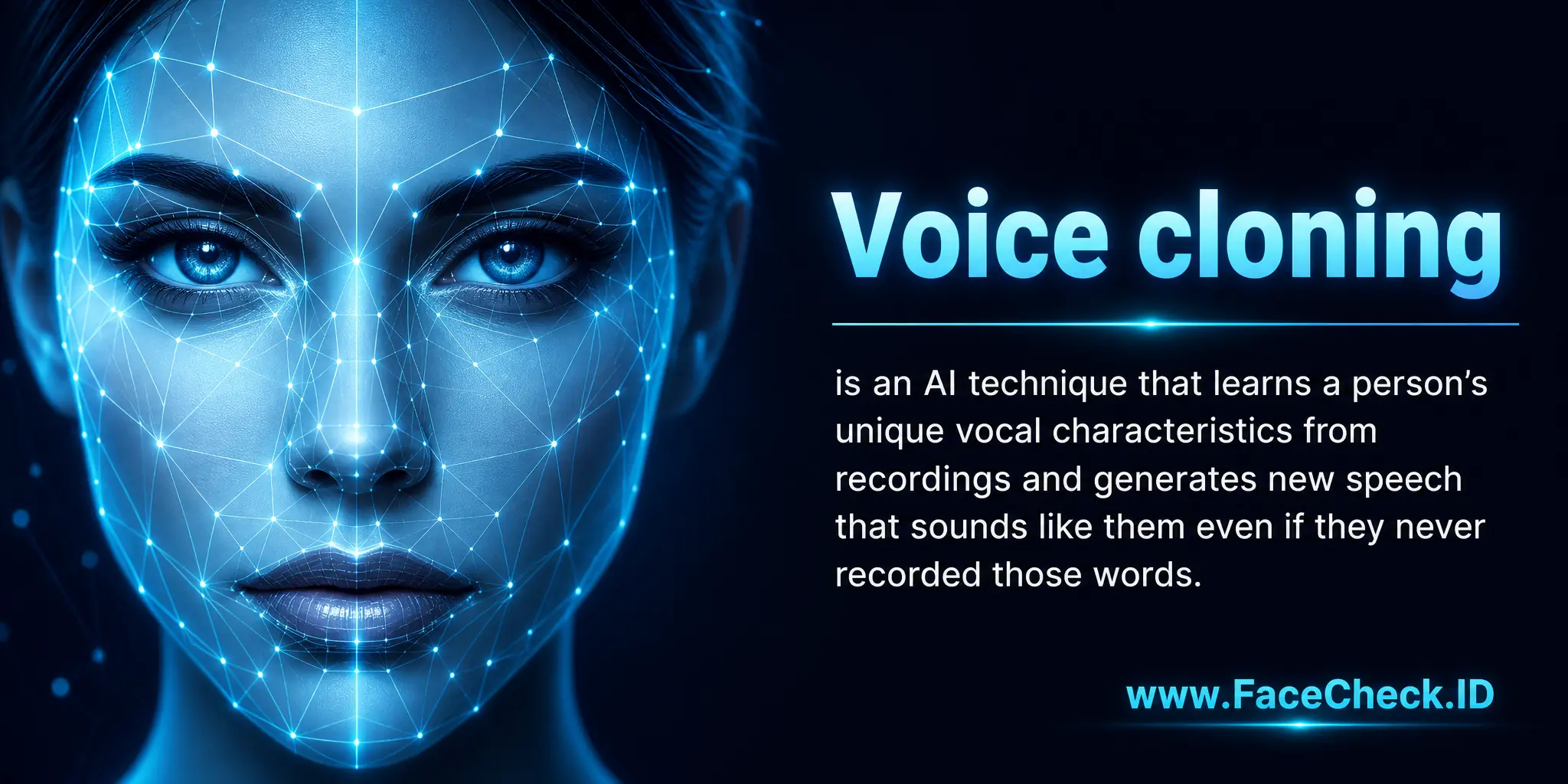
Voice Cloning

Voice cloning produces synthetic speech that mimics a specific person's voice, and it has become one of the fastest growing tools used in scams that often start with a stolen photo. When investigators trace a suspicious caller or romance-scam target back through reverse image search, they frequently find that the cloned voice is paired with reused profile pictures, stolen headshots, or stock model photos circulating across multiple fake accounts.
How voice cloning intersects with face search
A scammer building a believable fake identity rarely stops at a face. They pair a stolen photo with a cloned voice so the persona can survive a phone call or voice note, not just a chat window. This is why face search is often the first step in unmasking voice-cloning fraud. When someone receives an unexpected voice message from a "relative in trouble" or a "recruiter" with a polished accent, the attached profile photo or video thumbnail can be run through a reverse image search to check whether the same face appears on unrelated accounts, real social profiles belonging to a different person, or known scam-report pages.
Common patterns investigators see:
- A cloned voice paired with a face that traces back to a real person's Instagram, often a model, soldier, or doctor whose images are frequently stolen.
- Fake "executive" voices used in business email compromise calls, where the attached LinkedIn-style headshot turns out to be reused on dozens of shell-company sites.
- Romance scam targets receiving short voice notes recorded from public interviews or TikToks of the real person whose photos were stolen.
Face-search results give context that audio alone cannot provide: where the person actually lives, what their real name is, and whether the voice and face combination is plausible.
What a cloned voice usually requires
Modern systems can produce a passable clone from under a minute of clean audio. That audio almost always comes from somewhere public, and the same sources tend to leak photos too:
- YouTube videos, podcast appearances, and conference talks, which expose both face and voice in high quality.
- Instagram Reels and TikToks, where short clips are enough for zero-shot cloning models.
- Voicemail greetings and customer service recordings.
- Wedding videos, sermons, and other livestreams indexed by search engines.
If a face appears in a viral video, assume the voice is also cloneable. Reverse image searching a suspicious profile picture and finding the source video is often the moment an investigator realizes the voice they heard was lifted from the same clip.
Detecting impersonation that combines voice and face
Cloned voices often fail in subtle ways: flat affect on emotional words, odd breathing, mispronounced names, or background silence that sounds artificial. Visual evidence usually fails first, though. A face-match search can reveal that the photo behind the voice belongs to someone in a different country, has been used in prior scam reports, or appears on stock-photo sites. Useful checks include:
- Running the profile photo through reverse face search to find the original owner.
- Comparing the claimed identity's age, location, and profession against public matches.
- Looking for the same face on scam-warning forums, sextortion reports, or romance-fraud trackers.
- Checking whether the voice in a video matches the lip movement, since cloned audio is often dubbed over stolen footage.
What voice cloning and face search cannot prove on their own
A face match does not confirm that the person in the photo is the one speaking, and a voice match does not confirm the speaker is the person on camera. Cloned voices can be layered onto real videos, and real voices can be paired with stolen images. False positives also happen on both sides: lookalikes produce similar face-match scores, and family members often share vocal traits that confuse audio analysis.
Treat voice and face evidence as corroborating signals rather than proof. The strongest cases combine a reverse image search showing the photo was stolen, audio anomalies suggesting synthesis, and behavioral red flags like urgency, money requests, or refusal to do a live unscripted video call. Any one of those alone can mislead. Together they form a pattern that holds up.
FAQ
What is “Voice Cloning” and why is it relevant to face recognition search engines?
Voice cloning is the use of AI to generate speech that imitates a real person’s voice (often from short audio samples). It matters in face recognition search investigations because scams and impersonation campaigns often combine a cloned voice (phone call/voice note) with a stolen or synthetic profile photo—so a face search may help you check whether the pictured face appears elsewhere online, even though it cannot analyze the voice itself.
Can voice cloning “fool” a face recognition search engine into matching the wrong person?
Not directly. A face recognition search engine compares visual facial features in images; it does not authenticate or “listen to” audio. The risk is indirect: a voice-cloning scammer can pair a convincing cloned voice with someone else’s photo (or a face-swapped/deepfake image), which can mislead you into believing the photo represents the caller. Treat any face-search match as a lead to investigate, not proof of who spoke.
If I only have a phone call or voice note, can a face recognition search engine identify the caller?
No. A face recognition search engine needs an image with a clear face (e.g., a profile picture the caller used, a screenshot from a chat app, or a video frame). If you have no image, a face search can’t help identify the voice. If you do have an associated profile photo, you can run a face search to see where that face appears online and whether it seems reused across multiple identities.
What image should I upload for best results when a case involves suspected voice cloning (e.g., a scam call with a profile photo)?
Use the highest-quality, most natural-looking face image available: front-facing, well-lit, minimal filters, and not a tiny thumbnail. If it’s a screenshot, crop tightly to the face and remove UI elements, captions, and stickers. If you have multiple photos from the same person, run searches on several different images—especially one that looks least edited—to reduce the chance a manipulated picture drives misleading matches.
How can FaceCheck.ID add value when investigating a possible voice-cloning (impersonation) scenario?
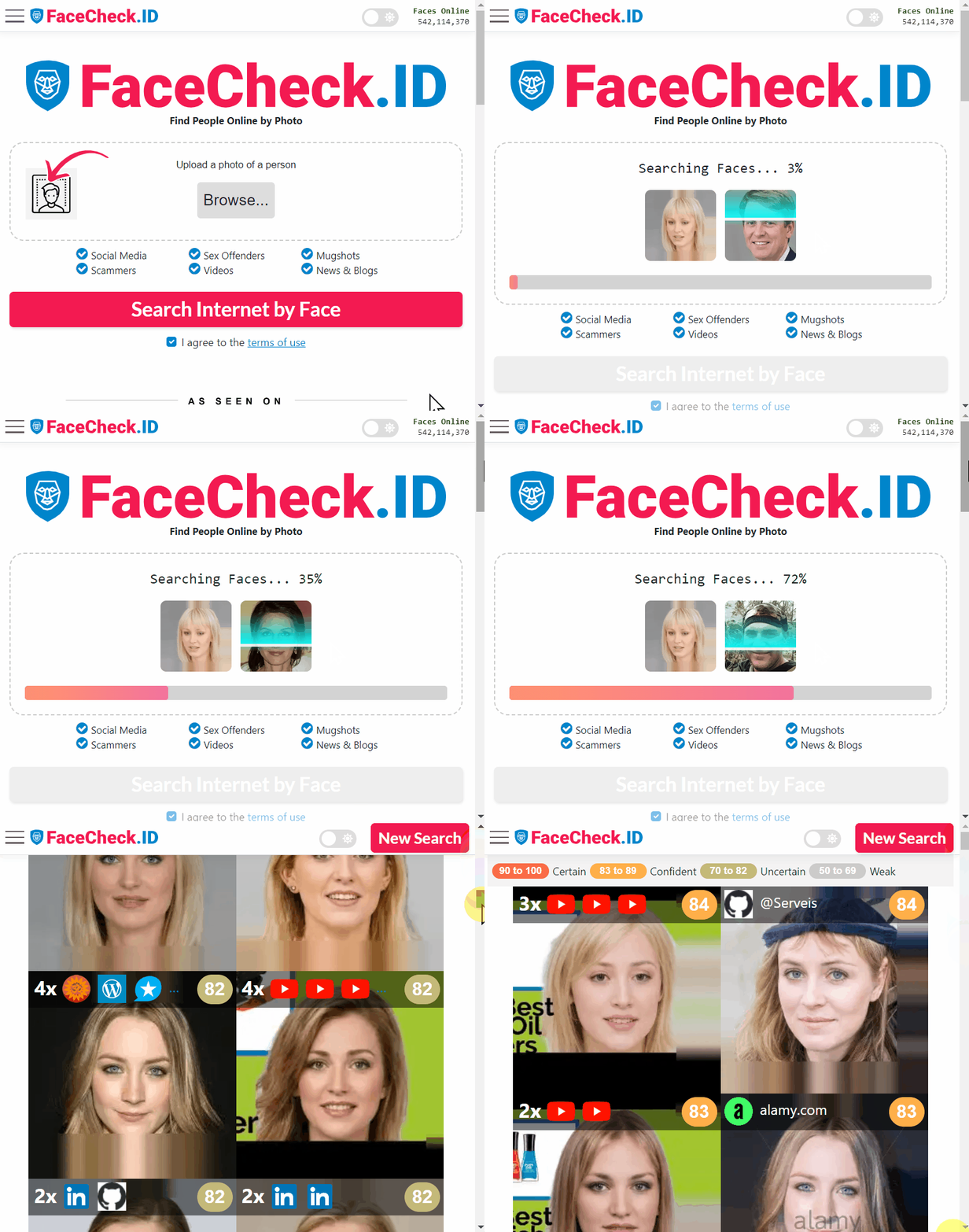
FaceCheck.ID (like other face recognition search tools) can help you check whether the profile photo tied to the voice appears on other sites or across multiple accounts, which may indicate photo reuse, impersonation, or synthetic/face-swapped imagery. Use the results to compare sources, timestamps, and context (original posts vs reposts/screenshots) and avoid concluding the caller’s identity from a single match—especially when voice cloning is suspected.

Recommended Posts Related to voice-cloning
-
How to Detect Fake Remote IT Workers with Facial Recognition (2026 Guide)
Voice cloning matched to identity documents. Deepfake videos and voice cloning during interviews.
-
How to Find and Remove Nude Deepfakes With FaceCheck.ID: A Step-by-Step Guide
Explain voice cloning scams - criminals often target grandparents.