Osint Explained: Meaning, Uses & OSINT Workflow
Meaning
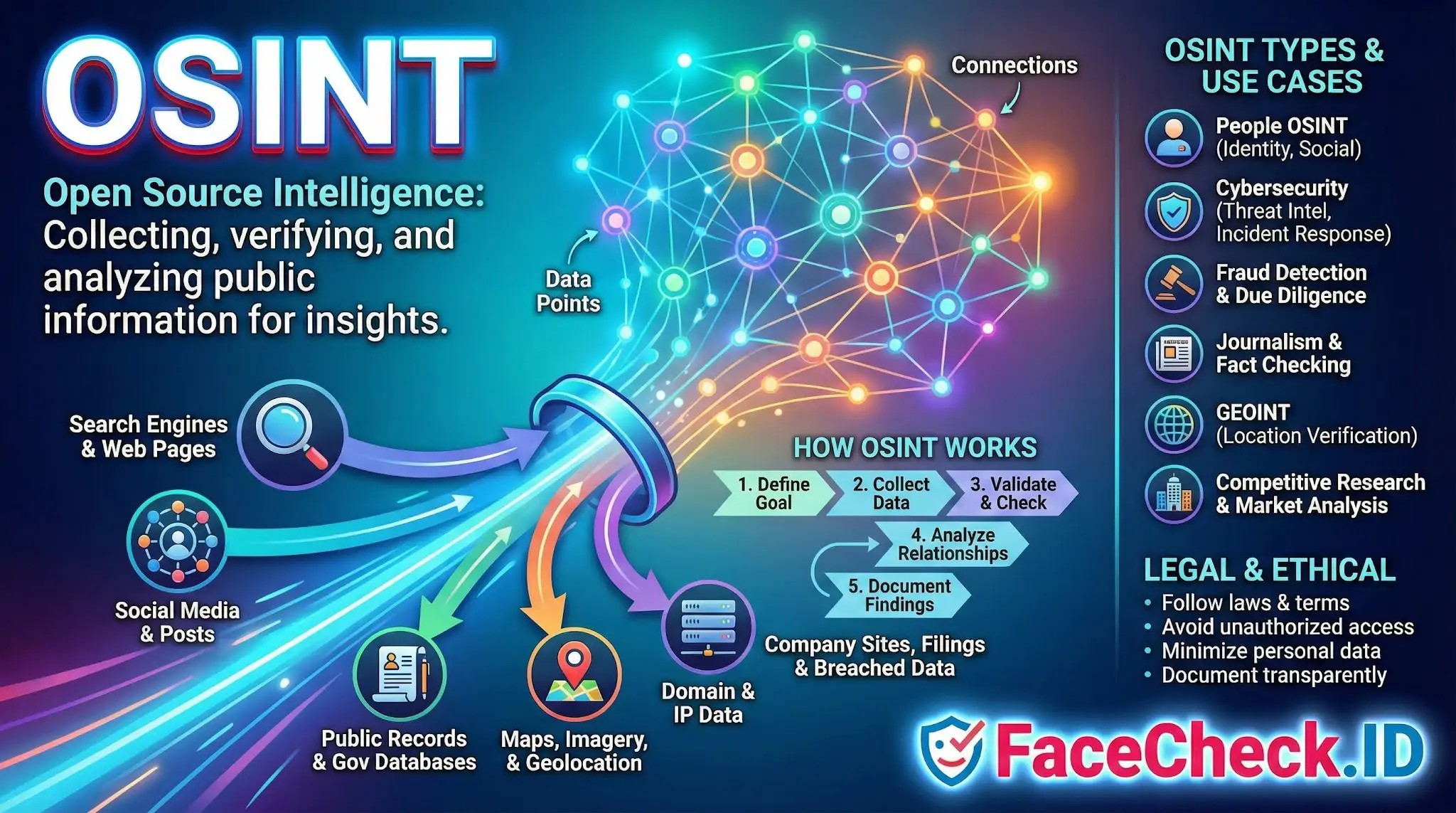
OSINT stands for Open Source Intelligence. It is the process of collecting, verifying, and analyzing information from publicly available sources to produce useful insights.
OSINT is used to answer questions like:
- Who is connected to a person, company, or online identity
- What happened during an event and when it happened
- Whether a claim, document, image, or account is authentic
- What digital traces exist about a target topic
What counts as open sources
OSINT uses information that is legally accessible to the public, including:
- Search engines and web pages
- Social media posts and profiles
- News articles and press releases
- Public records and government databases
- Company websites, filings, and job listings
- Domain, IP, and DNS data
- Code repositories and developer forums
- Maps, satellite imagery, and geolocation clues
- Online marketplaces and breached data that is publicly posted
Publicly available does not always mean easy to find. OSINT often involves turning scattered clues into a clear picture.
How OSINT works
A typical OSINT workflow includes:
- Define the goal and scope
- Collect data from multiple sources
- Validate information and check for misinformation
- Analyze relationships, timelines, and patterns
- Document findings with sources and methods
Good OSINT focuses on accuracy, repeatability, and clear sourcing.
Common OSINT types
- People OSINT: identity, usernames, emails, phone numbers, social profiles
- Social media OSINT: posts, networks, engagement, archived content
- Domain and network OSINT: WHOIS, DNS records, subdomains, certificates, IP ranges
- Geospatial OSINT: location verification using maps, imagery, weather, landmarks
- Dark web monitoring: tracking publicly shared data from underground forums and markets
- Brand and threat OSINT: mentions, leaks, impersonation, phishing infrastructure
OSINT use cases
OSINT is widely used in:
- Cybersecurity and threat intelligence
- Incident response and breach investigation
- Fraud detection and due diligence
- Journalism and fact checking
- Law enforcement and public safety
- Competitive research and market analysis
- Background checks where legally permitted
- Executive protection and risk monitoring
OSINT tools and techniques
OSINT can be done with simple methods or specialized tools. Common techniques include:
- Advanced search queries and operators
- Username and email correlation across platforms
- Metadata review for images and documents
- Reverse image search and visual matching
- Link analysis and graphing relationships
- Web archives and cached page review
- DNS and certificate transparency lookups
Tools often used for OSINT include Maltego, SpiderFoot, theHarvester, Shodan, Censys, and OSINT Framework.
OSINT vs cybersecurity intelligence
OSINT is one intelligence source type. In security, it is often combined with:
- HUMINT: human intelligence from people and interviews
- SIGINT: signals intelligence from communications
- IMINT or GEOINT: imagery and geospatial intelligence
OSINT is valuable because it is accessible and scalable, but it must be verified to avoid false conclusions.
Legal and ethical considerations
OSINT should be conducted responsibly:
- Follow local laws, platform terms, and privacy rules
- Avoid unauthorized access, hacking, and deception
- Minimize collection of personal data that is not relevant
- Keep clear notes and citations for transparency
OSINT is about using open information, not crossing legal or ethical boundaries.
Example
If a company suspects phishing, OSINT can help identify:
- Lookalike domains registered recently
- TLS certificates tied to suspicious infrastructure
- Social media accounts impersonating executives
- Public posts or leaks that mention the campaign
FAQ
What does “OSINT” mean in the context of face recognition search engines?
OSINT (Open-Source Intelligence) means collecting and analyzing information from publicly available sources. In face recognition search engines, OSINT typically refers to using a face photo to discover where that face (or very similar faces) appears on the open web, then using the surrounding page context (captions, usernames, dates, locations, repost chains) to assess what the results actually mean.
What are legitimate OSINT use cases for face recognition search engines (and what should be avoided)?
Legitimate OSINT uses include checking whether a profile photo is stolen or reused (impersonation/catfishing checks), finding the earliest known source of a headshot, and corroborating claims using publicly visible pages. Avoid using face search to harass, stalk, dox, target protected groups, or make high-stakes accusations; face-search results should be treated as leads that require independent verification from reliable sources.
What OSINT steps help verify a face-search “hit” without misidentifying someone?
Use multiple corroborating signals: compare several photos across time (age, hairstyle, distinctive features), check whether the same face appears with consistent identifiers (same username, linked accounts, consistent bio details), review the page’s context and repost trail, and look for non-face evidence (unique tattoos, logos, event photos, geotags, timestamps). If the hit is high-risk (e.g., crime, adult content, scam reports), require stronger confirmation and assume false matches are possible.
How do OSINT analysts reduce bias and false confidence when using face recognition search results?
Reduce bias by actively seeking disconfirming evidence, documenting uncertainty, and cross-checking with alternative methods (reverse image search for duplicates, keyword searches, platform-native searches, and independent sources). Don’t infer identity from one strong-looking match; instead, build a chain of evidence and note that demographic performance differences, photo quality, and look-alikes can skew results.
How can FaceCheck.ID add value in an OSINT workflow, and what precautions should you take?
FaceCheck.ID can be used as one input to locate open-web pages where a face (or similar faces) appears, which may help analysts discover reposts, impersonation patterns, or additional source pages to review. Precautions: treat results as investigative leads (not proof of identity), verify using page context and independent corroboration, avoid sharing sensitive findings, and follow privacy/consent and local-law requirements—especially when results could harm someone’s reputation or safety.

Recommended Posts Related to osint
-
How to Find Anyone Online: A Comprehensive Guide to Internet Sleuthing
OSINT (Open Source Intelligence) tools can be extremely useful for searching and gathering information about people online. Here's a list of some popular OSINT tools for people search:. Also, always ensure you respect people's privacy and adhere to your local laws and regulations when using OSINT tools.
-
Leveraging Facial Recognition Technology to Combat Human Trafficking
The Impact of Open-Source Intelligence (OSINT) on Human Trafficking Cases. Combining facial recognition with open-source intelligence (OSINT) significantly enhances the efficiency of investigations. OSINT involves analyzing large data sets to uncover patterns and connections that would be impossible to identify manually.
-
Search by Face to Find Social Media Profiles
Find social media profiles FAST with this OSINT tool! Find social media profiles FAST with this OSINT tool! OSINT: You can't hide // Your privacy is dead // Best resources to get started.
-
How-To Guide for Effective Face Lookup
Face Lookup by Facial Recognition - Image OSINT. Search for Photos by Facial Recognition (and more) | Image OSINT.
-
Yandex Image Search: Complete Guide to Finding Faces (2026)
Between 2018 and 2023, Yandex was the go-to recommendation in every OSINT community for face-based reverse image search. Users in OSINT forums have reported declining result quality for non-Russian subjects since mid-2024.
-
Best Facial Recognition Search Engines (2026)
Many OSINT researchers consider it a staple tool. For ongoing monitoring or professional OSINT work, a paid plan on FaceCheck.id or PimEyes makes more sense.
-
Find Criminals by Face Pic
Search for Someone's Criminal Records Online [Advanced OSINT].
-
AI Face Search: How It Works and Best Tools (2026)
OSINT researchers and journalists use face search to connect individuals across platforms, verify identities in photos from events or protests, and track down sources.
-
PimEyes Review: We Ran 16 Face Search Tests and Scored Every One
The subscription model works for professionals who search daily: PIs, journalists, OSINT analysts.
-
Face Recognition Systems: How They Work, Best Open Source Models, and Production APIs
OSINT tools: Build investigation tools that include web-scale face matching.