Biometric Face Matching
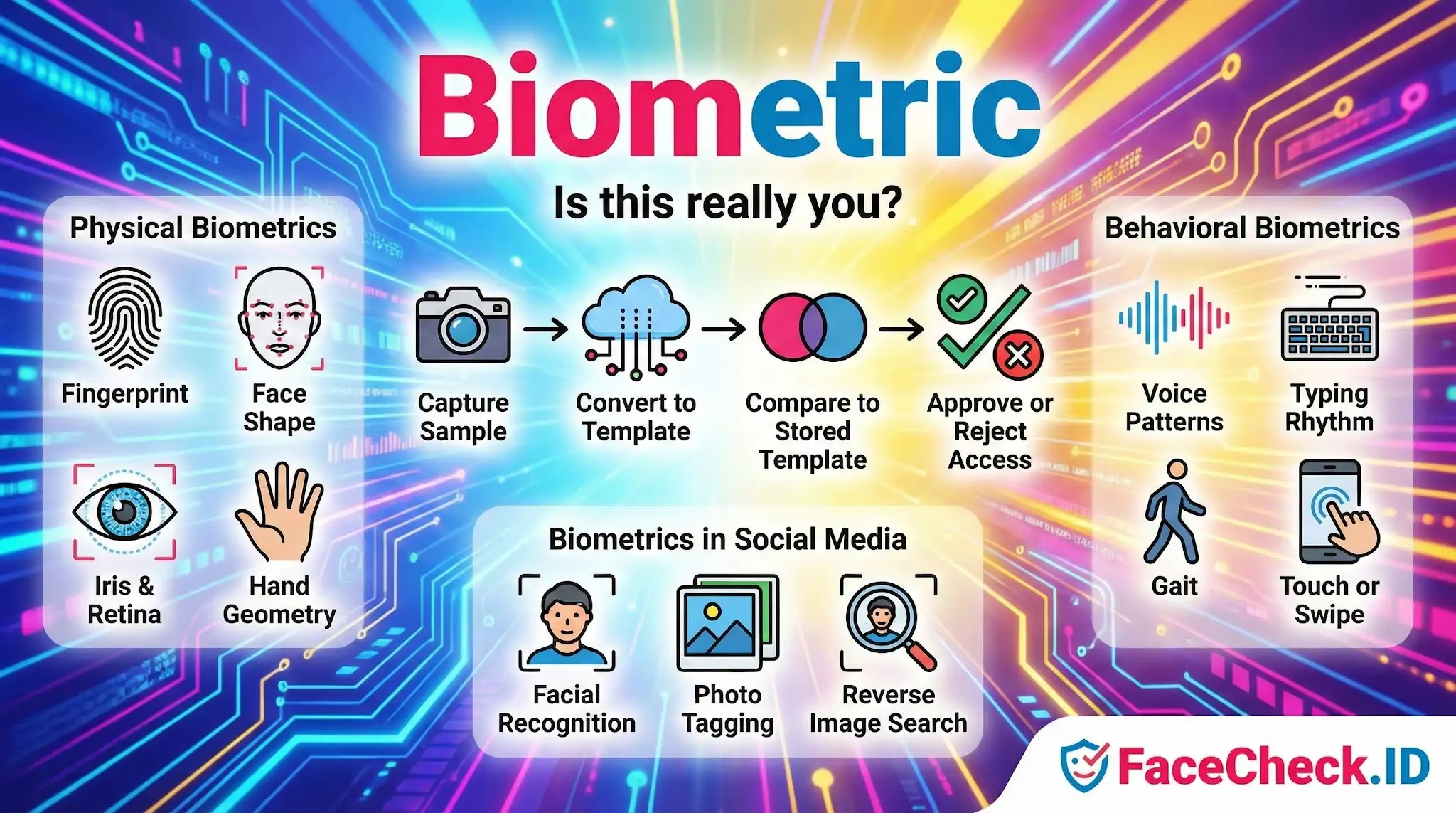
A biometric is any measurable physical or behavioral trait that can identify a specific person, and on FaceCheck.ID the relevant biometric is the face. When someone uploads a photo, the system extracts facial features and compares that signature against faces found in publicly indexed images across the web.
What counts as a biometric in face search
Face-search engines do not store or compare raw photos the way a Google image search might. They work from a numerical representation of facial geometry, sometimes called a face embedding or face template. That template captures the spatial relationships between landmarks like the eyes, nose, mouth, and jawline in a form that survives moderate changes in lighting, pose, and expression.
Other biometric signals exist and matter in adjacent contexts:
- Fingerprint, iris, and palm prints are used in device unlock and border control, but they are not searchable across the open web.
- Voice prints show up in scam detection, particularly for AI voice clones used in romance fraud.
- Gait and typing rhythm are behavioral biometrics used by banks and platforms to flag account takeover.
For reverse image search, only the face template is practical, because faces are the one biometric that people willingly publish at scale on dating profiles, LinkedIn pages, news articles, and social posts.
Why facial biometrics make face search possible
A biometric template is what lets a search engine find the same person across thousands of unrelated pages even when the photos differ. Two images of the same person taken years apart, in different lighting, and at different angles can still produce templates close enough to match. That is why a single profile picture can surface old forum posts, archived dating profiles, news photos, or mugshot listings.
Image quality directly shapes how well this works. Useful conditions include:
- A roughly front-facing pose, with both eyes visible
- Even lighting without strong shadows across half the face
- A face that occupies a meaningful portion of the frame, not a tiny crop from a group shot
- Minimal occlusion from sunglasses, masks, hats pulled low, or hair across the eyes
Heavy filters, beauty smoothing, and aggressive compression strip detail from the template and lower match confidence. Profile pictures that have been cropped from group photos often perform worse than originals because the face is small and pixelated by the time it reaches the search engine.
How biometric matches should be interpreted
A biometric match is a probability, not a verdict. FaceCheck-style results return a confidence score, and that score reflects how close two templates sit in the model's feature space. High confidence with multiple distinct source pages is strong evidence that the same person appears in both. A single weak match against one obscure page is closer to a lead than a conclusion.
Common ways biometric face matching can mislead an investigator:
- Identical twins and close siblings can produce high-confidence matches against the wrong person.
- Lookalikes are more common than people expect, especially within similar demographics, hairstyles, and age ranges.
- Reused stock photos and stolen images can attach one face to many fabricated identities, which matters when investigating catfishing or romance scams.
- AI-generated faces sometimes produce partial matches against real people whose images were in training data.
The right read on a biometric result is to treat it as a starting point. The score narrows the field, but corroboration from usernames, captions, timestamps, and contextual details is what turns a match into an identification.
What facial biometrics do not prove
A face template confirms visual similarity, not identity, intent, or context. It cannot tell you whether the person in a dating profile actually owns that profile, whether a flagged image was posted with consent, or whether two accounts on different platforms belong to the same individual rather than someone reusing a stolen photo. Face recognition is also subject to demographic performance gaps, and accuracy varies with age, skin tone, and image conditions. Treat biometric output as evidence to weigh, not a fact to repeat, and remember that legitimate use depends on consent, jurisdiction, and a clear reason to be searching in the first place.
FAQ
What does “Biometric” mean in the context of face recognition search engines?
“Biometric” refers to measurable biological characteristics used to recognize or compare people. In face recognition search engines, it typically means facial biometric data derived from a face image—features that can be used to compare one face to other faces.
What is a “biometric template” (or face template) and how is it used for face search?
A biometric template is a mathematical representation of a face (often called an embedding or face vector) produced by a face recognition model. The search engine compares the template from your query image to templates of indexed images and returns the closest matches by similarity, rather than searching by a person’s name.
Is uploading a photo to a face search engine the same as submitting biometric data?
It can be. If the service extracts a face template from the photo for matching, that derived template is generally treated as biometric data in many privacy frameworks. Whether the photo and/or template is stored, and for how long, depends on the provider’s policy and your applicable laws.
What privacy and security risks come with biometric face search compared to regular image search?
Biometric face search can link photos of the same person across different websites even when the images are not identical, which increases re-identification and profiling risks. If biometric templates or uploaded images are retained or breached, they may enable unwanted tracking; unlike passwords, biometric traits are difficult to change.
How should I handle biometric concerns when using a tool like FaceCheck.ID?
Treat any face photo you upload as potentially biometric data. Review FaceCheck.ID’s current privacy/retention and opt-out or removal options, avoid uploading sensitive images unless necessary, minimize metadata exposure (e.g., crop to the face if appropriate), and use results as leads rather than proof to reduce the risk of misidentification.

Recommended Posts Related to biometric
-
Facial Recognition: Understanding the Basics
It is one of the safest and most effective biometric methods. What are examples of biometric technology? Other biometric identification technologies include fingerprint analysis, voice recognition, DNA testing, and retinal scans.
-
Facial Recognition Resources
Face biometrics have the potential to be integrated anywhere you can find a modern camera. British Airways brings its biometric identification gates to three more US airports. These "biometric e-Gates," which have been on a trial at Los Angeles International Airport (LAX) since November 2017, use facial recognition to match flyers with their passport, visa, or immigration photos and can remove the need to show a boarding pass or identification when getting on a plane.
-
All About Face Recognition Technology
The technology is also sometimes called facial recognition or biometric identification. Biometric identification is any technology that identifies a person based on a physical or behavioral trait. As with other biometric security tools, face recognition technology has drawbacks.
-
Facebook Face Search: Find People by Photo (2026)
But after years of lawsuits (including a $650 million settlement in Illinois over biometric privacy violations) and growing regulatory pressure, Meta pulled the plug. Illegal: Stalking, harassment, using results to discriminate in hiring (in jurisdictions with biometric privacy laws like Illinois' BIPA).
-
How to Spot a Catfish Online in Under 60 Seconds with FaceCheck.ID
The tool instantly scans billions of indexed public images using biometric facial analysis, cross-referencing social media platforms, news archives, blogs, and known scam databases. Illinois (BIPA): Restricts commercial collection of biometric data without consent, but typically applies to businesses, not individual searches. No comprehensive federal biometric law currently, though privacy principles apply.