Deepfake Video: Spotting Synthetic Faces
Deepfake video is one of the hardest problems facing reverse face search today. When the same fabricated face appears across dating profiles, fake news clips, or scam livestreams, FaceCheck.ID has to separate a real person's online footprint from imagery that was synthesized to impersonate them or invented from scratch.
How deepfake video distorts face-search results
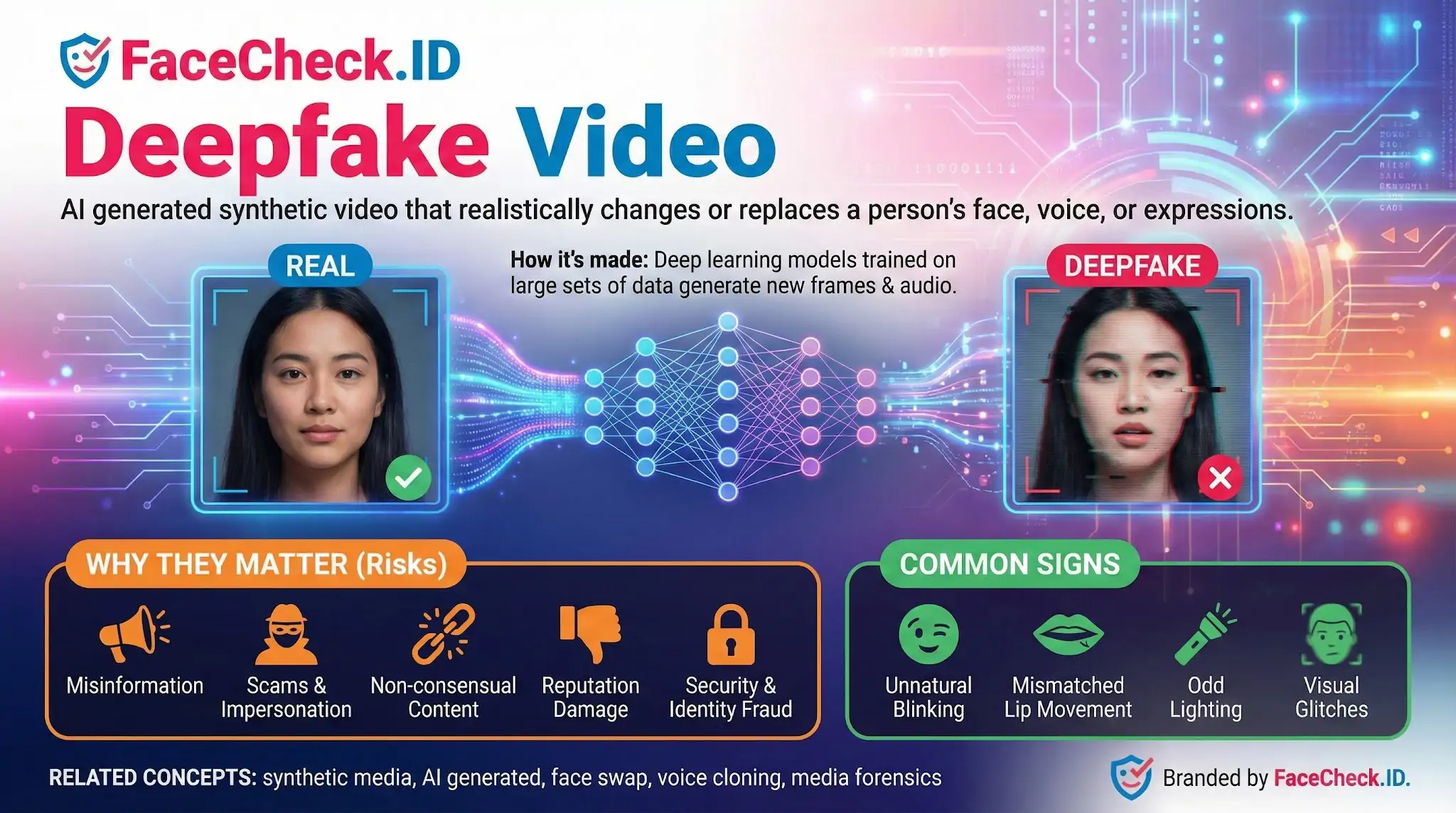
A deepfake video is a synthetic clip in which a person's face, voice, or expressions are altered or replaced using deep learning models trained on real footage. The output is rendered frame by frame, so when stills are extracted and indexed, each frame can become its own searchable face image.
This creates two distinct problems for reverse image search:
- Real victims, fake context. A deepfake of a real person spreads frames of their face across pages they never posed for. A face search on the genuine person can surface non-consensual content, fake endorsements, or fabricated statements that look like authentic appearances.
- Synthetic identities. GAN-generated and diffusion-generated faces belong to no one. They show up on romance scam profiles, fake LinkedIn accounts, and bot-run social pages. Searching one of these faces sometimes returns a cluster of unrelated profiles using the same generated portrait, which is itself a strong signal of fraud.
Match confidence behaves oddly with deepfakes. A high-quality face swap can produce strong matches to the source identity, while a fully synthetic face may match only itself across reused scam profiles. Both patterns are useful, but they mean different things.
Reading the signals during an investigation
When a face search surfaces video stills or screenshots, several patterns suggest the source material may be manipulated rather than genuine:
- The same face appearing across accounts with inconsistent names, ages, or locations
- Video frames where the jawline, hairline, or ears blur or warp during head turns
- Lighting on the face that does not match the lighting on the neck or background
- Eye reflections or teeth that look smoothed, painted, or asymmetric
- Lip movement that drifts out of sync with audio for a few frames at a time
- Reused stock backgrounds combined with a face that has no other web presence
A face that returns zero matches outside a single suspicious profile is a meaningful clue. Real people, especially adults active online, almost always leave traces across unrelated indexed pages. A polished portrait with no history is a candidate for a generated image.
Where deepfakes intersect with identity misuse
Common scenarios investigators encounter through face search:
- Romance scams using stolen video clips of real models, soldiers, or doctors stitched together with synthetic voice
- Sextortion where a target's face is swapped onto explicit footage to coerce payment
- Investment and crypto fraud featuring deepfaked celebrities or executives in short promotional videos
- Account takeover attempts that defeat selfie or video liveness checks using prerecorded face swaps
- Disinformation where a public figure appears to make statements that never occurred
In each case, reverse face search is useful for two opposite reasons. It can confirm that a face is being misused on platforms the real person has no connection to, and it can reveal that a face has no authentic footprint at all.
Limits of face search against deepfakes
Reverse image search does not detect manipulation directly. It compares faces, not provenance. A deepfake that matches the source person will look like the source person to the matcher, because that is what the model was trained to reproduce. Confirming whether a specific clip is genuine requires media forensics, metadata analysis, source tracing, and often direct contact with the person depicted.
Likewise, the absence of matches is not proof of a synthetic face. Private individuals, people who avoid social media, and minors can have legitimately thin web footprints. Lookalikes, twins, and heavy retouching can also mimic the patterns associated with generated faces. Face-search output is a starting point for investigation, not a verdict on authenticity.
FAQ
What is a “Deepfake Video” and why does it matter for face recognition search engines?
A deepfake video is a video that has been synthetically altered (often with AI) so a person appears to say or do things they never did—commonly by replacing or animating a face. For face recognition search engines, deepfakes matter because they can introduce convincing but false “evidence” images/frames into the open web, which can mislead searches that treat a video frame like a normal photo match.
Can a deepfake video “fool” a face recognition search engine into matching the wrong person?
Yes. If a deepfake overlays Person A’s face onto Person B’s body (or generates a synthetic face closely resembling a real person), a face search may return results for Person A because the facial features in the frames resemble Person A. The risk is highest when the deepfake is high quality, the face is front-facing, and the engine indexes the video thumbnail or extracted frames as if they were ordinary photos.
If I take a screenshot from a deepfake video and upload it, what results should I expect (including on tools like FaceCheck.ID)?
You should expect mixed outcomes: (1) matches to the impersonated person if the swapped face is clear; (2) matches to look-alikes if the deepfake introduces artifacts or shifts facial geometry; or (3) no strong matches if the frame is low resolution, heavily compressed, or motion-blurred. On face-search tools such as FaceCheck.ID, treat any hit from a suspected deepfake frame as an investigative lead, not proof of who appears in the original video.
How can I check whether a face-search match came from a deepfake video rather than a real photo?
Open the result source and verify context: confirm it’s a legitimate still photo rather than a video thumbnail, meme, or repost. Then look for deepfake clues such as inconsistent lighting/shadows on the face, unusual skin texture, warped teeth/ears, mismatched earrings/glasses, or flickering edges around the jawline across frames. Also compare multiple frames from the same video—deepfakes often vary frame-to-frame—while genuine photos are consistent.
What’s the safest way to use face recognition search engines when deepfake video is a possibility?
Use a verification workflow: run searches on several different frames (not just one), prefer higher-quality frames (sharp, front-facing, well-lit), and corroborate identity using non-face signals on the source page (account history, original uploader, timestamps, location claims, and cross-links). Avoid sharing accusations based solely on face-search hits, and assume deepfake risk is elevated when the content is sensational, political, or tied to scams or extortion.


Recommended Posts Related to deepfake-video
-
AI Dating Scams in 2026: How to Spot Fake Profiles and Avoid Romance Fraud
Romance scams are rising fast in 2026, with scammers using AI-generated photos and deepfake videos to trick people on dating apps.
-
Pig Butchering Crypto Scam Exposed: Fake Rich Friend Uses Deepfakes & Stolen Photos to Steal Billions
Deepfake video calls or rage when confronted. Deepfake Video Calls: The New Deception.
-
How to Find and Remove Nude Deepfakes With FaceCheck.ID
A recent report found that 98% of deepfake videos online are pornographic, with 99% of the victims being women.
-
Find & Remove Deepfake Porn of Yourself: Updated 2025 Guide
Distribution channels: These fakes may be uploaded to porn sites (some even specialize in deepfake videos), shared on forums or messaging groups, or posted on social media.
-
Celebrity Romance Scams 2026: How Scammers Use AI Deepfakes and Stolen Photos to Steal Millions
A Florida woman lost $160,000; scammers used deepfake video chats and later laundered money through her account. Deepfake Videos/Voice: Realistic calls or memos.