Facial Recognition Technology
When you upload a photo to FaceCheck.ID and it returns links to profiles, news articles, or forum posts featuring the same face, facial recognition technology is doing the heavy lifting. It is the difference between a reverse image search that only finds exact copies of a file and a face search that recognizes the same person across thousands of unrelated photos taken years apart, in different lighting, at different angles.
How face search actually identifies a person
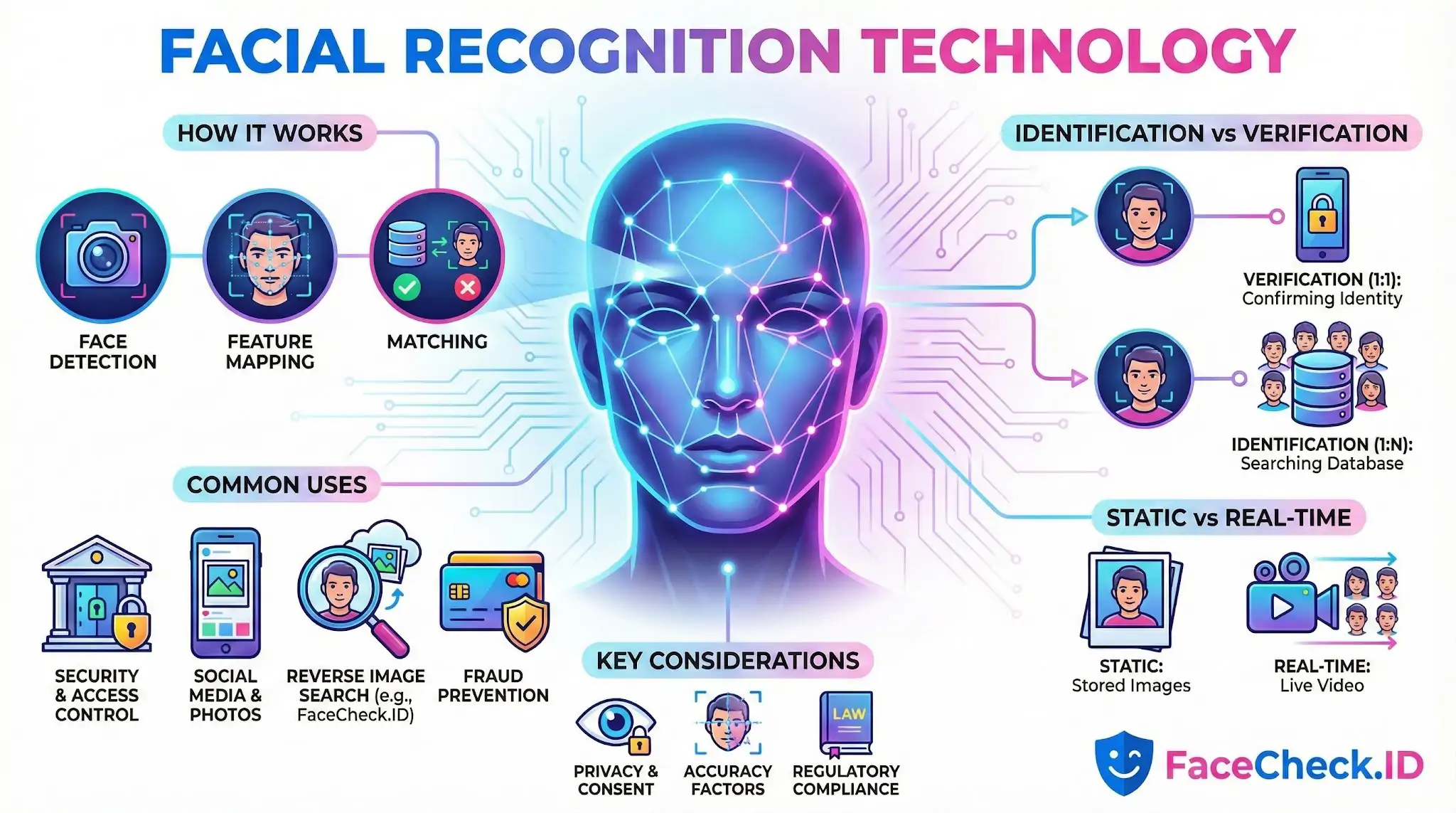
A face-recognition pipeline does not compare pixels. It converts each detected face into a numerical fingerprint — usually a vector of several hundred floating-point values — that captures the geometry and texture of the face independent of pose, lighting, and background. Two photos of the same person produce vectors that sit close together in this high-dimensional space; two strangers produce vectors that sit far apart.
For a face-search engine like FaceCheck, the workflow looks roughly like this:
- A web crawler harvests publicly indexed images from social profiles, news sites, blogs, dating apps, mugshot databases, and similar sources.
- Each image is run through a face detector to locate every face present.
- Each detected face is encoded into a vector and stored alongside the source URL.
- When you upload a query photo, its vector is computed and compared against the index, and the closest matches are returned with a confidence score.
The match score is what separates a likely identity hit from a coincidental look-alike. High scores typically come from clear, front-facing photos that resemble the kind of image platforms encourage — headshots, selfies, professional portraits — while side profiles, heavy filters, and low-resolution thumbnails produce weaker matches even when the person is the same.
Where face recognition outperforms text-based searches
Reverse image search by file hash or visual similarity breaks the moment someone crops a photo, applies a filter, or re-uploads a screenshot. Facial recognition cuts through all of that. A scammer running a romance scheme may steal a model's photos, edit them, and post them on a dozen dating profiles under different names. Text search cannot connect those profiles. Face search can, because the underlying biometric pattern survives cropping, compression, and re-encoding.
This is why face recognition is the core tool for:
- Catfish and romance scam detection — confirming whether a "new match" is using stolen photos that already exist on Instagram, modeling sites, or stock-photo libraries.
- Background checks on strangers — finding whether a person you met online appears in news coverage, court records, or sex-offender registries under a different name.
- Locating old or lost contacts — surfacing profiles that no longer share the person's current name.
- Verifying public figures — distinguishing an authentic account from impersonators using the same face.
The same technology underpins phone unlock, airport e-gates, and bank onboarding, but those systems perform one-to-one verification against a single enrolled template. Public face search performs one-to-many identification against a web-scale index, which is a fundamentally harder problem and is why match confidence and source URLs matter more than a binary "yes/no."
What a face match does not prove
A high-confidence match tells you that the same face appears in two places. It does not tell you that the person controls the linked account, that the linked account is current, or that the information on it is true. People reuse old photos. Identical twins exist. Stolen photos circulate widely, which means a face shown across fifty profiles may indicate one victim of impersonation, not fifty real accounts.
Accuracy also degrades in predictable ways. Heavy makeup, beards grown or shaved, significant weight change, aging across a decade, masks, sunglasses, and extreme angles all reduce match confidence. So does poor source material — a blurry CCTV still or a tiny avatar crop will return weaker scores even when the underlying person is correctly identified.
Treat face-search results as investigative leads, not verdicts. Cross-reference matched profiles against usernames, posting history, mutual connections, and metadata before drawing conclusions about who someone is or what they have done.
FAQ
How is Facial Recognition Technology used in face recognition search engines (e.g., FaceCheck.ID) compared with access-control systems?
In face recognition search engines, Facial Recognition Technology typically turns an uploaded face into a numeric representation (an “embedding”) and searches a large index of embeddings from publicly available web images for similar faces. In access-control or device unlock systems, the same core technology is usually used in a closed environment to compare a person against a small enrolled set (often just one person) under controlled conditions, with different thresholds and security goals.
What is liveness detection, and why is it usually not included in Facial Recognition Technology face search engines?
Liveness detection is a set of checks designed to confirm the face comes from a real, present person (not a photo, replayed video, or mask). Face recognition search engines generally focus on matching an image to other images online, so they often don’t perform liveness checks because the input is commonly a static photo and the goal is similarity search, not secure authentication.
Why can Facial Recognition Technology search results change over time in face recognition search engines?
Results can change as the engine crawls new pages, removes dead links, re-indexes content, or upgrades its matching model and similarity thresholds. Even if the same person is online, newly discovered photos, reposts, or higher-quality images can shift which matches appear first and which sources are returned.
Besides the face itself, what can influence matches returned by Facial Recognition Technology in face search engines?
While matching is primarily based on facial features, outcomes can be influenced by image quality factors such as pose, lighting, blur, resolution, occlusions (hats, masks), heavy makeup, and compression. Cropping and alignment (how the face is detected and framed) can also change the embedding and therefore which similar faces are retrieved.
How should Facial Recognition Technology results from a face search engine be used safely—as leads rather than proof?
Treat results as investigative leads, not identity confirmation. Verify by checking multiple independent source URLs, consistency across different photos (age, context, location clues), and whether the matched pages clearly refer to the same individual. Avoid taking harmful actions based on a single match, and consider the possibility of look-alikes, reposted images, or miscaptioned pages when interpreting results from tools like FaceCheck.ID.


Recommended Posts Related to facial-recognition-technology
-
Unlocking the Power of Facial Recognition Technology: 10 Eye-Opening Facts
Facial recognition technology has become a hot topic in recent years, thanks to its many potential applications across a wide range of industries. In this blog post, we'll take a closer look at 10 fascinating facts about facial recognition technology, from how it works to its many applications. Facial recognition technology works by analyzing and comparing unique facial features, such as the distance between the eyes and the shape of the nose, with a database of known faces.
-
All About Face Recognition Technology
Face recognition technology is everywhere. What are the pros and cons of face recognition technology? What Is Face Recognition Technology?
-
Google's Image Search vs. Yandex's Image Search: A Detailed Look
Understanding Facial Recognition Technology. Facial recognition technology in computers works like our own ability to recognize faces. Millions of online photos - like the ones we tag on Facebook or find on Google - help develop facial recognition technology.
-
Search for Actors by their Face
Importance of Facial Recognition Technology in the Entertainment Industry. Facial recognition technology is changing the game in the entertainment industry, not only for fans but also for professionals. Facial recognition technology is a game-changer for those spontaneous "I know them from somewhere!" moments.
-
How to Find People on VK.com by Photo
FaceCheck.ID is a search engine that uses facial recognition technology to match photos with public profiles on various social media platforms, including VK.com. FaceCheck.ID simplifies the process of finding people on VK.com by leveraging facial recognition technology. Start your search today and experience the convenience of facial recognition technology in finding people on VK.com.