Free Facial Recognition
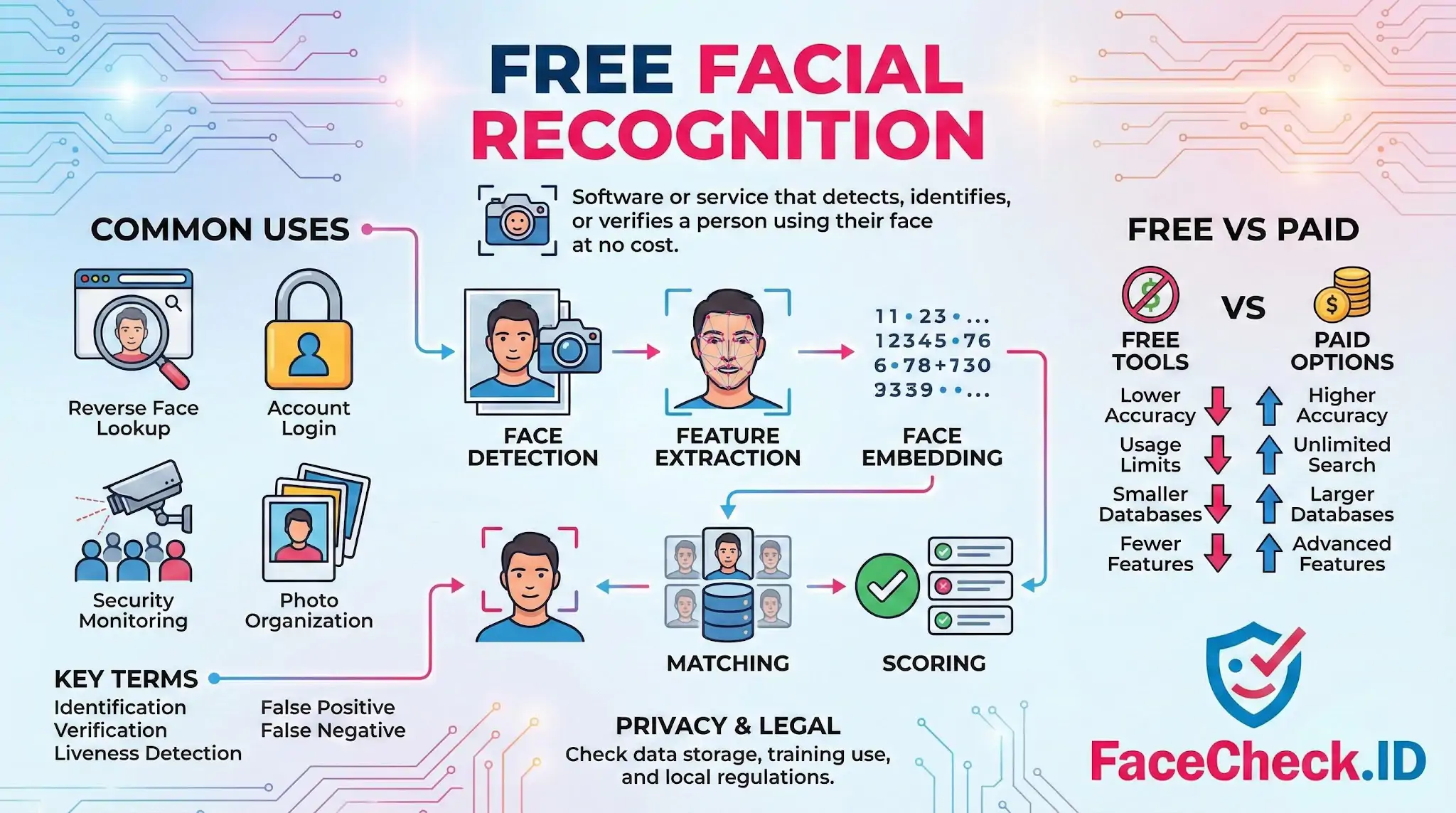
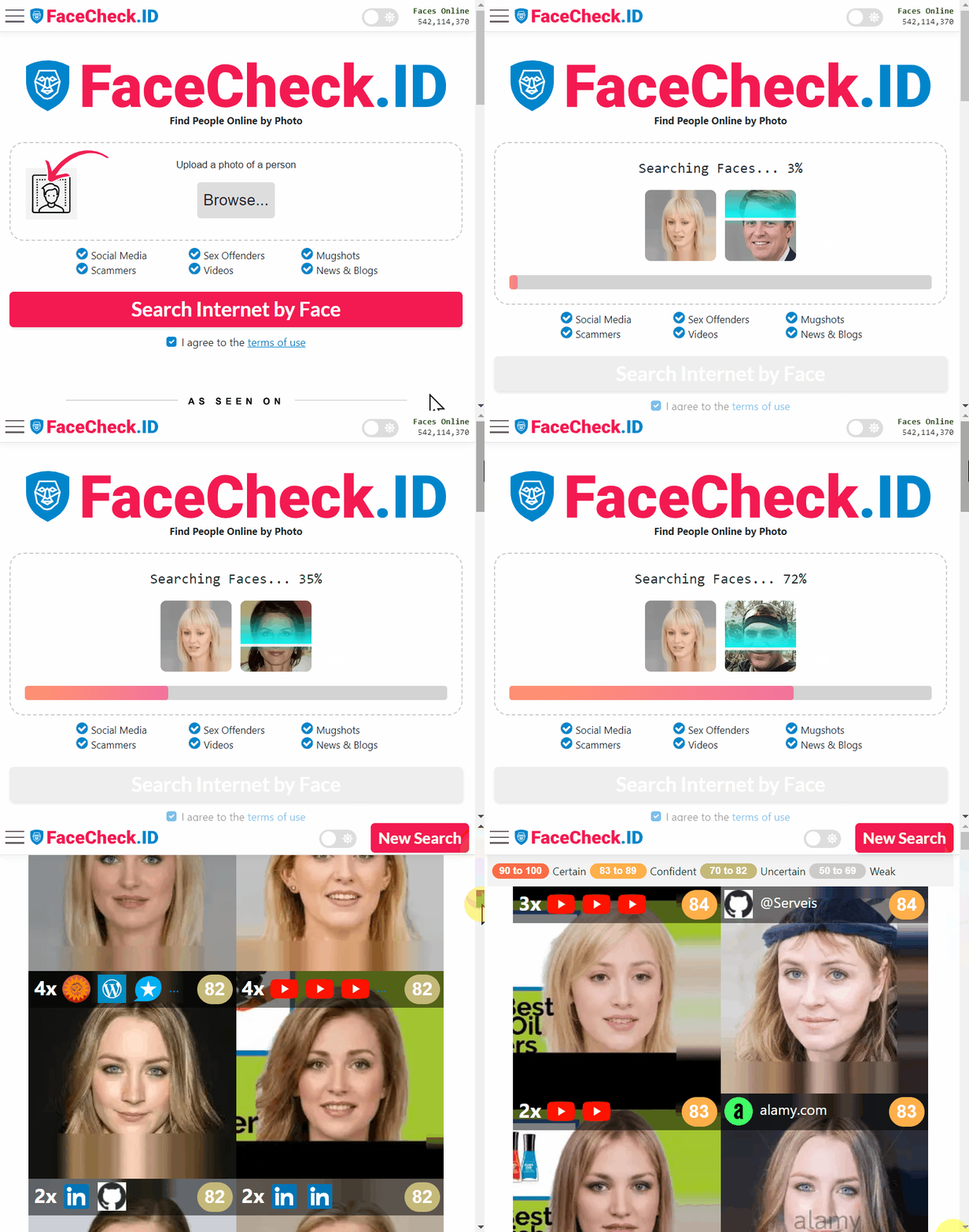
Free facial recognition refers to tools that let anyone search, identify, or verify a face without paying. On FaceCheck.ID, that usually means uploading a photo and getting back a list of public web pages where the same face appears, ranked by similarity score. The "free" part shapes what kind of results you can expect, how deep the index goes, and how the system handles your uploaded image.
What "free" actually means in face search
Free face search is not the same as a free image filter or a hobby project. Behind a usable face search engine sits a face detector, a neural network that converts faces into numeric embeddings, and an index of millions or billions of public images crawled from the open web. Running that infrastructure costs money, so free tiers come with tradeoffs.
Common limits you will see across free facial recognition tools:
- A capped number of searches per day or per session
- Lower-resolution result thumbnails or partially blurred previews
- Slower processing or queue priority behind paid users
- A smaller pool of indexed sources, often skewing toward social media and news rather than niche forums, dating sites, or scam databases
- Fewer filters, no video search, and no API access
A free search is usually enough to confirm whether a face appears anywhere obvious online. Deeper investigation, including weaker matches and less-indexed sources, often requires a paid tier.
Where free face search is useful
People reach for free facial recognition in specific situations where a quick lookup is enough:
- Checking whether a dating app match is using stolen photos from someone else's profile
- Verifying that a recruiter, investor, or "remote employer" is a real person
- Identifying the original source of a viral photo or screenshot
- Spotting reused headshots across multiple fake LinkedIn or Instagram accounts
- Looking up a stranger after an unusual encounter, when only a photo is available
In each case, the goal is not a courtroom-grade ID. It is a fast signal about whether a face has a public footprint that matches the story being told.
How to read free face search results
Match scores are the most misread part of any face search output. A high similarity score means the embeddings are close, not that identity is proven. A few things worth keeping in mind:
A confident match against a clearly labeled profile, news article, or institutional page is stronger evidence than a confident match against an anonymous image board or a recycled stock photo. Identical twins, siblings, and lookalikes regularly produce scores in the same range as true matches. Heavy makeup, weight changes, aging, glasses, and beards drag scores down even when the person is the same. Front-facing, well-lit photos like LinkedIn headshots tend to produce cleaner results than party photos, group shots, or low-resolution screenshots.
If a free search returns five mid-confidence hits across unrelated identities, that usually means the face is generic-looking or the input photo is poor, not that the person has five secret accounts.
Privacy tradeoffs of free tools
Free facial recognition services pay for their costs somehow. With reputable face search engines, the model is straightforward: free searches are limited and paid searches unlock more. With less reputable free tools, the cost can be your data. Before uploading a face, especially someone else's, it is worth checking whether images are deleted after the search, whether uploads feed model training, and whether the service logs queries against an account.
The face you upload is biometric data. Treating a free tool as harmless because it costs nothing is the most common mistake new users make.
What free face search cannot do
Free facial recognition can show you where a face appears in public, indexed content. It cannot read private accounts, locked profiles, or platforms that block crawlers. It cannot confirm a person's current name, address, or employer on its own. A negative result does not mean someone has no online presence, only that no indexed public image matched within the free tier's reach. And a positive match to a profile does not prove that profile is currently active, currently controlled by that person, or telling the truth about who they are. The tool surfaces leads. Verifying identity still requires human judgment and corroborating evidence.
FAQ
What does “Free Facial Recognition” usually mean when people talk about face recognition search engines?
“Free Facial Recognition” typically means you can run a face-search query without paying upfront, but it often comes with limits (e.g., fewer searches per day, lower result detail, watermarked previews, or restricted access to source links). In some cases, “free” is a marketing phrase for a demo tier rather than unlimited face recognition.
What are the most common limitations of “free” face recognition search engines compared to paid access?
Common limitations include strict daily/monthly query caps, fewer indexed sources, reduced match-ranking features, delayed results, limited ability to open source pages, and less support for refining searches (cropping, filtering, or sorting). Some services may also show only a subset of matches unless you upgrade.
Is “Free Facial Recognition” the same as a free reverse image search?
Not necessarily. Free reverse image search is often optimized for finding exact or near-duplicate images, while face recognition search focuses on matching the same face across different photos (different lighting, angles, crops, or time). A tool can be free and still be either type, but the underlying matching goal is different.
What privacy risks should I consider before using a “free” facial recognition search site?
Key risks include unclear retention of uploaded images, logging of searches, reuse of uploads for training or indexing, and exposure of sensitive context in the photo (background, bystanders, metadata, or identifiers). Before uploading, remove bystanders, crop tightly to the face, avoid images of minors, and review the service’s privacy/retention and removal/opt-out options.
How can FaceCheck.ID add value if I’m specifically looking for “Free Facial Recognition” options?
If you’re comparing “free” options, FaceCheck.ID can be useful as a benchmark to cross-check leads from other tools: run the same face photo and compare whether results converge on the same sources. Regardless of tool, treat matches as investigative leads—not proof of identity—and validate using page context (date, location, accompanying text, and other corroborating identifiers).

Recommended Posts Related to free-facial-recognition
-
Is There a FREE Facial Recognition Site?
How to Use a Free Facial Recognition Site: If you're looking for a free facial recognition platform, FaceCheck.ID is a top choice.
-
How to Spot a Catfish Online in Under 60 Seconds with FaceCheck.ID
Run the Free Facial Recognition Search.
-
Can You Reverse Image Search a Face?
Exploring Free Facial Recognition Solutions. Is there a free facial recognition site? Several websites offer free facial recognition services.
-
Face Recognition Online: What Actually Works in 2026
Random "Free Face Recognition" Sites. Any tool offering unlimited free face recognition is either subsidized by something else (your data, usually) or isn't doing real face matching at all. Will free face recognition tools steal my photo?