How to Find Someone on Facebook
Finding a person on Facebook is one of the most common starting points in online identity work, whether you are reconnecting with someone, vetting a new contact, or trying to confirm whether a face from a photo belongs to a real person. Facebook's built-in search tools handle the easy cases, but they fall short when you only have a picture, a vague username, or a suspicion that the profile in front of you is not who it claims to be.
Searching with what Facebook gives you
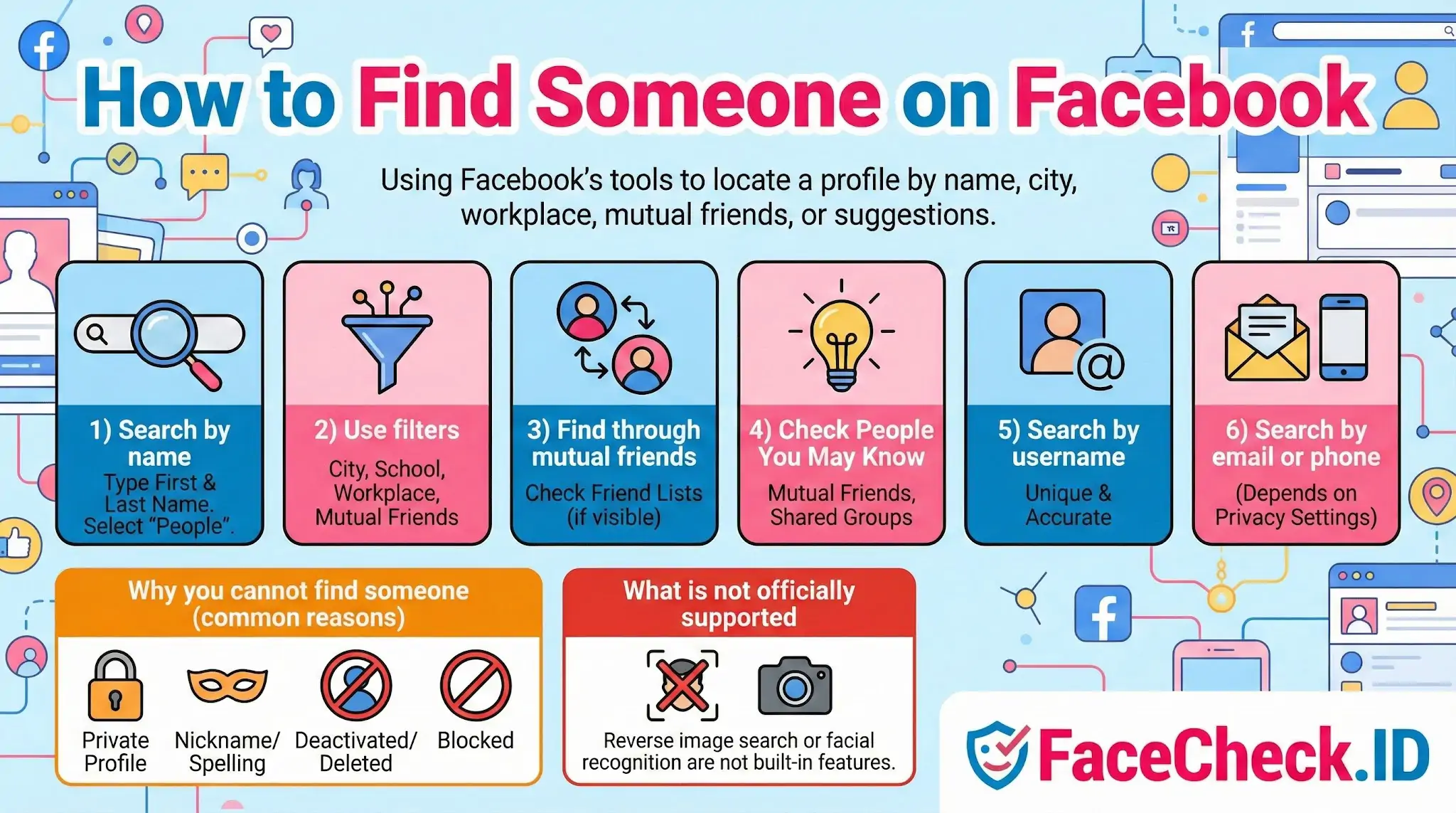
If you have a name, the standard search bar is the obvious first stop. Type the full name, then filter by People, and add narrowing details such as city, employer, school, or mutual friends. For common names, filters do most of the work. A search for "John Smith" returns thousands of results; "John Smith, Cleveland, OH, Cleveland State University" usually returns a handful.
Other approaches that often work:
- Username search. If you have a unique handle, search it directly. Usernames map to one account.
- Email or phone lookup. Works only if the person allowed lookup by that contact method in their privacy settings. Many users disable this.
- Mutual friend lists. Open a shared connection's profile and scan their friends. Useful when the target's profile does not appear in name search.
- People You May Know. Suggestions surface accounts based on contact uploads, shared groups, location overlap, and friend graph proximity.
When name search is not enough
Plenty of cases break Facebook's standard tools. The person uses a nickname or a Cyrillic spelling. Their profile is set to "Friends only" visibility, so it does not appear in non-friend search. They deactivated the account. They blocked you. They created the account under a fake name to scam, catfish, or harass, and the only thing you actually have is a photo from a dating app, a Marketplace listing, or a DM.
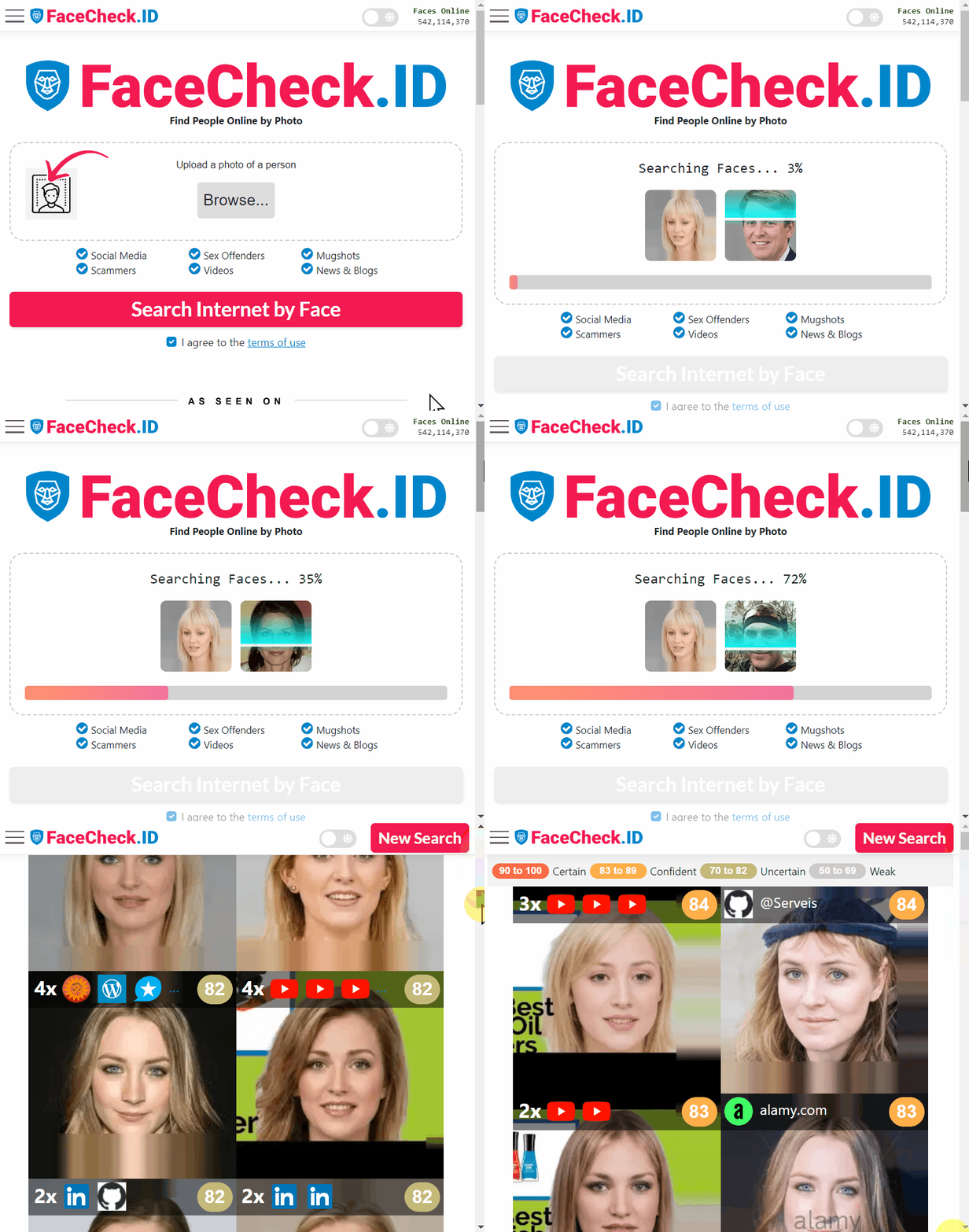
This is where face search fits in. If you have a photo of the person, a reverse image search engine like FaceCheck.ID can scan publicly indexed pages, including public Facebook profile photos and other social platforms, for visual matches of the same face. Instead of guessing names, you start from the face and work backward to wherever that face has been posted online.
A few practical points about combining face search with Facebook investigation:
- Profile pictures and cover photos on Facebook are often public even when the rest of the account is locked down. These are the images most likely to surface in a face-search index.
- Cropped, low-resolution, or heavily filtered profile photos reduce match confidence. A clear, front-facing image returns better candidates.
- Scammers frequently reuse the same stolen photo across multiple fake Facebook, Instagram, and dating profiles. Face search is good at catching this pattern, since the same face appears under different names.
- A match to a public Facebook profile is a lead, not proof. Two people can look alike, and stolen photos can land on real accounts as well as fake ones.
Reading results without overreaching
Whether you found a profile through name search, mutual friends, or by reverse-searching a photo, treat the profile as a starting point. Confirmation should rest on more than one signal: posting history, tagged photos with friends and family, check-ins consistent with a real life, comments from people who appear to know them.
What Facebook search and face search cannot do:
- Prove identity on their own. A profile name is self-declared. A face match shows visual similarity, not legal identity.
- Surface accounts the user has hidden from public search and indexing.
- Distinguish between the real person and someone using their photos without permission. If a face appears on ten profiles with ten different names, the photo owner is the victim, not all ten accounts.
- Replace direct verification when stakes are high. For dating, hiring, lending money, or in-person meetings, video calls and document checks still matter.
Used together, Facebook's built-in tools and a face-based reverse image search cover most realistic scenarios: known name, partial information, or nothing but a photo.
FAQ
What should I try on Facebook first before using a face recognition search engine to find someone?
Start with Facebook’s built-in options: search the person’s name (including alternate spellings), search by username if you have it, check mutual friends’ friend lists, look through tagged photos and comments where you originally saw them, and search Groups/Events they might belong to. Only consider face recognition search if you still can’t find them and you have a legitimate reason, because it can increase privacy risk and false-identification risk.
How can I use a face recognition match to locate the correct Facebook profile without misidentifying someone?
Treat face-search results as leads, not proof. Cross-check multiple non-sensitive signals on Facebook (consistent photos across time, mutual connections, location/schools/employers if publicly listed, and matching context like the same event or group). Avoid contacting or accusing anyone based on a single match; if the stakes are high, seek independent verification or use official channels.
Why might a face recognition search engine not show any Facebook results even if the person has a profile photo?
Common reasons include: the profile and photos are not publicly accessible, Facebook blocks or limits automated indexing, the photo hasn’t been reposted on public pages, the person uses different photos on Facebook than the one you searched, or the image quality/angle prevents reliable matching. A tool like FaceCheck.ID (or similar) can only return what it can access/index from public web sources, so “no results” doesn’t mean the person isn’t on Facebook.
What should I do if face search returns several Facebook profiles that look like the same person?
Assume ambiguity. Compare each profile for timeline consistency (age progression, recurring friends, long-term posting history), repeated unique photos, and consistent biographical details. Consider that some may be fan pages, repost accounts, or look-alikes. Don’t merge identities or take action until you have strong corroboration from multiple independent cues.
If a face recognition search points to a Facebook profile that seems like an impersonation, what are the safest next steps?
Do not engage directly with the suspected impersonator. Collect minimal evidence (URLs, screenshots of public-facing content), alert the real person if you can do so safely, and report the account through Facebook’s impersonation reporting flow. If fraud, threats, or extortion are involved, preserve evidence and consider contacting the relevant platform support and/or local authorities.

Recommended Posts Related to how-to-find-someone-on-facebook
-
How to Search Facebook by Photo
How to Find Someone on Facebook by Photo in 4 Steps.
-
Facebook Face Search: Find People by Photo (2026)
How to Find Someone on Facebook by Photo Using FaceCheck.id.
-
Facebook Image Search: What Works When Facebook Won't Search by Photo
How to find someone on Facebook by photo with FaceCheck.ID.