Identification
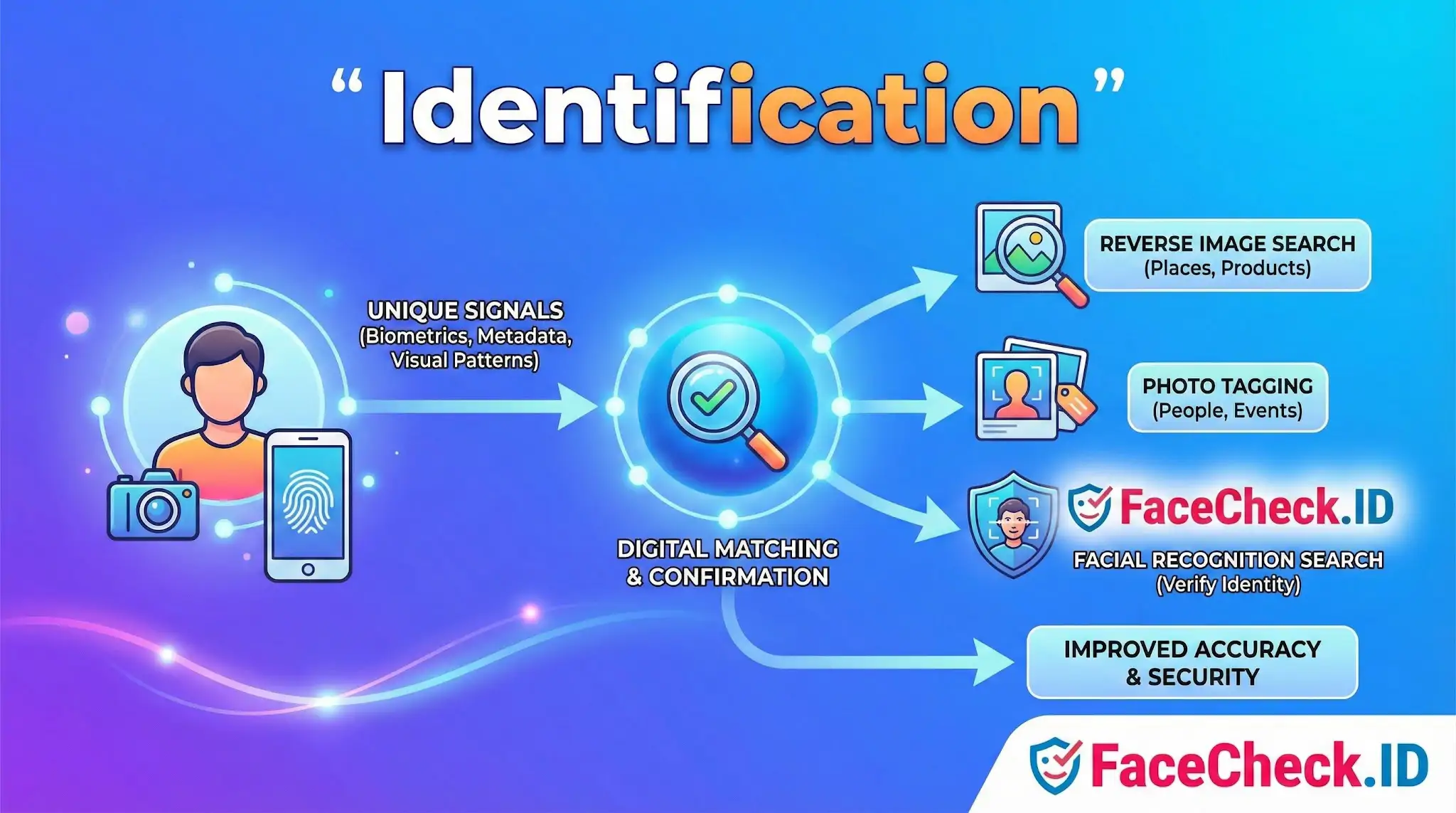
In a face-search context, identification means moving from an unknown face in a photo to a probable name, profile, or set of online appearances. FaceCheck.ID approaches this by indexing faces visible on the public web and ranking candidate matches by similarity, leaving the final judgment to the person reviewing the results.
How face-based identification differs from generic image matching
Most reverse image search tools look for the same image or near-duplicates. Face identification works differently. The system extracts a numerical representation of facial features, called a face embedding, from the query photo and compares it against embeddings of faces found on indexed pages. Two completely different photos of the same person, taken years apart, in different lighting, with different hairstyles, can still produce similar embeddings and surface as a match.
This matters because identification through faces does not depend on the photo itself being reused. A scammer who steals one Instagram selfie and then crops it, filters it, or pastes it into a fake dating profile will still leave a recognizable face signature. A pixel-based reverse search would miss the manipulated copy. A face search can still connect them.
What goes into a confident identification
A face match is rarely a single yes or no answer. Useful identification usually combines several signals:
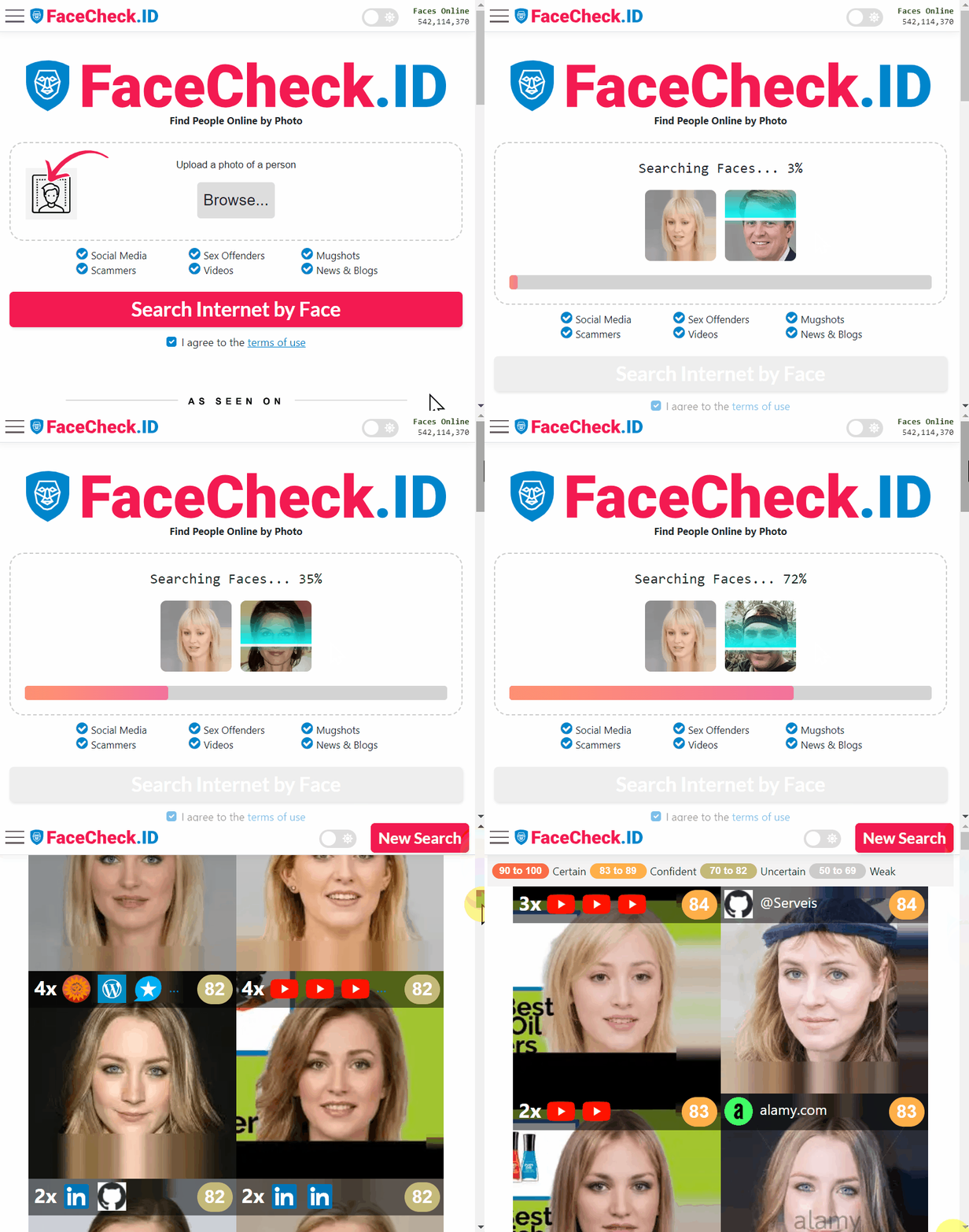
- Match score or confidence: How close the face embeddings are. High scores narrow the candidate pool but do not eliminate lookalikes.
- Multiple independent appearances: The same face turning up across a LinkedIn page, a personal blog, and a conference photo is far stronger evidence than one isolated hit.
- Contextual clues: Names, usernames, captions, locations, and timestamps on the matched pages. A face match means little until the surrounding metadata supports a coherent identity.
- Image quality on both sides: Front-facing, well-lit photos at reasonable resolution produce more reliable embeddings. Heavy filters, sunglasses, masks, extreme angles, or motion blur degrade accuracy.
- Age gap between photos: Faces drift over time. A query photo from someone's twenties may not cleanly match their fifties, even when the person is the same.
Identification is the conclusion you draw after weighing these together, not the raw output of the search.
Where identification through face search tends to fail
False positives are the main hazard. Identical twins, close relatives, and unrelated lookalikes can produce high similarity scores. Heavily edited photos, AI-generated faces, and stylized portraits can also trigger spurious matches. A single high-confidence hit on an obscure page is not proof of identity, especially if the page itself contains scraped or recycled content.
Identification can also fail in the other direction. If a person keeps a small online footprint, uses private accounts, avoids being photographed, or only appears in images that were never crawled by public indexers, no system will find them. Absence of matches is not evidence that a person does not exist or is hiding something.
What face identification does not prove
A match places a face on a page. It does not prove the person controls that page, wrote the content, or did anything described there. Profile photos get stolen constantly for romance scams, fake recruiter accounts, and impersonation campaigns. The real person whose face appears in a scam profile is usually a victim, not the operator.
Identification through face search is most useful as a starting point for further investigation: confirming whether a stranger online is who they claim to be, checking whether a photo has been reused elsewhere, or finding additional context about a face that appears in an unfamiliar setting. Treat the results as leads that need corroboration through names, account histories, mutual contacts, or direct verification, not as a final verdict on someone's identity.
FAQ
What does “Identification” mean in the context of face recognition search engines?
In face recognition search engines, “identification” usually means trying to determine who a person is by finding likely online appearances of a similar face and then inferring an identity from the surrounding context (names, usernames, profiles, captions). A face match alone is not an identification; it’s a lead that may or may not support an identity claim.
How do face recognition search results contribute to identifying a person if they don’t return a verified name?
They can support identification indirectly by linking to webpages where the person may be named or consistently associated with the same account. Identification typically comes from corroborating evidence across multiple independent sources (same face, same handle, same location or affiliations), not from a single match.
What is “open-web identification” and why is it riskier than identifying someone in a controlled database?
Open-web identification uses public internet content that may be incomplete, outdated, mislabeled, or reposted without context. Unlike controlled databases (e.g., employee IDs), web sources often lack reliable ground truth, increasing the risk of misidentifying someone due to look-alikes, wrong tags, or recycled profile photos.
What are common ways face recognition searches can lead to false identification?
Common causes include doppelgängers/look-alikes, low-quality or angled photos, heavy filters/edits, AI-generated faces, incorrect captions or tags on webpages, reposted images attributed to the wrong person, and assuming that a profile link equals the person in the photo. Treat results as hypotheses and verify with additional evidence.
How can I use FaceCheck.ID (or similar tools) for identification more responsibly?
Use results as starting points only: check multiple high-confidence matches, open the source pages and verify context, look for consistent identifiers (same username, repeated photos across time), and avoid making accusations or decisions based on one hit. If the stakes are high (employment, legal, safety), use non-biometric verification methods and follow applicable laws and platform policies.

Recommended Posts Related to identification
-
Top 5 Reverse Image Search APIs for Your Projects
Reverse image search technology is vital in various areas, such as detecting copyright infringement, fraud prevention, people and product identification, image grouping and tagging, and enhancing search functionality. Reverse image search APIs offer efficient and precise image matching and identification, essential for intel gathering applications. Whether it's FaceCheck.ID for facial recognition or Google Cloud Vision for product identification, each API offers specific strengths.
-
Facial Recognition Resources
Facial recognition technology measures and matches the unique characteristics for identification or authentication. British Airways brings its biometric identification gates to three more US airports. These "biometric e-Gates," which have been on a trial at Los Angeles International Airport (LAX) since November 2017, use facial recognition to match flyers with their passport, visa, or immigration photos and can remove the need to show a boarding pass or identification when getting on a plane.
-
All About Face Recognition Technology
The technology is also sometimes called facial recognition or biometric identification. Biometric identification is any technology that identifies a person based on a physical or behavioral trait.
-
How to Find Someone on TikTok by Photo (2026)
Upload a face and you will usually get similar-looking stock photos, a confident identification of the sweater, or the message that results for people are limited.
-
How to Enhance a Low-Resolution Blurry Face like a CSI Detective
Limitations in People Identification and Face Restoration. This limitation is particularly significant in forensic contexts or scenarios where precise identification is critical. AI-generated facial enhancements should therefore not be solely relied upon for definitive identification or restoration, necessitating additional evidence or verification methods.