Image Fingerprinting in Face Search
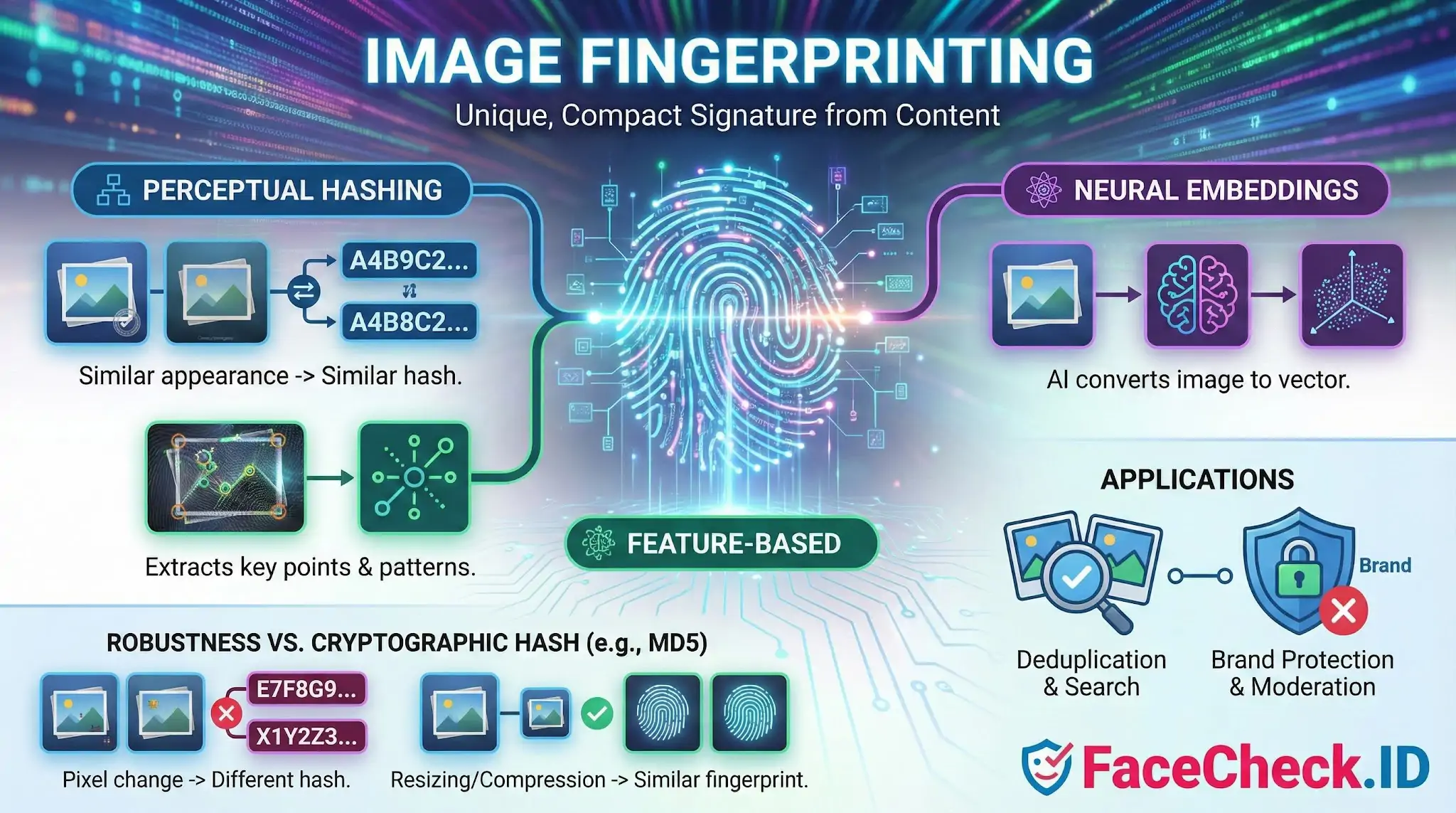
When FaceCheck.ID returns matches for a face photo, image fingerprinting is part of what makes that lookup possible at scale. It is the technique that lets a search engine recognize the same picture, or a slightly altered version of it, across millions of indexed pages without comparing raw pixels every time.
How fingerprinting fits into face search
A reverse image search system does not store full copies of every image it has crawled. Instead, it converts each image into a compact signature, then searches that signature space when a user uploads a query. For face search specifically, two layers usually run together:
- A general image fingerprint that identifies the photo itself, useful for catching exact reposts, mirrored copies, and lightly edited versions.
- A face embedding, which is a vector derived from the facial region that allows matching the same person across entirely different photos.
The image fingerprint answers "is this the same picture, possibly cropped or recompressed?" The face embedding answers "is this the same person in a different picture?" Both matter when investigating an online identity, because reused photos and unique photos tell different stories.
Why fingerprinting matters for catfish and scam investigations
Fingerprinting is what lets a face-search tool flag stolen or recycled images. Romance scammers, fake recruiters, and impersonation accounts often pull pictures from a small pool of source photos, then crop, recolor, or watermark them before reuse. A perceptual hash or feature-based fingerprint can tie a suspicious dating profile photo back to the original Instagram post, a model portfolio site, or a stock library, even if the scammer:
- Resized the image to fit a profile crop
- Recompressed it from PNG to JPG
- Added a logo, username overlay, or filter
- Adjusted brightness or saturation to disguise it
- Mirrored the photo horizontally
When the same fingerprint shows up across unrelated names, locations, or platforms, that pattern is a strong signal of impersonation. It is often more useful than a face embedding alone, because it proves the literal image was reused, not just that someone resembles someone else.
Fingerprinting versus exact-file hashing
Cryptographic hashes like MD5 or SHA-256 change completely if a single byte differs. Save the same JPEG twice with different quality settings and you get two unrelated hashes. That makes them useless for tracking an image across the web, where re-encoding happens constantly. Perceptual hashes (pHash, dHash, aHash), feature descriptors (SIFT, ORB), and neural embeddings are designed to survive those transformations and stay close in similarity space.
For face-search investigations, this distinction is the difference between "we have never seen this exact file" and "this picture, or something visually identical to it, appears on these other pages."
What fingerprints cannot tell you
Image fingerprinting is a matching tool, not an identity verification system. A few limits worth keeping in mind when reading results:
- A high fingerprint similarity score proves two images are visually the same. It does not prove the account using the image is the original owner. Stolen photos and authentic photos can produce identical fingerprints.
- Fingerprints do not understand context. The same headshot on a corporate bio page and on a fraudulent investment site will match cleanly, but the fingerprint cannot tell you which one is legitimate.
- Heavy edits break perceptual hashes. Aggressive cropping, large rotations, AI face swaps, or generative reworks can lower similarity below the matching threshold, producing false negatives.
- Lookalikes and stock-style photos generate noise. Generic portraits with similar lighting and pose can score higher than expected on weaker fingerprint methods, leading to false positives.
- Fingerprints identify images, not people. Tying an image to a person still requires the face-recognition layer, supporting context from the page where the image appears, and human judgment.
Used well, image fingerprinting is what makes a face-search result navigable: it groups duplicates, surfaces the original source when it is still online, and exposes patterns of reuse that a single match score would hide. Used carelessly, it can suggest connections that do not exist. The output is a starting point for investigation, not a verdict.
FAQ
What is “Image Fingerprinting” in face recognition search engines?
In face recognition search engines, “Image Fingerprinting” usually means generating a compact, searchable signature from an image. This can refer to (a) a perceptual fingerprint of the whole image (useful for finding near-duplicate files) and/or (b) a face-specific fingerprint derived from the detected face region (often a face embedding used to find the same or similar faces across different photos).
How is image fingerprinting different from a face embedding (faceprint) when doing face search?
An image fingerprint often describes a signature for the entire picture (background, layout, colors), which is good for near-duplicate image matching. A face embedding is computed from the face area and is designed to represent facial features while ignoring many non-face details. Face recognition search engines typically rely on face embeddings for “same person” searches, while whole-image fingerprints may help with deduplication, finding reposts, or grouping visually similar uploads.
What kinds of edits can break or weaken an image fingerprint in face-search contexts?
Whole-image fingerprints are commonly affected by heavy cropping, overlays, borders, captions, large watermarks, strong color changes, and collage-style recompositions. Face-specific fingerprints (embeddings) can be weakened by low resolution, motion blur, extreme angles, occlusions (masks, hands), strong beauty filters, face swaps, or AI-generated alterations that change key facial geometry. Many systems try to be robust to small resizes or mild compression, but major transformations can still reduce match quality.
How do face recognition search engines use image fingerprinting in their search pipeline?
Image fingerprinting can be used to (1) deduplicate identical/near-identical images, (2) cluster multiple reposts of the same photo, (3) speed up retrieval by filtering candidates before deeper face-matching, and (4) help rank results (for example, prioritizing exact/near-duplicate image matches vs face-only matches). In practice, a tool may combine whole-image similarity with face-embedding similarity to produce more useful result groups.
Does image fingerprinting create privacy risks in face recognition search engines (e.g., FaceCheck.ID)?
Yes. A fingerprint (especially a face-derived fingerprint/embedding) can function like a persistent identifier: it can enable linking the same face across different sites or photos even when the images are not exact duplicates. If a service stores fingerprints, uploaded images, or search logs, that can increase privacy risk. When using face-search services such as FaceCheck.ID or similar tools, it’s safer to review their retention/opt-out policies, avoid uploading unnecessary sensitive images, and treat results as leads rather than definitive identity proof.


Recommended Posts Related to image-fingerprinting
-
TinEye Review: We Tested It 16 Times and It Failed 10
This is image fingerprinting, not facial recognition. TinEye's image fingerprinting catches crops, resizes, and watermark additions. Its image fingerprinting technology is specifically built for this.
-
Free Reverse Image Search Tools That Actually Work (2026)
It works differently from Google and Yandex by using image fingerprinting rather than visual similarity.
-
Find & Remove Deepfake Porn of Yourself: Updated 2025 Guide
StopNCII is a free global tool to block intimate images on partner platforms by uploading an image fingerprint; your actual photo never leaves your device.