Deepfake Video Explained: Meaning, Risks & Signs
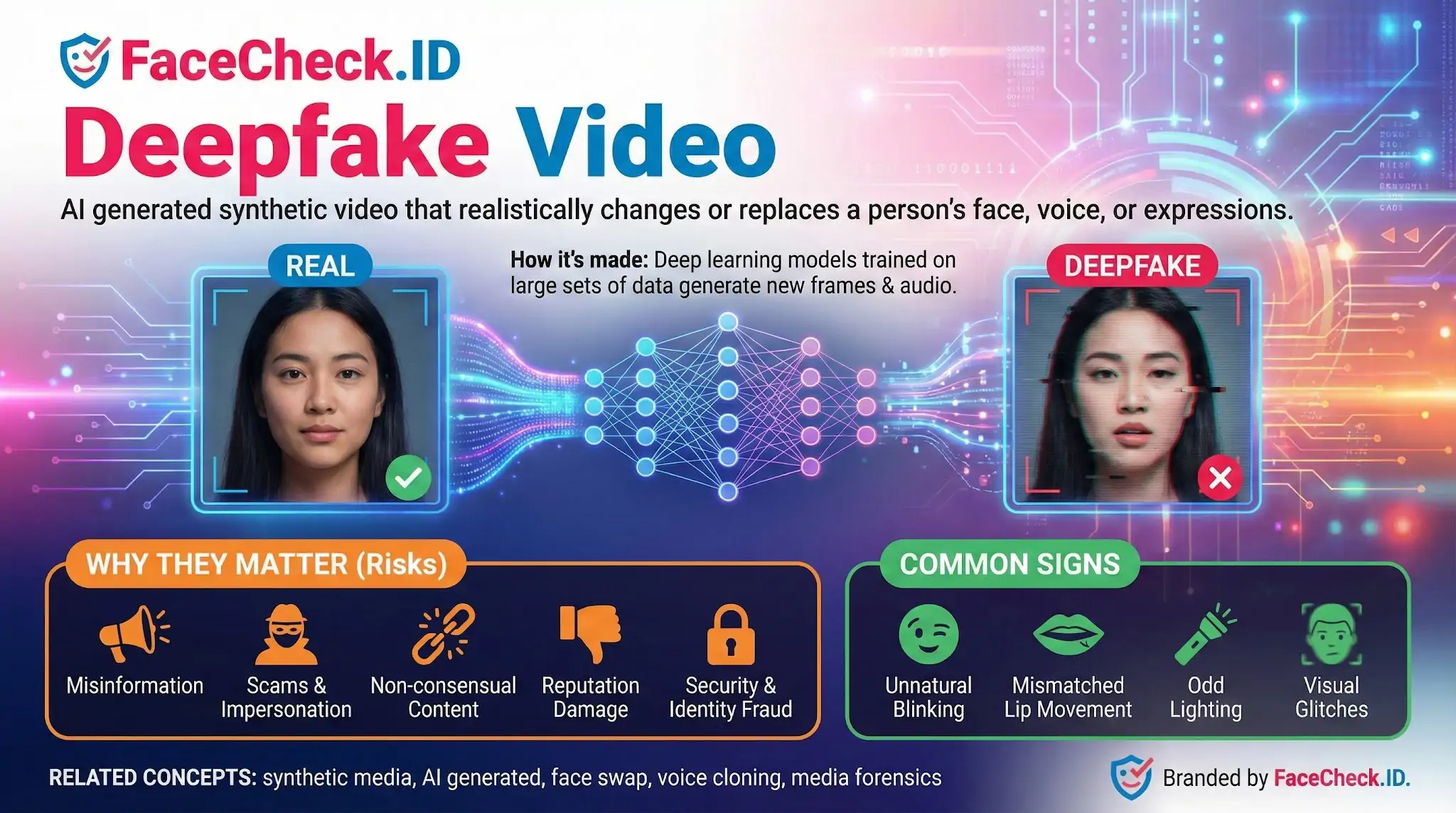
A deepfake video is a type of AI generated synthetic video that realistically changes or replaces a person’s face, voice, or expressions to make it look like they said or did something they never did.
How deepfake videos are made
Deepfake videos are created using deep learning models trained on large sets of images, videos, and sometimes audio of a real person. After training, the model can generate new frames and audio that match the person’s appearance and mannerisms, then blend them into a video so the result looks authentic.
Why deepfake videos matter
Deepfakes can be used for harmless or creative purposes, but they are also linked to serious risks, including:
- Misinformation and propaganda
- Scams and impersonation
- Non consensual explicit content
- Reputation damage and harassment
- Security and identity fraud
Common signs of a deepfake video
Some deepfakes are extremely convincing, but possible red flags include:
- Unnatural blinking, lip movement, or facial expressions
- Odd lighting or shadows that do not match the scene
- Blurry edges around the face or hairline
- Mismatched voice tone, cadence, or background audio
- Visual glitches during fast head turns or hand movements
Related concepts
Deepfake videos are part of a broader category called synthetic media, which includes AI generated images, audio, and text. The same techniques can be used for entertainment, training, accessibility, and also for manipulation.
FAQ
What is a “Deepfake Video” and why does it matter for face recognition search engines?
A deepfake video is a video that has been synthetically altered (often with AI) so a person appears to say or do things they never did—commonly by replacing or animating a face. For face recognition search engines, deepfakes matter because they can introduce convincing but false “evidence” images/frames into the open web, which can mislead searches that treat a video frame like a normal photo match.
Can a deepfake video “fool” a face recognition search engine into matching the wrong person?
Yes. If a deepfake overlays Person A’s face onto Person B’s body (or generates a synthetic face closely resembling a real person), a face search may return results for Person A because the facial features in the frames resemble Person A. The risk is highest when the deepfake is high quality, the face is front-facing, and the engine indexes the video thumbnail or extracted frames as if they were ordinary photos.
If I take a screenshot from a deepfake video and upload it, what results should I expect (including on tools like FaceCheck.ID)?
You should expect mixed outcomes: (1) matches to the impersonated person if the swapped face is clear; (2) matches to look-alikes if the deepfake introduces artifacts or shifts facial geometry; or (3) no strong matches if the frame is low resolution, heavily compressed, or motion-blurred. On face-search tools such as FaceCheck.ID, treat any hit from a suspected deepfake frame as an investigative lead, not proof of who appears in the original video.
How can I check whether a face-search match came from a deepfake video rather than a real photo?
Open the result source and verify context: confirm it’s a legitimate still photo rather than a video thumbnail, meme, or repost. Then look for deepfake clues such as inconsistent lighting/shadows on the face, unusual skin texture, warped teeth/ears, mismatched earrings/glasses, or flickering edges around the jawline across frames. Also compare multiple frames from the same video—deepfakes often vary frame-to-frame—while genuine photos are consistent.
What’s the safest way to use face recognition search engines when deepfake video is a possibility?
Use a verification workflow: run searches on several different frames (not just one), prefer higher-quality frames (sharp, front-facing, well-lit), and corroborate identity using non-face signals on the source page (account history, original uploader, timestamps, location claims, and cross-links). Avoid sharing accusations based solely on face-search hits, and assume deepfake risk is elevated when the content is sensational, political, or tied to scams or extortion.


Recommended Posts Related to deepfake video
-
AI Dating Scams in 2026: How to Spot Fake Profiles and Avoid Romance Fraud
Romance scams are rising fast in 2026, with scammers using AI-generated photos and deepfake videos to trick people on dating apps.
-
Pig Butchering Crypto Scam Exposed: Fake Rich Friend Uses Deepfakes & Stolen Photos to Steal Billions
Deepfake video calls or rage when confronted. Deepfake Video Calls: The New Deception.
-
How to Find and Remove Nude Deepfakes With FaceCheck.ID
A recent report found that 98% of deepfake videos online are pornographic, with 99% of the victims being women.
-
Find & Remove Deepfake Porn of Yourself: Updated 2025 Guide
Distribution channels: These fakes may be uploaded to porn sites (some even specialize in deepfake videos), shared on forums or messaging groups, or posted on social media.
-
Celebrity Romance Scams 2026: How Scammers Use AI Deepfakes and Stolen Photos to Steal Millions
A Florida woman lost $160,000; scammers used deepfake video chats and later laundered money through her account. Deepfake Videos/Voice: Realistic calls or memos.
-
How to Detect Fake Remote IT Workers with Facial Recognition (2026 Guide)
Real-time deepfake video overlays during live interviews. Deepfake video impersonators. Deepfake videos and voice cloning during interviews.
-
Yilong Ma: Elon Musk's Doppelgänger or a Deepfake Masterpiece?
Real-time deepfakes, unlike pre-rendered deepfake videos, require sophisticated technology that can manipulate facial expressions and movements in real-time. Adding another layer to the Yilong Ma controversy, the interview video in question was analyzed by Deepware, a company that specializes in deepfake video detection.