Fake Profiles
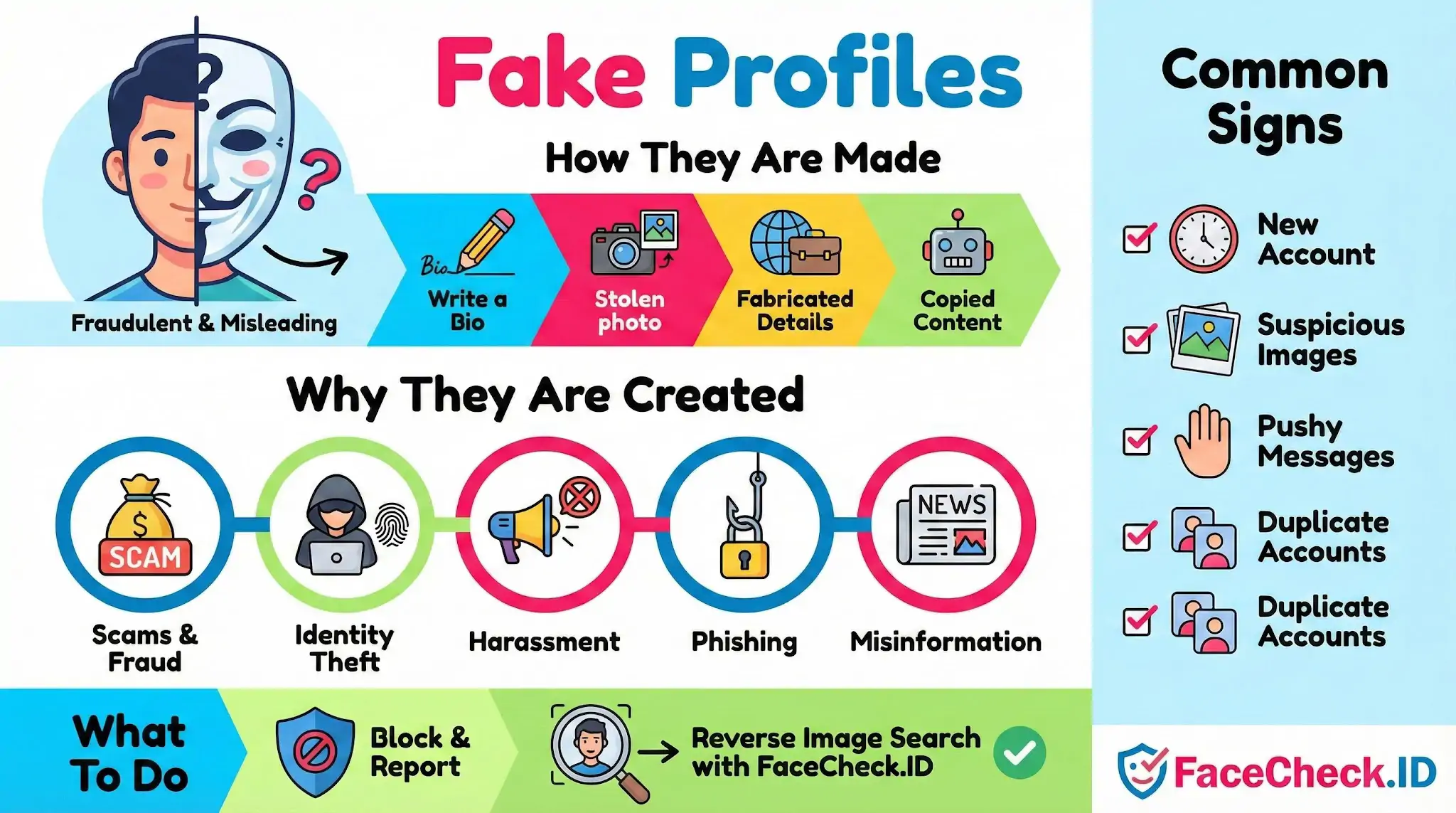
Fake profiles are one of the main reasons people run a face search in the first place. When a stranger online seems too smooth, too eager, or too good-looking to be real, a reverse image search on their photos is often the fastest way to find out who is actually behind the account.
How face search exposes fake profiles
Most fake accounts reuse photos taken from someone else. Scammers pull images from Instagram models, fitness influencers, military personnel, doctors, and small-business owners, then attach those photos to a new fabricated identity. A face search works against this by indexing public-web pages where a face appears, so a single match on an unrelated name, country, or profession is usually enough to break the story the profile is telling.
Patterns that show up repeatedly in face-search results from fake accounts:
- The same face appears under several different names across dating sites, Facebook, and Telegram.
- The photos trace back to a public Instagram or YouTube account belonging to someone with a different nationality or language.
- The matched person is a known model, adult performer, or minor influencer whose images get scraped frequently.
- The face appears on scam-warning forums, romance-scam databases, or watchdog blogs.
- An account claims to be in one country, but face matches place the real person somewhere else entirely.
AI-generated faces are a separate case. They often produce few or no matches because the face does not exist on the public web. Zero matches on an otherwise polished profile photo is itself a signal worth paying attention to, especially when paired with the small artifacts typical of generative models, such as warped earrings, mismatched eyes, or strange hair edges.
Where fake profiles cluster
Different platforms attract different fake-profile patterns, and that affects what a face search will surface.
- Dating apps like Tinder, Hinge, Bumble, and niche sites are heavy with romance scams using stolen attractive photos. Reverse image search frequently links the photo back to an unrelated public Instagram.
- LinkedIn sees fake recruiter and executive profiles built around stock-style headshots or stolen corporate photos. These are used for phishing, fake job offers, and social engineering.
- Instagram and TikTok host impersonation accounts that copy a real person's name, bio, and photos almost exactly. Face search can show the original account next to the imposter.
- Facebook still hosts large numbers of duplicate accounts using the same face under different names, often tied to investment or crypto scams.
- Telegram, WhatsApp, and Discord profile photos can be searched the same way once the image is saved, which is useful when contact moves off the original platform.
How to interpret matches without overreaching
A face match is a strong lead, not a verdict. Real people do have multiple accounts, change names after marriage, run business and personal profiles in parallel, or appear on republished news articles and old forum posts. A profile that surfaces under two names is not automatically fake.
What raises confidence that a profile is fraudulent is the combination of signals: a face that traces to a different real identity with a long history, photos lifted from a public account that predates the suspicious profile, matches on scam-report sites, and behavior on the account itself such as fast escalation to money, secrecy, or refusal to do live video.
Limits of face search against fake profiles
Face search cannot prove intent. Two people can genuinely look alike, and lookalike matches do happen, especially with low-resolution, heavily filtered, or sharply angled photos. A confident match on the wrong person can lead to false accusations.
Face search also cannot see private accounts, deleted posts, or images that were never indexed. A scammer using freshly generated AI faces, or photos stolen from a locked profile, may produce no useful results at all. Treat face-search output as evidence to weigh alongside the account's behavior, the story it tells, and any independent verification you can get through video calls, official records, or trusted mutual contacts.
FAQ
What are “Fake Profiles” in the context of face recognition search engines?
Fake Profiles are accounts (often on dating, social, or marketplace platforms) that use misleading identity details—commonly stolen photos, fabricated names, or AI-generated faces. A face recognition search engine can help check whether the profile photos appear elsewhere online under different names or contexts.
How can a face recognition search engine help detect a fake profile using stolen photos?
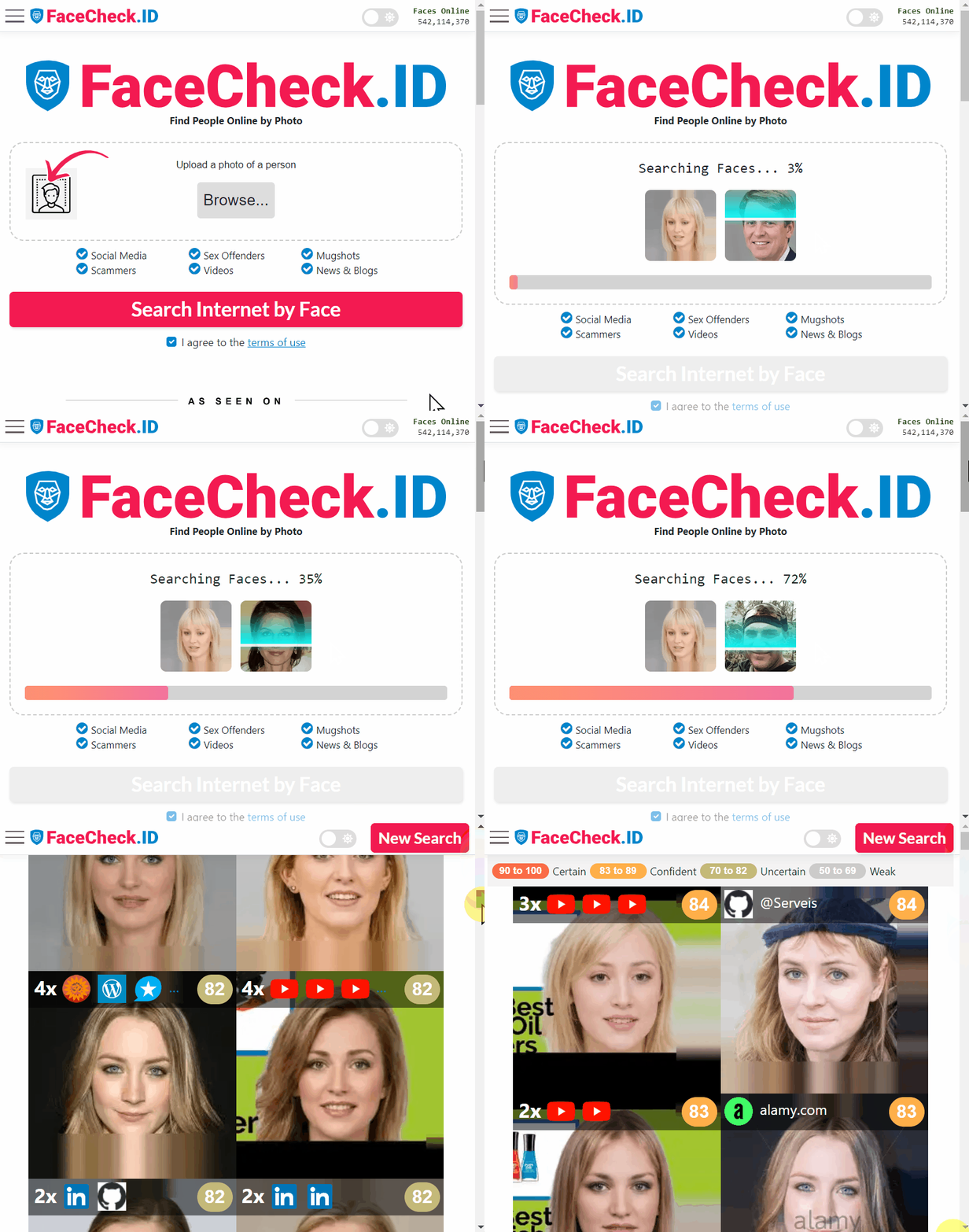
By searching the profile photo as a face, the engine may return matches to the same person on other sites. Strong warning signs include the same face appearing across many unrelated accounts, the same headshot tied to different names, or the photo showing up on stock-photo, modeling, or scam-report pages. Tools such as FaceCheck.ID can be used as a lead generator for these checks, not as proof by itself.
What result patterns are common when a fake profile uses AI-generated or heavily edited images?
AI-generated or heavily edited faces may produce few or no reliable matches, or they may return weak “look-alike” results rather than the same person. Other clues include inconsistent facial details across uploads (earrings, hairline, teeth), unnatural skin texture, distorted backgrounds, or mismatched lighting—especially when multiple profile photos don’t appear to depict the same real-world individual.
If a face search finds multiple matches, does that confirm the profile is fake?
No. Multiple matches can happen for legitimate reasons (reposts, news articles, public profiles, fan pages, or mirrored content). Treat results as evidence to verify: check whether matches consistently point to one real person, whether the names and biographical details align, and whether the earliest sources look authentic. A single match set is a clue, not an identity confirmation.
What should I do if I find a fake profile impersonating me or someone I know via face search results?
Document the evidence (URLs, screenshots, timestamps), report the account through the platform’s impersonation process, and request removal of reused images where applicable. If you used a face search tool (including FaceCheck.ID), also check whether it offers a takedown/opt-out path for indexed results. Consider tightening privacy settings, watermarking or limiting public headshots, and escalating to legal or law-enforcement channels if fraud or extortion is involved.

Recommended Posts Related to fake-profiles
-
Facial Recognition and Reverse Search on Facebook: A Deep Dive into FaceCheck
Prepare to find friends, expose fake profiles, and explore a variety of applications to keep your online life secure! Report fake profiles (optional). If you come across a fake profile, give Facebook a heads up.
-
Fake Profile Scam? Why 99% of the Time the Person in the Photo Is Innocent
This post shows you how to spot a fake profile, how to do a reverse image search, and how to warn others without accusing the wrong person. Create a convincing fake profile. Common fake profile scam types.
-
The Rise of Romance Scams: Protect Your Heart and Wallet
They'll create a fake profile using pictures of someone attractive, and then they'll start messaging you. This is where the scammer creates a fake profile using pictures of someone else, and then they'll start messaging you. They'll create fake profiles using pictures of attractive young people, and then they'll reach out to older adults and try to build a relationship with them.
-
How Do You Reverse Image Search on Dating Sites?
Criminals create fake profiles and fabricate emotional stories to manipulate victims into trust and money transfers. Expose Fake Profiles with Reverse Image Search.
-
Face Recognition Online: What Actually Works in 2026
She needed to find every fake profile using her photos. By the end of the hour, she had a list of 11 fake profiles using her photos across 8 different platforms. PimEyes found three of the same fake profiles FaceCheck caught, plus one FaceCheck missed (a small forum).