Fingerprint
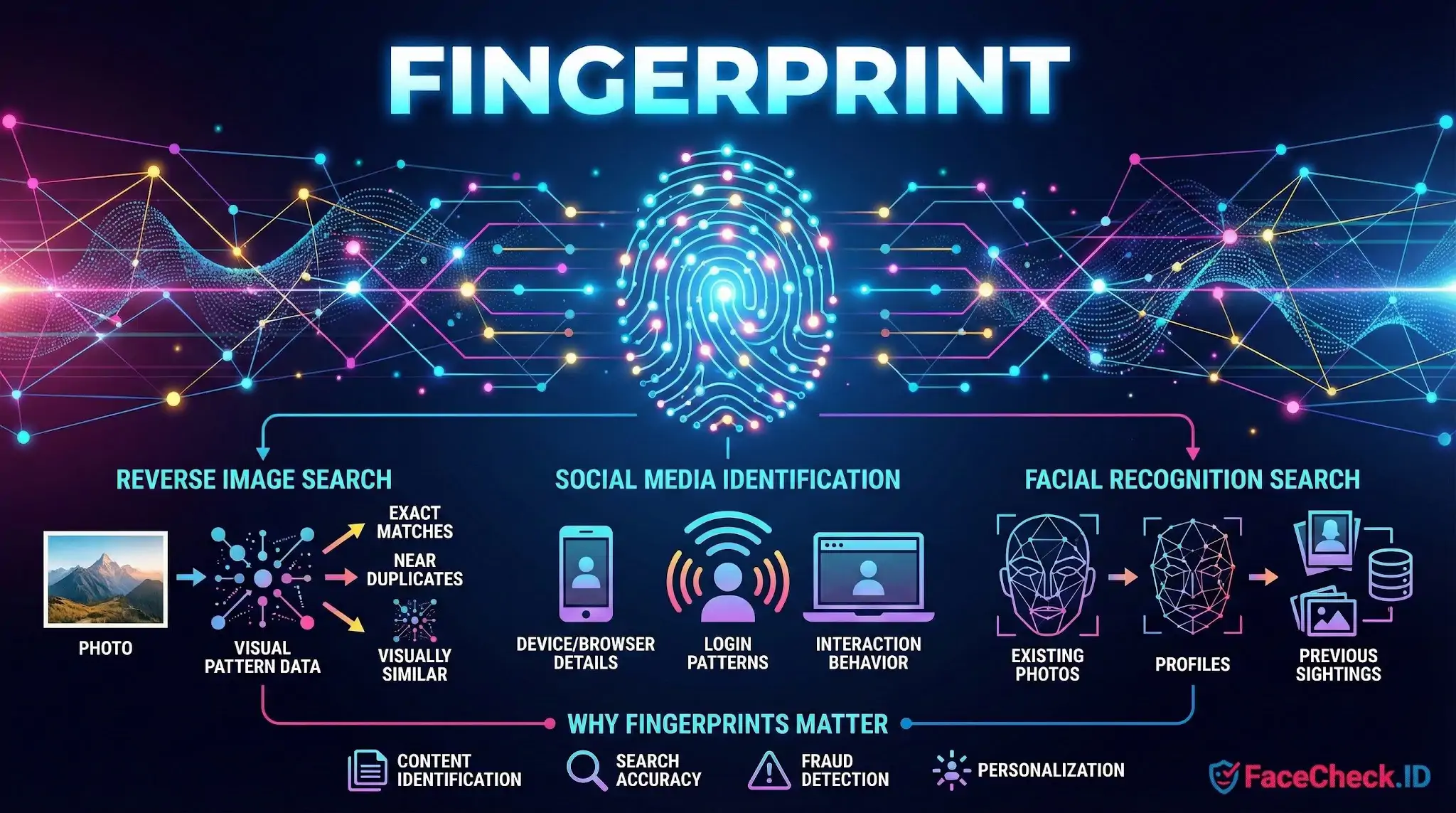
In face search, a fingerprint is the compact mathematical representation of a face that makes matching possible at scale. When you upload a photo to FaceCheck.ID, the system does not store or compare raw pixels. It extracts a numeric signature from the face and compares that signature against fingerprints already indexed from public web pages.
How a face fingerprint is built
A face fingerprint, often called an embedding or face vector, is a list of hundreds of numbers describing the geometry and texture of a face. The model measures relationships between features such as the distance between the eyes, the shape of the jawline, the curvature of the nose bridge, and finer texture patterns the human eye does not consciously register. Two photos of the same person taken years apart can produce fingerprints that land close together in vector space, while two strangers who look alike will usually land farther apart.
This is different from a perceptual hash of the whole image. A perceptual hash captures the picture itself, so cropping the background, recoloring, or adding a watermark changes the hash. A face fingerprint ignores most of the image and focuses on the face, which is why FaceCheck can still match a photo even when the lighting, outfit, or background is completely different.
Why fingerprint quality drives match confidence
The quality of the fingerprint depends almost entirely on the input image. A blurry, low-resolution, or heavily filtered photo produces a noisy fingerprint, which lowers confidence scores and increases the chance of false positives. Conditions that weaken a face fingerprint include:
- Extreme angles or profile shots where key features are hidden
- Sunglasses, masks, or hands covering part of the face
- Strong shadows, backlighting, or overexposed skin
- Heavy beauty filters or AI smoothing that flatten facial geometry
- Tiny faces in group photos where only a few pixels describe the features
Front-facing, evenly lit photos at decent resolution produce stable fingerprints that match reliably across LinkedIn headshots, dating profiles, news photos, and old social media posts. This is also why the same person can score very differently across two uploaded photos. The face has not changed, but the fingerprint extracted from each image has.
Fingerprints in scam and catfish investigations
When someone runs a face search to check whether a dating app match or online acquaintance is real, fingerprints are doing the actual work. The uploaded photo is fingerprinted, then compared against fingerprints generated from public images across the indexed web. A scammer reusing a stolen photo will often score very high against the original owner's profiles, since both images trace back to the same source face. A catfish using AI-generated faces is harder, because synthetic faces produce real-looking fingerprints that simply do not match anyone, which itself can be a useful signal.
Fingerprints also explain why duplicate accounts surface so easily. The same person posting under different names on Instagram, a dating site, and an escort directory will produce nearly identical fingerprints from their selfies, even when usernames, bios, and locations differ.
What a fingerprint match does not prove
A high fingerprint similarity score is evidence, not proof. Identical twins routinely score in the same range as the same person matched against themselves. Close family members, especially siblings, can produce uncomfortably high scores. Lookalikes exist in every population, and the larger the index being searched, the more likely a stranger with similar geometry will appear near the top of the results.
Fingerprints also say nothing about context. Two profiles can share the same face for legitimate reasons, such as a public figure being quoted on multiple sites, or for harmful ones, such as image theft and impersonation. The fingerprint connects the faces. A human still has to read the surrounding pages, check timestamps, compare usernames, and decide what the match actually means. Treat the score as a strong starting point for investigation rather than a conclusion.
FAQ
What does “Fingerprint” mean in the context of face recognition search engines?
In face recognition search engines, a “fingerprint” usually means a computed digital signature of a face image—often called a faceprint or embedding. It’s a numeric representation of facial features used to compare one face to many others, rather than an actual human fingerprint.
How is a face “fingerprint” created from a photo?
A system typically detects the face, aligns it (accounting for pose/rotation), and then uses a neural network to convert the face into a vector (an embedding). This embedding acts as the face “fingerprint” and can be searched against an index of other embeddings.
Is a face “fingerprint” unique and permanent like a real fingerprint?
Not perfectly. A face embedding is designed to be similar for photos of the same person, but it can vary with lighting, age, expression, occlusion, filters, or image quality. Different models can also produce different “fingerprints” for the same face.
Does a face recognition search engine store my “fingerprint” when I upload a photo?
It depends on the service’s policies and settings. Some tools may retain the uploaded image, the derived face embedding (“fingerprint”), both, or neither for a period of time (e.g., for improving results, rate-limiting, or abuse prevention). Check the provider’s privacy policy and retention/opt-out options—this applies to services such as FaceCheck.ID and similar platforms.
Can two different people have similar face “fingerprints,” and what does that mean for results?
Yes. Look-alikes (or certain photo conditions) can produce embeddings that are close enough to be ranked as potential matches, increasing the risk of false positives. Treat results as leads, verify using multiple images and contextual page evidence, and rely on higher-confidence matches rather than a single close “fingerprint” similarity.


Recommended Posts Related to fingerprint
-
TinEye Review: We Tested It 16 Times and It Failed 10
TinEye creates a digital fingerprint of any image you upload and searches for exact or near-exact copies of that image across its 67-billion-image database. This is image fingerprinting, not facial recognition. TinEye: "Has this exact image been posted somewhere else?" It compares pixel fingerprints.
-
TinEye Review: What It Does Well and Where It Falls Short
When you upload a picture, TinEye makes a fingerprint of it. That fingerprint doesn't describe what's in the photo; TinEye doesn't know or care that it's a golden retriever in a birthday hat. It then checks that fingerprint against its index of more than 77.6 billion images (its late-2025 figure) and lists every page where the same image, or an edited copy of it, turns up.
-
Facial Recognition: Understanding the Basics
The system converts facial data into a unique faceprint, similar to a fingerprint. Other biometric identification technologies include fingerprint analysis, voice recognition, DNA testing, and retinal scans. Other forms include fingerprint verification, DNA matching, eye recognition, hand geometry recognition, voice recognition, and signature recognition.
-
Best Facial Recognition Search Engines (2026)
Embedding extraction: An AI model converts the face into a numerical "fingerprint," a vector of 128 to 512 numbers that represent its unique geometry.
-
How to Use Reverse Image Search to Find LinkedIn Profiles by a Photo
That mathematical fingerprint is what gets matched against photos scraped from social profiles, including LinkedIn.